How To Streamline Logistics Business Document Workflow In 2026 Using Proof of Delivery Data Extraction
The global logistics industry is a $10.2 trillion USD market in 2023 and is expected to grow at a CAGR of 7.3%, and it is expected to reach $20.1 trillion USD by 2023, according to Allied Market Research data. Logistics and shipping industries deal with various types of documents on a day-to-day basis. These documents could be bills of lading, purchase orders, seaway bills, invoices, or proof of delivery documents, which are most common for successful business operations. However, the majority of these documents are either paper documents, handwritten notes, scanned image documents, or PDFs. Managing and extracting data from these documents poses great organizational challenges.
Recent data from Cargoclix show that 45.5% of logistics companies still rely on paper data rather than digital document formats. Trans info's analysis of proof of delivery shows that as much as 99% of EU international road transport still relies on paper data. Paper PODs can be lost, arrive late, carry illegible signatures, or contain errors, and disputes over them can take days or weeks to settle, which holds up invoices and payments.
But the rise of AI-based data extraction tools and ML solves this proof of delivery data extraction problem by automating every step of the data extraction process. With the help of AI and IDP (Intelligent Document Processing), data extraction from POD documents and other logistics documents can be accelerated with greater accuracy and speed. In this guide, we will discuss the role of AI, IDP, and ML in proof of delivery data extraction, how it works, the challenges with POD data extraction, the best tools, and other aspects.
Proof of delivery data extraction closes this gap. It combines proof of delivery OCR, machine learning, and logistics IDP (Intelligent Document Processing) to read each POD and turn it into structured data that your systems can use. This guide explains how it works, where manual methods break down, how the leading tools compare, and how to choose the right approach for your operation.
TL;DR
- Proof of delivery data extraction automatically reads POD documents and captures fields such as delivery date, recipient, signature, shipment number and exception notes.
- Proof of delivery OCR only converts an image into text. IDP adds layout understanding, validation and system integration.
- Manual document handling is a major hurdle: 82% of respondents in a transport and logistics back office survey said it remains a significant challenge.
- Automation speeds up invoicing, flags damage and shortage notes early and gives finance and operations one clean data source.
- Five tools worth testing: Algodocs, Klippa, Affinda, Lido and Kognitos.
- No tool verifies signature authenticity. The original receipt remains the evidence.
What Is Proof of Delivery Data Extraction and How It works?
Proof of delivery data extraction is the process of using AI and intelligent document processing technologies to capture and extract key details from a POD document, such as the delivery date, recipient name, signature, and shipment reference, in a structured data format so that logistics, billing, and ERP systems can use them for other business operations.
POD extraction tools can capture and extract the following fields from proof of delivery documents:
- Delivery date and time
- Recipient or signatory name
- Signature present or missing
- Tracking, PRO, order or shipment reference
- Delivery address or stop reference
- Items and quantities delivered
- Carrier and driver details
- Exception notes such as damage, shortage or refusal
How Proof of Delivery Data Extraction Works
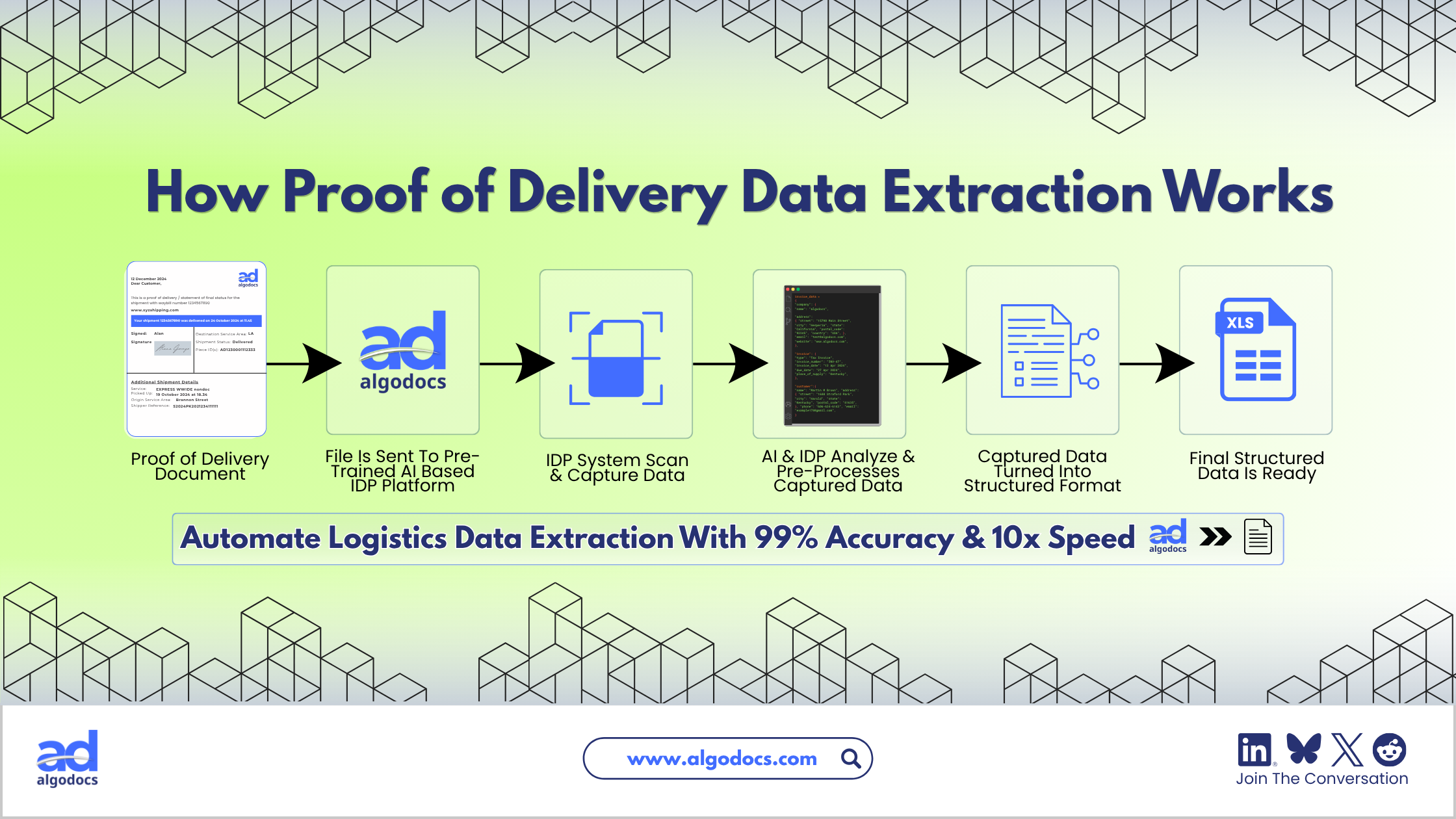
Proof of delivery (POD) data extraction uses Intelligent Document Processing (IDP), which combines AI technologies to upload, read, extract, validate, and export data from delivery documents.
First, the POD document is uploaded to an AI-based IDP platform. The platform combines Optical Character Recognition (OCR) with machine learning (ML) and natural language processing (NLP). If the POD is a scanned image or a scanned PDF, OCR converts it into machine-readable text. If it is a digital PDF, the system reads the embedded text layer directly.
Next, the system analyzes the document layout to locate key areas such as headers, tables, line items, and signature fields. ML and NLP models then extract the required details, such as the delivery date, consignee name, shipment number, item quantities, and receiver signature, and convert them into structured fields.
The extracted data is then validated. The system checks for missing values, formatting errors, and mismatches against reference data, and flags low-confidence results for human review.
Finally, the structured data can be exported in formats such as CSV, Excel, or JSON. It can also be sent to other systems, such as ERP, TMS, or accounting software, through APIs.
The exact steps and field names vary by IDP vendor, so check them against the specific tool you are describing.
What Is a Proof of Delivery Document in the Logistics & Shipping Industry
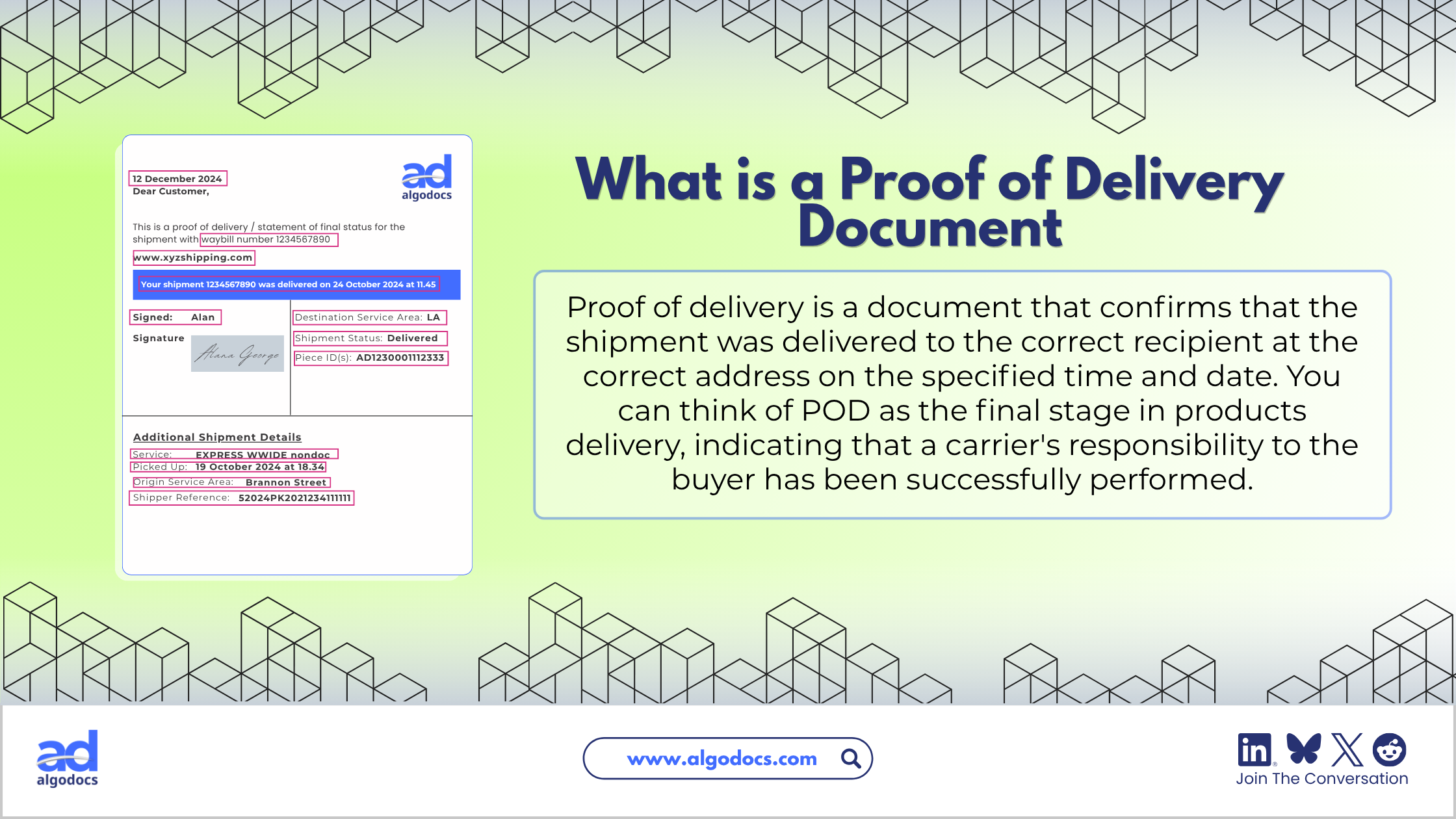
Proof of delivery is a document that confirms that the shipment was delivered to the correct recipient at the correct address at the specified time and date. You can think of a POD as the final stage in product delivery, indicating that a carrier's responsibility to the buyer has been fulfilled.
A typical proof of delivery document can contain information such as delivery date, time, tracking ID, address, recipient's signature, etc.
Template Based Proof of delivery OCR vs IDP Based Proof of delivery Data Extraction
| Feature | Template-Based OCR | IDP (Intelligent Document Processing) |
| Core Technology | Extracts text based on strict predefined spatial coordinates (Zonal OCR). | Uses AI, Machine Learning, and NLP to understand context and identify data regardless of position. |
| Document Flexibility | Rigid. Fails if the document structure, spacing, or margins shift even slightly. | Adaptable. Processes varied layouts, multi-page PODs, and unstructured formats seamlessly. |
| Setup & Maintenance | Requires manual drawing and configuration of a new template for every unique carrier or vendor layout. | Uses pre-trained models. Automatically learns from manual corrections to handle new or shifting layouts. |
| Handling Imperfections | Struggles significantly if the physical POD is skewed, crumpled, stamped over, or contains handwritten notes. | Robust against noise. Computer vision models can read through overlapping stamps, correct angles, and decipher handwriting. |
| Data Validation | Blind extraction. Pulls whatever text happens to fall inside the designated zone, without verifying if it makes sense. | Context-aware. Validates extracted data (e.g., recognizing that a string of numbers is a tracking ID, or cross-referencing against an ERP database). |
| Scalability | Low. Scaling to handle 100 different carrier POD formats requires building and maintaining 100 unique templates. | High. Can process thousands of distinct vendor formats out-of-the-box with minimal manual intervention. |
| Exception Handling | High exception rate requiring constant human intervention to fix broken templates. | Low exception rate. Straight-Through Processing (STP) is much higher, with human intervention only needed for edge cases. |
| Total Cost of Ownership | Lower initial software cost, but high ongoing labor costs due to template maintenance and manual data correction. | Higher initial setup or subscription cost, offset by drastically reduced manual labor and administrative overhead. |
How AI, ML, and IDP Solve Proof of Delivery Data Extraction Challenges
Older template-based tools (Zonal OCR) needed customization for every carrier document layout. But modern logistics IDP works differently. It uses Intelligent Document Processing, which is a blend of traditional OCR engines alongside natural language processing (NLP) and machine learning (ML). IDP can handle messy scans, mixed formats, and tables from different layouts, formats, and types of logistics documents without needing adjustments to the code.
Proof of delivery IDP has three core layers.
OCR reads the text
Proof of delivery OCR is the first layer. It turns pixels into characters, even from skewed scanned photos and low contrast carbon copies. On its own, though, it returns a block of text with no meaning attached.
Artificial Intelligence
Pre-trained AI models are trained on vast amounts of industry-specific data to identify data patterns, layouts, and formats. So AI can easily scan, capture, and identify fields, rows, columns, data types, and values, and extract data more efficiently.
Machine learning understands the document & NLP
Past datasets are used with machine learning models to make pre-trained AI models more robust at extracting data from proof of delivery documents. Industry-specific data, such as scanned images, PDFs, documents, and other data, is used by ML algorithms. These algorithms improve the accuracy, speed, and analysis of POD document data extraction.
IDP runs the full workflow (OCR + AI + ML)
IDP wraps extraction in a repeatable workflow:
- Ingest: Collect PODs from email, shared folders, mobile apps and APIs.
- Classify: Separate PODs from bills of lading, invoices and packing lists.
- Extract: Capture header fields and line item tables.
- Validate: Check values against rules and shipment records.
- Export: Send clean data to a TMS, ERP or billing system.
With the help of traditional OCR, AI, ML, and IDP, data from proof of delivery documents can be accurately extracted and automated with third-party apps.
Major Challenges with Proof of Delivery Data Extraction
Extracting data from logistics documents such as proof of delivery documents, BOLs, and other documents can be challenging. Unlike other document types, which come in clear and easily structured formats, POD documents come in various layouts, formats, styles, etc. The major challenges with proof of delivery data extraction are:
Inconsistent formats across carriers
Document formats can differ and be inconsistent across different organizations and countries. This creates a big challenge in extracting data from proof of delivery document. In a Deep Analysis survey of transport and logistics back offices, reported by MH&L News, 82% said manual document processing remains a significant hurdle, 53% cited document compatibility problems such as varied formats, inconsistent quality and handwriting, and 49% called the lack of standard formats a pervasive challenge. The survey was produced for an IDP vendor and gives no sample size, so read it as directional. Fixed templates break quickly here.
Handwriting and poor image quality
The most important information on a POD is often handwritten on carbon paper in a truck cab. Driver handwriting, faded carbon copies, and damage notes written anywhere on the page often appear together on one form.
Matching PODs to shipments and invoices
A POD is only useful once it is tied to a shipment record. That means matching tracking numbers, order references, and quantities across the POD, bill of lading, packing list, and carrier invoice. Mismatches slow down payments and trigger disputes.
Manual entry errors and rework
Manual handling also invites billing mistakes. At a Journal of Commerce panel covered by FreightWaves, one importer reported invoice discrepancy rates of 3% to 4%, while another panelist described about 20% as the industry average. A logistics executive on the panel said resolving a single error typically took six to ten phone calls. These figures date from 2017 and cover ocean freight invoices, not PODs, but they show how small data errors become repeated rework. Measure your own rates before building a business case.
Manual vs IDP Based Proof of Delivery Data Extraction
| Factor | Manual entry | IDP based extraction |
| Speed | Minutes per document, queues build at peak volume | Seconds per document, runs continuously |
| Accuracy | Prone to typing and misreading errors, especially with poor handwriting | Vendors report 99% or higher on clean documents, so test on your own samples |
| Handwriting | Depends on who reads it | Model reads it and flags low confidence fields |
| Exceptions | Easy to miss in free text | Captured into a dedicated field and routed |
| Scalability | Needs more staff as volume grows | Handles higher volume with the same team |
| Cost | Labor grows with every document | Cost per page, usually lower at scale |
| Audit trail | Spreadsheet edits, hard to trace | Source image linked to every extracted value |
People stay in the loop, but they review flagged documents instead of typing every field.
Benefits of Automated Proof of Delivery Data Extraction in the Logistics Industry
Cost Savings
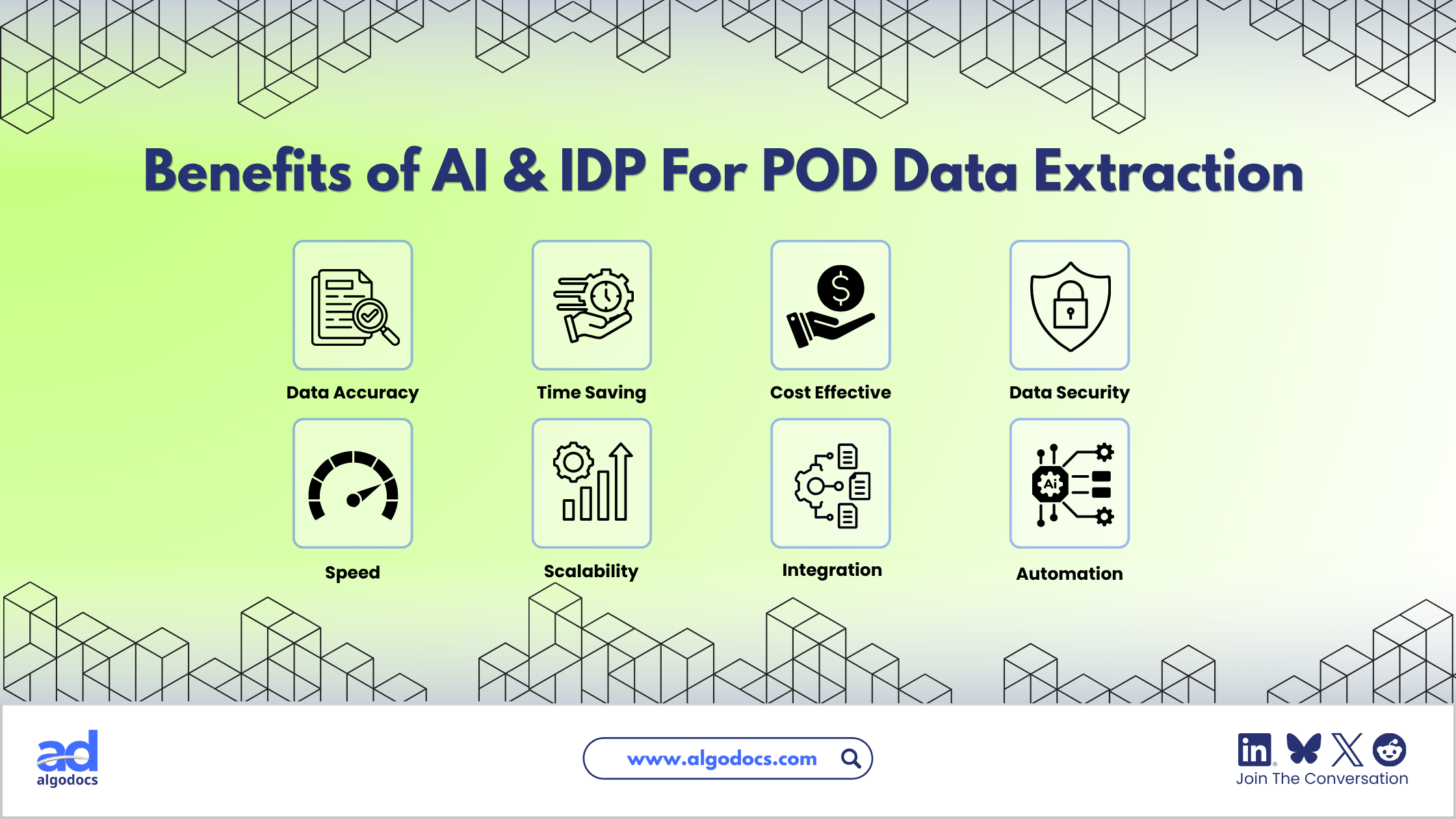
The financial impact of moving away from manual documents is staggering. According to research by McKinsey & Company, digitalizing trade documentation across the supply chain could save the logistics industry $6.5 billion in direct costs annually and enable up to $40 billion in new global trade by removing friction. Automating your PODs is the foundational first step toward capturing those margins for your own operation.
Faster invoicing and better cash flow
When delivery data is captured the same day, billing does not wait. The Trans info analysis reports that companies adopting digital proof of delivery have cut days sales outstanding by 30% to 50%, though it does not name them, so treat the range as indicative. Extraction brings the same speed to PODs that still arrive as scans or photos, because every day saved between delivery and invoice returns cash sooner.
Fewer data errors
A system that reads the source document and validates it against shipment data removes the retyping step where most errors begin. Cleaner data means fewer invoice disputes and fewer corrections downstream.
Quicker exception and claims handling
When damage and shortage notes become structured fields, they can trigger alerts and cases automatically. Teams can contact carriers while the evidence is fresh instead of finding the note weeks later.
Better visibility from logistics data extraction
Structured POD data can be reported on, such as exception rates by carrier and time from delivery to invoice.
Best Proof of Delivery Data Extraction Tools
When comparing options, check handwriting support, accepted formats, validation, integrations, export formats, security certifications, and pricing. These five are worth a trial with your own sample PODs. Descriptions are based on each vendor's published product information.
1. Algodocs
Algodocs is an AI-powered document data extraction platform that offers pre-trained AI extraction models for extracting data from various logistics documents, such as proof of delivery documents, bills of lading, seaway bills, and other documents. Algodocs can extract data from fields, table rows, dates, reference numbers, addresses, and signatures in scanned images, handwritten notes, and PDF proof of delivery documents. Extracted data can be exported to CSV, Excel, JSON, or XML. It suits logistics teams that handle many document types, not only PODs. Algodocs is a GDPR-compliant platform, so your data is safe with Algodocs. You can try Algodocs' free plan to test all the paid features of its proof of delivery data extraction tool.
2. Klippa DocHorizon
Klippa offers document processing solutions for businesses looking to digitize delivery records and simplify data handling. Its platform supports various document formats and structured data outputs, making it an option for organizations seeking to streamline document-related workflows.
3. Affinda
Affinda provides document data extraction capabilities for businesses looking to digitize document-based workflows. Its suitability depends on specific processing requirements, workflow complexity, and the level of customization needed.
4. Lido
Lido offers document processing solutions for businesses looking to manage delivery records and digitize operational workflows. Its capabilities can support document handling across logistics and related business processes, depending on specific requirements.
5. Kognitos
Kognitos provides AI-driven automation solutions for businesses seeking to streamline document processing and operational workflows. Its platform can support integration with existing business systems, depending on an organization's automation and process management needs.
How Algodocs Solves Proof of Delivery Data Extraction Challenges for Logistics Operations
Algodocs is designed to streamline logistics document data processing using IDP, AI, and ML. You don’t need lengthy, complex extraction setups to extract data from proof of delivery and other types of logistics documents. Simply upload the document, use the pre-trained extractors, and the AI model will do the job. Here are the features that make Algodocs an ideal platform for logistics document data extraction and automation.
Intelligent AI and ML-based IDP tool
Algodocs uses AI, ML, NLP, and IDP to automate data extraction from proof of delivery and other types of documents. These features make data extraction more accurate, swift, and scalable compared to the generic logistics document extraction tools widely available in the market.
Pre-trained AI models
Ease of use is what makes Algodocs a great platform for data extraction. The various pre-trained AI extraction models help you extract data instantly, without needing to build, customize, or optimize any extraction model. Everything is pre-built. You simply upload the file, choose the extractor, and everything is done automatically.
Customization
Algodocs isn’t limited to basic data extraction. Customization of extractor models is what makes Algodocs unique for proof of delivery data extraction. You can create, set up, and customize new or existing models as per your requirements. That gives you the freedom to choose what you want to extract from POD documents.
Control
Simply allowing software to extract data can cause a lot of trouble. That’s why Algodocs offers multiple validation checkpoints via AI systems, which can detect any errors or anomalies during the data extraction process. Human-in-the-loop (HITL) allows users to oversee the extraction process by reviewing changes and other issues.
Data safety and security
Algodocs places a strong emphasis on the safety and security of users’ personal and business data. That’s why the Algodocs platform is compliant with EU GDPR, HIPAA, and ISO 27001. All your personal and business data is safe on the platform.
Integration
You can integrate Algodocs with any third-party business tools, such as ERP, billing, CRM, and other logistics software, to share, update, upload, and export raw or extracted data. This saves time, keeps your data in one safe place, and improves work efficiency.
Conclusion
Proof of delivery is where operations, finance, and customer service meet. When its data is trapped on paper or in photos, billing slows, exceptions are missed and teams spend hours typing. Proof of delivery data extraction, built on OCR, machine learning and logistics IDP, turns those documents into data you can act on the same day.
Start small. Run 50 to 100 real PODs, including poor-quality ones, through two or three tools and measure field accuracy and exception capture. Choose the tool that performs best on your documents, not on a demo file.
Key Takeaways
- Proof of delivery data extraction turns POD images and PDFs into structured fields for TMS, ERP and billing.
- OCR reads text. IDP understands, validates and routes it.
- Manual document handling remains a top back office hurdle, and billing data errors create costly rework.
- Faster extraction means faster invoicing, earlier exception handling and cleaner reporting.
- Extraction confirms that a signature exists. It does not prove it is genuine.
- Test every tool on your own documents before you commit.
Frequently Asked Questions
What is proof of delivery data extraction?
Proof of delivery data extraction means using technologies such as IDP, AI, and ML to extract valuable data, such as a POD reference number, date, customer address, and other valuable details, from a POD document.
What is the difference between Proof of Delivery Extraction Vs Proof of Delivery OCR?
Proof of delivery OCR only converts a scanned document into editable text, and POD OCR is prone to errors. But proof of delivery extraction uses IDP and AI to capture, extract, synthesize, and automate this entire journey in one click without human intervention.
Can an AI-based proof of delivery extraction tool read handwritten documents?
Yes, modern AI-based IDP tools such as Algodocs can read handwriting, ticked signatures, and cursive fonts from scanned images or various document file types.
Is Algodocs Proof of Delivery Data Extraction is Free?
Yes, Algodocs offers a free monthly plan with a limit of 50 pages per month. Other than that, you can sign up for a paid monthly plan starting as low as $35 USD per month.
Suggested Reading From Algodocs
- Chain Data Extraction: How IDP and AI Can Transform Data Extraction
- How to Automate Packing List Data Extraction: A Practical Guide
- Warehouse Receipt Data Extraction: How AI Automates Warehouse Document Processing
Source Links
The links below provide access to the named sources and vendor websites referenced in the article. The article's statistics and claims have not been fact-checked or changed.
- Allied Market Research: https://www.alliedmarketresearch.com/logistics-market
- Cargoclix: https://start.cargoclix.com/2026/04/09/almost-half-of-all-logistics-companies-still-work-predominantly-with-paper-cargoclix-survey-reveals-digital-gaps-in-logistics/
- Trans.info: https://trans.info/en/
- MH&L News: https://www.mhlnews.com/
- FreightWaves: https://www.freightwaves.com/
- McKinsey & Company: https://www.mckinsey.com/industries/logistics/our-insights/the-multi-billion-dollar-paper-jam-unlocking-trade-by-digitalizing-documentation