
How To Extract Data From Packing List With AI And Intelligent Document Processing (Complete Guide)
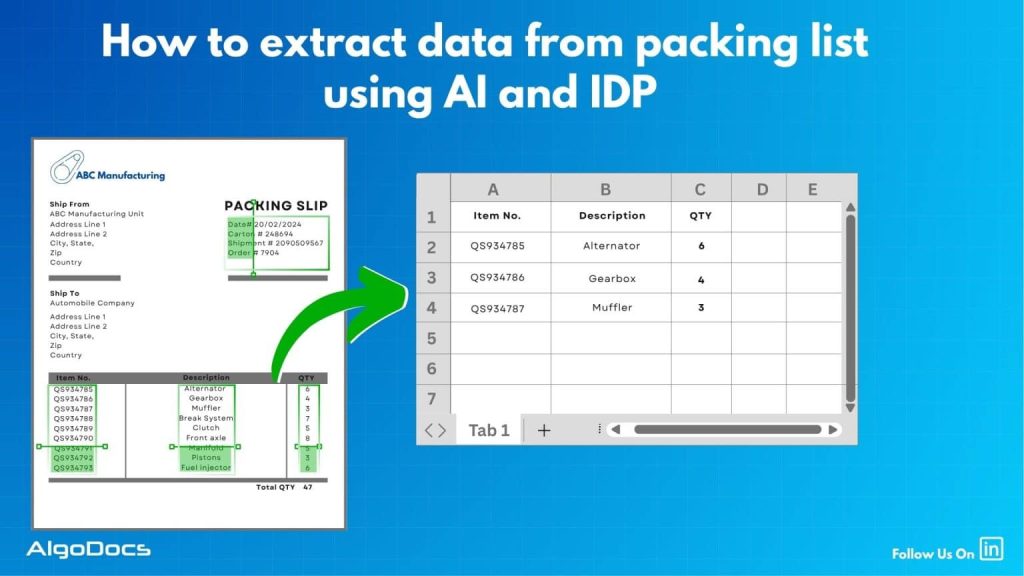
Back to Blog Table of contents On this page How To Extract Data From Packing List With AI And Intelligent Document Processing (Complete Guide) Home › Blog › Data Extraction › How To Extract Data From Packing List With AI And Intelligent Document Processing (Complete Guide) Categories Data Extraction invoice extraction Tags ai platform for data extraction invoice extraction packing list data extraction By Shubhankar Biswas Published September 1, 2025, 06:50 Updated July 20, 2026, 10:02 The world of eCommerce revolves around many types of documents. Some of the major documents include packing lists, purchase orders, bills of lading, sea waybills, etc. Now, extracting data from packing lists is another challenge that requires a proper technological approach. But the question still remains: how to extract data from packing lists? Utilizing technology such as OCR, Intelligent Document Processing, and the new tech revolution such as AI has made data extraction from packing lists very easy, accurate, and efficient for businesses. However, handling packing lists manually is a slow and error-prone task, especially when you’re dealing with hundreds or thousands of shipments every month. The risk of human error is high and can lead to serious business setbacks.In this blog, we will explain in detail how to extract data from packing lists using AI and IDP, how packing lists and SKU lists are two different documents, what challenges you may face with packing list data extraction, top tools for packing list data extraction, and how tools like Algodocs offer an effective solution for packing list data extraction. What Is a Packing List? A packing list is a document that provides details of the products lined up for shipment. This includes details such as product names, product descriptions, product quantities, weight, dimensions, number of boxes, and other relevant information.The packing list is usually prepared by the seller or the warehouse and is included with the shipment process. It serves as a reference for everyone involved in the shipping process, including logistics providers, customs officers, and the buyer.Packing lists are typically generated in digital formats such as PDFs, spreadsheets, or Word documents, but they are often printed or scanned, especially in traditional supply chain settings. Because of this, the quality and format of the document can vary significantly. What Is the Purpose of a Packing List in eCommerce? In the eCommerce industry, the packing list is not just a formality—it’s a crucial document that supports the entire order fulfillment process. Here’s why it matters: Order Verification: Helps verify that the correct items and quantities are shipped. Prevents order mismatches and customer complaints. Inventory Management: Supports stock tracking and inventory control. Assists in identifying discrepancies between what was picked and what was shipped. Logistics Coordination: Enables warehouse teams and shipping providers to organize packages efficiently. Streamlines dispatch and delivery operations. Customs and Regulatory Compliance: Helps international shipments clear customs smoothly by providing product details. Ensures compliance with import/export regulations. Returns and Disputes Handling: Used to confirm the contents of returned shipments. Acts as proof in case of disputes regarding missing or damaged items. What is the Difference Between Packing List vs SKU List? SKU list – A SKU list is created and maintained at the individual business level, which shows how many products are available in their inventory to sell in the market. This list contains product details such as product title, product dimensions, weight, SKU ID, product image URL, and other information. Various types of businesses use different types of SKU lists, which can be for their online or offline business inventory. Try Algodocs Free Forever Plan to Automate Data Extraction From Packing List and Other Logistics Documents In Real Time Try Now Packing list – A packing list is generated to list all items that will be shipped by the shipping or logistics company. A packing list includes various information such as the number of items to be shipped, their quantity, number of boxes, tracking number, etc. It basically serves as a receipt that indicates the number of detailed items. What Is Packing List Data Extraction? Packing list data extraction means extracting key-value information from a packing list document with the help of automated tools such as packing list OCR, intelligent document processing tools, or AI and ML-based tools. A typical packing list document contains details such as item descriptions, quantities, product dimensions and weights, sender and receiver address details, shipping dates, and delivery terms. These extracted data from packing lists are later used for record-keeping, tracking, billing, and other business activities by businesses or shipping companies. Previously, packing list data extraction used to be a tedious process as most of the data extraction was done manually by humans. The manual process took more time and the possibility of human error was high. This resulted in many setbacks for businesses due to slower extraction speed, inaccuracy in extracted data, increased extraction costs, and other challenges.But the modern data extraction approach has shifted from manual methods to AI-based methods, which have significantly improved workflow efficiency for businesses. Challenges With Packing List Data Extraction While packing list documents are major documents for shipping and logistics businesses, extracting and organizing data accurately remains a challenge due to: Document Format Variation: A packing list document can come in various formats or layouts. Every logistics provider designs packing list formats in their own way. This could be due to region, language, preference, business type, or other external factors. Unstructured or Poorly Formatted Data: Packing list documents are often generated in unstructured formats, and extracting data from these documents creates many challenges. Scanned or Low-Quality Documents: Document quality is another issue. Poorly scanned documents, documents of very low quality, and skewed fonts create many problems in data extraction. High Volume of Documents: While extracting data from one or two packing list documents seems feasible with manual methods, extracting 100 or sometimes 1000 documents at once isn’t possible manually. It’s slow, full of errors, and inefficient. Language Barriers: Multilingual packing list documents create hurdles in data extraction. Extracting data from regional language documents
