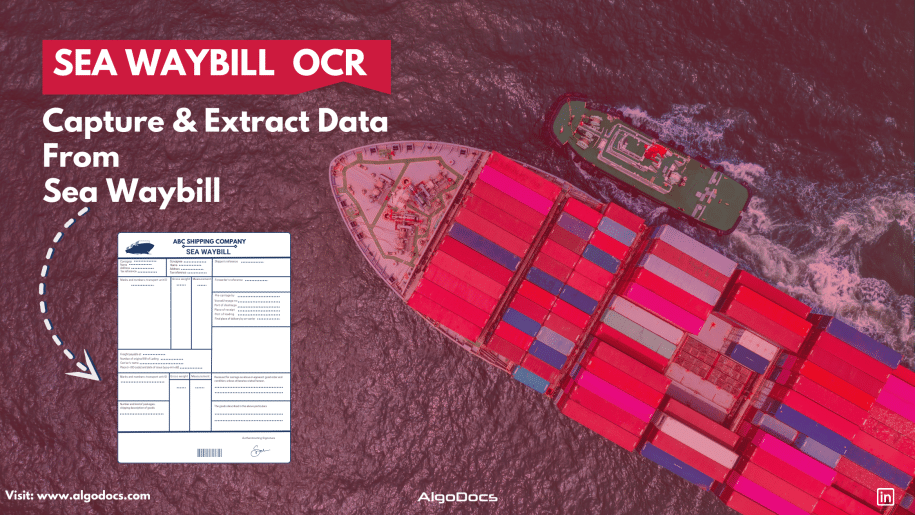
Sea Waybill OCR: Revolutionizing Maritime Logistics With AI-Powered Document Processing
Back to Blog Table of contents On this page Sea Waybill OCR: Revolutionizing Maritime Logistics With AI-Powered Document Processing Home › Blog › Algodocs › Sea Waybill OCR: Revolutionizing Maritime Logistics With AI-Powered Document Processing Categories Algodocs Tags ai platform for data extraction algodocs character recognition image to text invoice process sea waybill ocr By Shubhankar Biswas Published September 1, 2025, 08:39 Updated July 20, 2026, 08:08 Introduction Maritime logistics plays a crucial role in global trade, with millions of shipping documents processed daily. Among them, the sea waybill is a critical document in ocean freight digitalization, facilitating cargo movement and ensuring smooth supply chain operations. However, manually extracting and processing bulk sea waybills is time-consuming, prone to errors, and inefficient. With the advent of OCR (Optical Character Recognition) technology, businesses can now automate data extraction from shipping documents, streamlining operations and reducing human intervention. Sea Waybill OCR is a transformative technology that helps logistics companies by providing fast, accurate, and scalable data extraction solutions for document processing and automation. In this blog, we will explore how OCR technology is revolutionizing the maritime industry, along with its benefits, use cases, and future trends. Understanding the Sea Waybill A sea waybill is a shipping document issued by a carrier that acts as a contract of carriage but does not confer title to the goods. Unlike a bill of lading (BOL), a sea waybill is non-negotiable, meaning that the consignee can take delivery of goods without presenting the original document. This makes it a preferred choice for faster and more efficient transactions. Key Differences: Sea Waybill vs. Bill of Lading What is a Sea Waybill? A Sea Waybill is a commonly used document in international shipping that simplifies the transportation process. Why is it important? Acts as a Receipt – Confirms that the carrier has received the goods for shipment. Specifies the Destination – Clearly indicates where the shipment is headed. Does Not Transfer Ownership – Unlike a Bill of Lading, it does not grant ownership rights to the holder. Simplifies Delivery – Reduces paperwork and speeds up the shipping process. Ideal for Established Trade Relationships – Best suited for situations where: Ownership remains unchanged during transit. There is no need for a document to control the transfer of goods. By streamlining logistics, the Sea Waybill helps freight forwarders and businesses ensure faster, hassle-free deliveries. What is a Bill of Lading? A Bill of Lading (BOL) is a crucial document in international trade that serves multiple purposes in the shipping process. Why is it Important? Acts as a Primary Shipping Document – It is the key document required for importing and exporting goods. Identifies Key Parties – It specifies the sender (shipper), the carrier (transport company), and the recipient (consignee). Serves as a Receipt – It confirms that the shipping company has received the goods in proper condition. Establishes Legal Ownership – The BOL proves who owns the goods during transit. Grants Control Over the Shipment – The person holding the original BOL has the right to: Claim the goods upon arrival. Transfer ownership to another party in the supply chain. By clearly defining roles and responsibilities, the Bill of Lading ensures smooth coordination among all parties involved in the shipment process. Feature Sea Waybill Bill of Lading (BOL) Negotiability Non-negotiable Negotiable Document Requirement No original required for delivery Original required for cargo release Speed of Transaction Faster, direct delivery Slower due to title transfer Risk of Fraud Lower risk Higher risk Since sea waybills are widely used in automated document processing, integrating OCR solutions can significantly improve efficiency. What is Sea Waybill OCR? Sea Waybill OCR technology is designed to automatically capture and extract data from scanned sea waybill images and PDFs. You don’t need to set up custom extractors or rules, as the system automatically recognizes document types, layouts, and data fields, extracting values with precision. This OCR model is trained on vast amounts of data using AI and machine learning, allowing it to understand patterns, layouts, and data types in sea waybill documents. By leveraging the power of AI and ML, Sea Waybill OCR seamlessly digitizes and automates data extraction from shipping documents, making the process faster and more efficient. By using machine learning-based OCR, businesses can accurately capture essential information such as: Shipper and consignee details Cargo descriptions Freight terms Port of loading and discharge Carrier and vessel details This eliminates the need for manual data entry and enhances the accuracy and efficiency of logistics operations. The Role of AI in OCR for Sea Waybills Modern AI-powered OCR solutions go beyond simple text recognition. They incorporate advanced natural language processing (NLP), deep learning, and computer vision to extract structured data from unstructured documents. Here’s how AI enhances OCR capabilities: Intelligent Data Extraction – AI models can recognize different fields in sea waybills and classify information accurately. Handwritten and Printed Text Recognition – AI-powered OCR can process both typed and handwritten text, improving versatility. Multi-Language Support – Maritime trade is global, and AI-driven OCR supports multiple languages for seamless operations. Automated Data Validation – AI cross-checks extracted information with databases to ensure accuracy. Seamless Integration with ERP and TMS – OCR solutions integrate with transportation management systems (TMS) and enterprise resource planning (ERP) software for real-time data processing. Benefits of Implementing Sea Waybill OCR 1. Increased Efficiency & Speed Manual data entry is slow and labor-intensive. OCR enables instant data extraction, reducing processing time from hours to minutes. 2. Cost Reduction Automated document processing minimizes labour costs and operational expenses by reducing manual intervention. 3. Improved Accuracy & Data Integrity Human errors in shipping documents can lead to costly delays. AI-powered OCR enhances accuracy and ensures compliance with shipping regulations. 4. Better Compliance & Security OCR solutions can flag inconsistencies and prevent fraud, ensuring better regulatory compliance in maritime trade. 5. Scalability Businesses can process large volumes of documents effortlessly, making it ideal for shipping companies, freight forwarders, and customs agencies. Use Cases of OCR in Maritime Logistics 1. Digitization of Shipping Documents OCR converts physical sea waybills into digital formats, making them searchable and easy to retrieve. 2. Automated Freight Auditing AI-powered
