Algodocs

Algodocs

Product guides, step-by-step tutorials and real-world use cases for AlgoDocs. See how teams set up document types, define extraction rules without writing code, and send clean data straight to Excel, their accounting software or their own systems through the API.
what is ocr
Algodocs

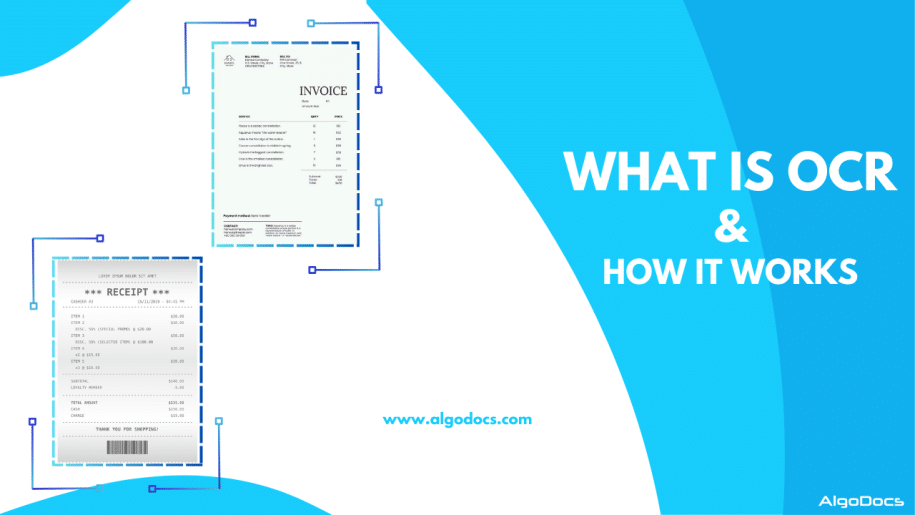
What is OCR and How Does it Work? A Comprehensive Guide to Understand Optical Character Recognition

Back to Blog Table of contents On this page What is OCR and How Does it Work? A Comprehensive Guide to Understand Optical Character Recognition Home › Blog › Algodocs › What is OCR and How Does it Work? A Comprehensive Guide to Understand Optical Character Recognition Categories Algodocs Tags data extraction guide machine learning OCR ocr api By Shubhankar Biswas Published September 1, 2025, 09:29 Updated July 21, 2026, 05:24 When it comes to data extraction, you have multiple options, including IDP, OCR, ICR, and more. OCR (Optical Character Recognition) is a widely used technology for extracting data from various types of documents, such as PDFs, scanned images, and Word files. While manual data extraction methods like copy-pasting are still used, they are less reliable and can be time-consuming. In today’s data-driven business landscape, effective data extraction tools have become essential for successful decision-making. This comprehensive guide delves deep into the world of OCR, exploring its intricacies, applications, benefits, and other aspects. Whether you’re a seasoned tech enthusiast or just starting to explore the possibilities of data extraction, this article will provide you with a thorough understanding of OCR and how it can revolutionize your data management processes. What is OCR? OCR is a technology that converts different types of documents, such as scanned papers, PDF files, or images, into editable machine-readable text. In simpler terms, it can extract unstructured data from scanned images, PDFs, and Word files into a structured data format. Imagine a super-efficient assistant who can tirelessly read through piles of documents and convert them into a format your computer can understand. Consider this scenario: you have a mountain of invoices in various formats – some are printed, some are handwritten, and others are even photographs of documents. Manually entering all that data into your system would be a logistical nightmare, prone to errors and incredibly time-consuming. OCR simplifies this process by automatically extracting the text from these documents, saving you countless hours and resources. History of OCR The history of Optical Character Recognition (OCR) is a fascinating journey that spans over a century, evolving from early mechanical devices to sophisticated artificial intelligence-powered systems. In the early 1900s, pioneers like Emanuel Goldberg envisioned machines that could read characters and convert them into telegraph code, marking the first steps towards OCR. These early efforts focused on specialized tasks like reading specific fonts or recognizing machine-readable characters. The mid-20th century witnessed significant advancements with the development of electronic computers. Researchers began exploring ways to use computers to analyze images and recognize patterns, laying the foundation for modern OCR technology. Early OCR systems were limited in their capabilities, often struggling to recognize complex fonts, handwritten text, and low-quality images. However, with the rise of artificial intelligence and machine learning in the late 20th and early 21st centuries, OCR technology experienced a dramatic transformation. Researchers developed sophisticated algorithms that could learn to recognize patterns in text, adapt to different fonts and styles, and even handle handwritten input. These advancements have led to significant improvements in accuracy, speed, and reliability, making OCR a valuable tool in various applications. Today, OCR technology is widely used in a variety of fields, including data entry, document management, archival research, and accessibility for the visually impaired. From digitizing historical documents to automating invoice processing, OCR plays a crucial role in streamlining workflows and improving efficiency across numerous industries. As technology continues to evolve, we can expect further advancements in OCR, such as improved accuracy for handwritten text, support for more languages, and integration with other emerging technologies like natural language processing and computer vision. These advancements will further expand the potential of OCR, making it an even more powerful and indispensable tool in the digital age. How Does OCR Work? At its core, OCR technology mimics the human process of reading. It analyzes the structure of an image, identifies characters, and then converts them into machine-encoded text. This seemingly simple process involves several intricate steps: Image Pre-processing: Before the actual character recognition takes place, the input image is prepared for analysis. This often involves techniques like noise reduction, skew correction, and binarization to remove unwanted artifacts, straighten the image, and enhance contrast. Character Segmentation: Once the image is pre-processed, it’s divided into individual characters or glyphs. This step is crucial for accurate recognition, as it isolates each character for subsequent analysis. Feature Extraction: In this step, unique features of each character are extracted and analysed. These features might include lines, curves, loops, and other distinguishing characteristics that differentiate one character from another. Character Recognition: The extracted features are then compared to a database of known characters. The system uses sophisticated algorithms, often based on machine learning or neural networks, to determine the closest match for each character. Post-processing: The recognized text is further refined to correct any errors and improve accuracy. This may involve using dictionaries, contextual analysis, grammatical rules, or even machine learning algorithms to identify and correct misspellings, incorrect spacing, or other inconsistencies. The Benefits of OCR OCR offers a multitude of benefits across various industries and applications, but here are some of the essential benefits that suit all industry and business needs: Improved Efficiency: OCR automates data entry, eliminating the need for manual input and freeing up valuable time and resources that can be redirected to more strategic tasks. This eventually improves work efficiency and allows you to focus on more important work. Reduced Costs: By automating manual tasks, OCR can significantly reduce labor costs associated with data extraction. This can lead to substantial cost savings, especially for organizations that handle large volumes of documents. Enhanced Accuracy: OCR systems can achieve high accuracy rates, minimizing errors associated with manual data extraction. This ensures data integrity and reliability. Better Searchability: OCR converts scanned documents and images into searchable text, making it easier to find information within large volumes of data. This can significantly improve information retrieval and knowledge management. Improved Data Management: OCR helps organize and manage data more efficiently. By converting unstructured data into structured formats, OCR facilitates data analysis, reporting, and decision-making.
Algodocs

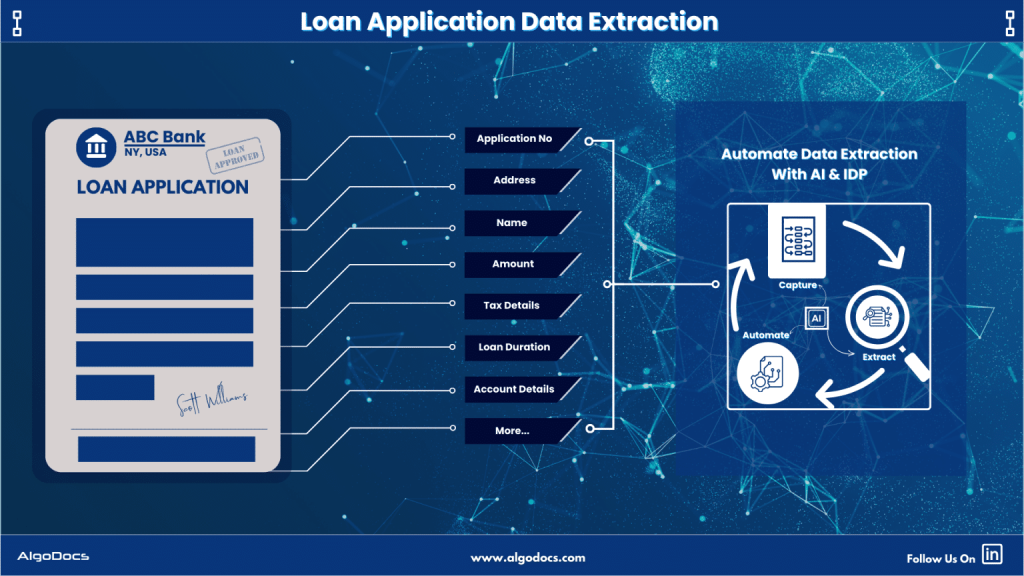
Automating Loan Document Data Extraction with Intelligent Document Processing: A Case Study

Back to Blog Table of contents On this page Automating Loan Document Data Extraction with Intelligent Document Processing: A Case Study Home › Blog › Algodocs › Automating Loan Document Data Extraction with Intelligent Document Processing: A Case Study Categories Algodocs Tags algodocs data extraction from images IDP loan forms machine learning By Shubhankar Biswas Published September 1, 2025, 09:06 Updated July 20, 2026, 03:52 The process of applying for a home loan, car loan, education loan, or any type of personal or business loan is a lengthy one. It involves extensive documentation, verification, validation, screening, and ultimately, loan approval. Numerous documents are essential in this process, such as loan forms, identity documents, tax forms, and more. However, capturing, extracting, and organizing data from each individual form presents a significant challenge. Manually extracting data from diverse document types and formats, then effectively sorting, refining, and applying that data for real business tasks, is an additional hurdle. Thankfully, AI and Intelligent Document Processing have made these tasks more accessible, accurate, and efficient for various financial institutions that offer different types of loan services to their customers. In this blog, we will explore how banks and financial institutions can leverage Artificial Intelligence and Intelligent Document Processing to enhance the speed and accuracy of loan document data extraction. We will also discuss why modern businesses are increasingly investing in these technologies to automate data extraction for loan documents. Before diving into the main topic, let’s first understand what a loan document is, the types of loans, the documents involved in processing a loan, the types of data businesses need to extract from these documents, and then we will delve into the core topic. Understanding Loan Document Data Extraction In 1959, when Barclays Bank in Britain first used a computer for banking purposes, computer technology has since made significant strides in various types of banking and financial activities. Among these, loans and mortgages are some of the financial activities that have seen complete transformation. Loan document data extraction is a critical part of modern banking where computers, Artificial Intelligence, and Intelligent Document Processing are enhancing the efficiency of this process. Essentially, loan document data extraction refers to the process of identifying and capturing relevant information from financial documents. These documents come in various formats, including PDFs, scanned images, and handwritten notes. Manually extracting crucial details such as borrower information, loan amounts, interest rates, repayment terms, and supporting financial data can be difficult due to human errors, lack of speed, inaccuracy, and slow processing times. However, with the rise of AI-driven IDP solutions, businesses can now automate this process, reducing manual effort and improving data accuracy. By utilizing technologies such as Optical Character Recognition (OCR), Natural Language Processing (NLP), and Machine Learning (ML), IDP tools can extract both structured and unstructured data, validate it, and integrate it seamlessly into loan processing systems. The Role of Intelligent Document Processing in Loan Data Extraction Intelligent Document Processing (IDP) is revolutionizing how financial institutions handle loan documents and extract data from them. IDP combines AI and ML with traditional data extraction techniques such as OCR to extract, classify, and validate data in real-time from a loan document. Here’s how IDP enhances loan document data extraction: Automated Data Capture: IDP eliminates the need for manual entry by automatically capturing key data fields from loan documents. This results in increased work efficiency, saving both time and cost. Additionally, you can integrate IDP with third-party platforms to make loan data extraction even more useful. Improved Accuracy: Advanced AI and ML algorithms reduce errors that occur in manual processing, ensuring higher data integrity. In manual data extraction, reliance on humans for evaluation and extraction of data often leads to errors. In contrast, automated AI-based IDP tools make fewer or no errors in data extraction. Faster Loan Processing: Automation accelerates document verification, reducing approval times and enhancing customer experience. On the other hand, manual document verification and processing take more time, eventually hampering the customer experience. Compliance and Security: IDP solutions ensure adherence to financial regulations and protect sensitive customer information. Manual data extraction, however, exposes valuable data to unauthorized access, which can lead to serious data breaches. Scalability: Businesses can process large volumes of loan documents efficiently without increasing operational costs. In contrast, manual data extraction requires more manpower to extract data from loan documents, resulting in higher operational costs and limited scalability. Challenges in Manual Loan Document Data Extraction Manual loan document data extraction presents several challenges that hinder efficiency, speed, accuracy, and cost for data extraction. Some of the key challenges include: Time-Consuming Process: Manual data entry is labor-intensive and time-consuming, leading to delays in loan processing and approval. Extracting data from each individual document takes more time, which slows the loan processing and approval timeline for borrowers. Prone to Errors: There is a famous quote by Alexander Pope, “To err is human,” which means humans are destined to make errors. Human errors are common in manual data extraction, which can result in incorrect data entry and compliance issues. High Operational Costs: Manually extracting data from loan documents requires more human power, leading to an increase in operational costs. You need to hire more people to extract data from loan documents, and then you also need to train them to do the task efficiently. This results in labor costs, operational costs, and additional expenses for the employer. Limited Scalability: As the volume of loan documents increases, manual data extraction becomes unsustainable and limits scalability. This requires more manpower to do the job, which leads to rising operational costs, decreased work efficiency, and other challenges. In short, manual loan document data extraction isn’t ideal in terms of scalability. Benefits of Automating Loan Document Data Extraction with IDP Implementing IDP solutions for loan document data extraction offers numerous benefits which can greatly improve loan processing, verification, and approval timeline. Below are the benefits of IDP for loan document data extraction: Try Algodocs AI for extracting data from any loan documents and achieve 10x speed and accuracy with our app. Try For Free Enhanced Data Management: Automated

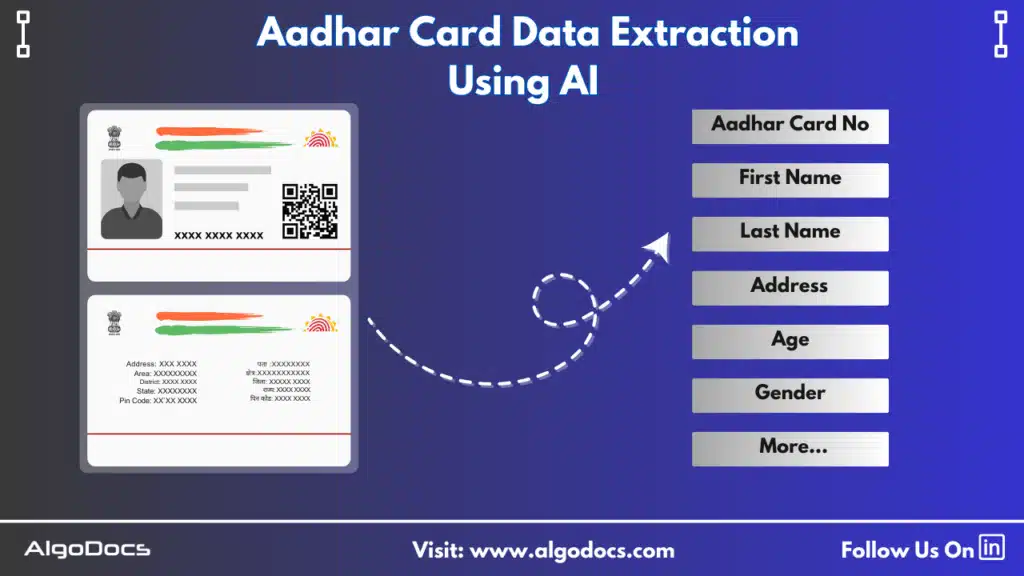
Aadhar Card Data Extraction using AI
Algodocs

Aadhar Card OCR: Extracting Data From Aadhar Card Using AI

Back to Blog Table of contents On this page Aadhar Card OCR: Extracting Data From Aadhar Card Using AI Home › Blog › Algodocs › Aadhar Card OCR: Extracting Data From Aadhar Card Using AI Categories Algodocs Tags ai platform for data extraction algodocs data extraction from images id card extraction id card ocr machine learning ocr api web-based ai platform for data extraction By Shubhankar Biswas Published September 1, 2025, 08:50 Updated July 20, 2026, 05:40   In today’s fast-paced digital era, automation and artificial intelligence (AI) have transformed data extraction processes across various industries. One of the most critical use cases in India is Aadhar Card data extraction, where Optical Character Recognition (OCR) and AI technology are used to extract data from Aadhar cards with higher accuracy. Since the Aadhar card serves as a crucial identity document (ID) for Indian citizens, automating data extraction can significantly enhance work efficiency in many industries such as finance, telecom, healthcare, and e-governance. With the growing need for faster and more reliable document processing, AI-powered OCR solutions (IDP) are becoming essential tools for businesses in India. By eliminating manual data entry, businesses can reduce errors, enhance efficiency, and improve data management. In this blog, we will explore how Aadhar Card OCR works, its advantages, and how AI-driven solutions like Algodocs streamline the data extraction process. So What is Aadhar Card OCR? Aadhar Card OCR is an Optical Character Recognition (OCR) technology used to capture and extract details from a scanned image or PDF format of an Aadhar card. The key details extracted through this process include the 12-digit Aadhar card number, the full name of the cardholder, date of birth, gender, address, and QR code data. Extracting this information manually can be time-consuming and prone to errors. However, an AI-based OCR app can easily capture, extract, and sort the data with the help of AI, allowing you to automate the entire process. The best part of AI-based OCR tools is that they improve accuracy, speed, and efficiency by using sophisticated algorithms that analyze, recognize, and extract text even from low-quality images, which is not possible with manual data extraction approaches. Unlike traditional OCR systems, AI-powered solutions are trained on vast datasets, allowing them to recognize different fonts, complex formats, and text placements with greater precision and speed. How AI Elevates  Aadhar Card Data Extraction Efficiency Traditional OCR solutions often struggle with poor-quality images, handwritten text, or complex document layouts. However, AI-powered OCR can overcome these challenges by using machine learning (ML), natural language processing (NLP), artificial intelligence (AI), and advanced image preprocessing techniques. Machine learning algorithms and artificial intelligence enable OCR tools to recognize and extract text from Aadhar cards with a high degree of accuracy. These algorithms are trained to learn from large volumes of data, allowing them to improve their performance over time. Natural language processing (NLP) helps in interpreting and structuring the extracted information correctly, ensuring that fields such as names and addresses are properly identified. Image preprocessing techniques further enhance accuracy by removing background noise, adjusting contrast, and correcting distortions in scanned or photographed documents. This ensures that even low-quality images can be processed with minimal errors. Another significant advantage of AI-powered OCR is fraud detection. The system can identify forged or tampered Aadhar cards by analyzing patterns and inconsistencies within the document, thus ensuring data authenticity. The Aadhar Card Data Extraction Process Extracting data from an Aadhar card using AI-based OCR involves several key steps. The process begins with image acquisition, where a scanned copy or photograph of the Aadhar card is uploaded; the file can be a PDF as well. The AI-driven OCR software then processes the image to enhance readability by removing any background noise and correcting distortions. Once the image is pre-processed, the OCR engine scans the document and recognizes the text using deep learning algorithms. The extracted data is then structured into predefined fields, ensuring that each piece of information, such as the Aadhar number, name, age, gender, and address, is correctly categorized. After the text is extracted, the system validates the information by cross-checking it with predefined data formats. Finally, the structured data is exported for integration into various applications, such as customer onboarding systems, KYC verification processes, and digital record management solutions. Benefits of AI-Powered Aadhar Card OCR platforms AI-powered Aadhar Card OCR apps offer numerous advantages over manual data entry or traditional OCR apps. One of the primary benefits of AI-powered Aadhar Card OCR apps is their enhanced data extraction accuracy and increased extraction speed. AI models trained specifically for Aadhar card data extraction ensure precision, minimizing errors that could occur due to manual input. This high accuracy is particularly beneficial for businesses that require large-scale data processing, such as banks, telecom companies, and government agencies. Try Algodocs AI-based Aadhar Card OCR for all types of ID card data extraction and KYC document data extraction work for free. Another key advantage is speed. The automation of data extraction significantly reduces processing times, allowing businesses to complete customer verifications, document submissions, and other administrative tasks much faster. This improved efficiency translates into cost savings, as organizations no longer need to rely on extensive human labour for data entry tasks. One of the most important benefits of AI-powered Aadhar Card data extraction is fraud prevention and data security, which are crucial factors in safeguarding personal information as the Aadhar card is an important ID card. Unauthorized access to this information can lead to many negative consequences for users and the organization. AI-powered OCR systems can detect forged or tampered documents by analyzing subtle inconsistencies in text alignment, font variations, and background patterns. This ensures that only genuine Aadhar card data is processed, enhancing security and compliance. Furthermore, AI-based OCR tools integrate seamlessly with existing systems. Whether it’s a CRM platform, banking application, or government database, the extracted data can be automatically transferred to ensure smooth workflow automation. Applications of Aadhar Card OCR Across Industries Though Aadhar Card OCR has a wide range of applications across

sea waybill ocr
Algodocs

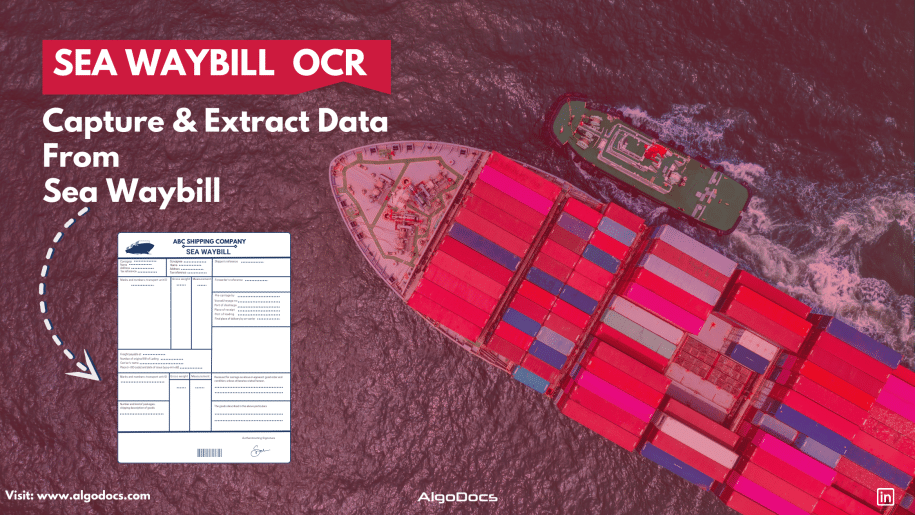
Sea Waybill OCR: Revolutionizing Maritime Logistics With AI-Powered Document Processing

Back to Blog Table of contents On this page Sea Waybill OCR: Revolutionizing Maritime Logistics With AI-Powered Document Processing Home › Blog › Algodocs › Sea Waybill OCR: Revolutionizing Maritime Logistics With AI-Powered Document Processing Categories Algodocs Tags ai platform for data extraction algodocs character recognition image to text invoice process sea waybill ocr By Shubhankar Biswas Published September 1, 2025, 08:39 Updated July 20, 2026, 08:08 Introduction Maritime logistics plays a crucial role in global trade, with millions of shipping documents processed daily. Among them, the sea waybill is a critical document in ocean freight digitalization, facilitating cargo movement and ensuring smooth supply chain operations. However, manually extracting and processing bulk sea waybills is time-consuming, prone to errors, and inefficient. With the advent of OCR (Optical Character Recognition) technology, businesses can now automate data extraction from shipping documents, streamlining operations and reducing human intervention. Sea Waybill OCR is a transformative technology that helps logistics companies by providing fast, accurate, and scalable data extraction solutions for document processing and automation. In this blog, we will explore how OCR technology is revolutionizing the maritime industry, along with its benefits, use cases, and future trends. Understanding the Sea Waybill A sea waybill is a shipping document issued by a carrier that acts as a contract of carriage but does not confer title to the goods. Unlike a bill of lading (BOL), a sea waybill is non-negotiable, meaning that the consignee can take delivery of goods without presenting the original document. This makes it a preferred choice for faster and more efficient transactions. Key Differences: Sea Waybill vs. Bill of Lading What is a Sea Waybill? A Sea Waybill is a commonly used document in international shipping that simplifies the transportation process. Why is it important? Acts as a Receipt – Confirms that the carrier has received the goods for shipment. Specifies the Destination – Clearly indicates where the shipment is headed. Does Not Transfer Ownership – Unlike a Bill of Lading, it does not grant ownership rights to the holder. Simplifies Delivery – Reduces paperwork and speeds up the shipping process. Ideal for Established Trade Relationships – Best suited for situations where: Ownership remains unchanged during transit. There is no need for a document to control the transfer of goods. By streamlining logistics, the Sea Waybill helps freight forwarders and businesses ensure faster, hassle-free deliveries. What is a Bill of Lading? A Bill of Lading (BOL) is a crucial document in international trade that serves multiple purposes in the shipping process. Why is it Important? Acts as a Primary Shipping Document – It is the key document required for importing and exporting goods. Identifies Key Parties – It specifies the sender (shipper), the carrier (transport company), and the recipient (consignee). Serves as a Receipt – It confirms that the shipping company has received the goods in proper condition. Establishes Legal Ownership – The BOL proves who owns the goods during transit. Grants Control Over the Shipment – The person holding the original BOL has the right to: Claim the goods upon arrival. Transfer ownership to another party in the supply chain. By clearly defining roles and responsibilities, the Bill of Lading ensures smooth coordination among all parties involved in the shipment process. Feature Sea Waybill Bill of Lading (BOL) Negotiability Non-negotiable Negotiable Document Requirement No original required for delivery Original required for cargo release Speed of Transaction Faster, direct delivery Slower due to title transfer Risk of Fraud Lower risk Higher risk Since sea waybills are widely used in automated document processing, integrating OCR solutions can significantly improve efficiency. What is Sea Waybill OCR? Sea Waybill OCR technology is designed to automatically capture and extract data from scanned sea waybill images and PDFs. You don’t need to set up custom extractors or rules, as the system automatically recognizes document types, layouts, and data fields, extracting values with precision. This OCR model is trained on vast amounts of data using AI and machine learning, allowing it to understand patterns, layouts, and data types in sea waybill documents. By leveraging the power of AI and ML, Sea Waybill OCR seamlessly digitizes and automates data extraction from shipping documents, making the process faster and more efficient. By using machine learning-based OCR, businesses can accurately capture essential information such as: Shipper and consignee details Cargo descriptions Freight terms Port of loading and discharge Carrier and vessel details This eliminates the need for manual data entry and enhances the accuracy and efficiency of logistics operations. The Role of AI in OCR for Sea Waybills Modern AI-powered OCR solutions go beyond simple text recognition. They incorporate advanced natural language processing (NLP), deep learning, and computer vision to extract structured data from unstructured documents. Here’s how AI enhances OCR capabilities: Intelligent Data Extraction – AI models can recognize different fields in sea waybills and classify information accurately. Handwritten and Printed Text Recognition – AI-powered OCR can process both typed and handwritten text, improving versatility. Multi-Language Support – Maritime trade is global, and AI-driven OCR supports multiple languages for seamless operations. Automated Data Validation – AI cross-checks extracted information with databases to ensure accuracy. Seamless Integration with ERP and TMS – OCR solutions integrate with transportation management systems (TMS) and enterprise resource planning (ERP) software for real-time data processing. Benefits of Implementing Sea Waybill OCR 1. Increased Efficiency & Speed Manual data entry is slow and labor-intensive. OCR enables instant data extraction, reducing processing time from hours to minutes. 2. Cost Reduction Automated document processing minimizes labour costs and operational expenses by reducing manual intervention. 3. Improved Accuracy & Data Integrity Human errors in shipping documents can lead to costly delays. AI-powered OCR enhances accuracy and ensures compliance with shipping regulations. 4. Better Compliance & Security OCR solutions can flag inconsistencies and prevent fraud, ensuring better regulatory compliance in maritime trade. 5. Scalability Businesses can process large volumes of documents effortlessly, making it ideal for shipping companies, freight forwarders, and customs agencies. Use Cases of OCR in Maritime Logistics 1. Digitization of Shipping Documents OCR converts physical sea waybills into digital formats, making them searchable and easy to retrieve. 2. Automated Freight Auditing AI-powered

Intelligent Document Processing (IDP)
Algodocs

Intelligent Document Processing Trends in 2025: How AI & Automation are Reshaping Digital Workflows

  Intelligent Document Processing (IDP) is revolutionizing how businesses handle unstructured data. From invoices and contracts to medical records and customer correspondence, IDP enhances operational efficiency, compliance, and innovation. As we move into 2025, IDP is evolving rapidly to meet the growing need for speed, accuracy, and scalability. This article explores the key Intelligent Document Processing trends shaping 2025, the technologies driving change, and their real-world applications. driving change, and their real-world applications. What is Intelligent Document Processing? IDP leverages Artificial Intelligence (AI), Machine Learning (ML), Natural Language Processing (NLP), and Optical Character Recognition (OCR) to extract, classify, and process data from structured and unstructured documents. Unlike traditional document management systems, IDP understands context, learns from data, and seamlessly integrates into business workflows. Top Intelligent Document Processing Trends in 2025 Hyperautomation in IDP Hyperautomation combines AI, Robotic Process Automation (RPA), and advanced analytics to automate complex workflows. Businesses are now striving for end-to-end automation, allowing IDP systems to extract data, validate it, and route it for processing without human intervention. For example, in the finance sector, IDP-powered hyperautomation significantly reduces loan application processing times by automatically verifying documents and routing approvals. By 2026, over 80% of enterprises are expected to utilize generative AI-powered APIs or models, significantly enhancing various operations, including document processing. Generative AI for Document Understanding Generative AI is transforming IDP by understanding context and generating actionable insights. These models can summarize contracts, flag risks, and automate compliance checks. Zero-Shot Learning for Faster Adaptation Zero-shot learning enables IDP systems to process new document formats without prior training. This means businesses no longer need to configure IDP for each unique invoice or contract layout manually. Privacy-First IDP: Meeting Compliance Needs With stricter data privacy regulations (GDPR, HIPAA, CCPA), IDP vendors are focusing on privacy-first architectures: For example, law firms digitizing case files can extract key information while ensuring compliance with data protection laws. Sustainable IDP Solutions Businesses are aligning IDP with Environmental, Social, and Governance (ESG) goals by optimizing IDP algorithms for efficiency and using green cloud computing. Human-on-the-Loop (HOTL) for AI Supervision Human-in-the-loop (HITL) systems are evolving into human-on-the-loop (HOTL), where humans monitor IDP decision-making instead of directly intervening. Industry-Specific IDP Solutions Generic IDP tools are being replaced by tailored, industry-specific solutions that are pre-trained on domain-specific jargon, layouts, and compliance needs. Blockchain for Secure Document Processing Blockchain-enhanced IDP is improving document integrity by: Conclusion Intelligent Document Processing in 2025 is driven by AI, automation, and privacy-first approaches. As businesses shift toward hyper-automation, generative AI, and industry-specific solutions, IDP is becoming a strategic asset rather than just a document management tool. Platforms such as AlgoDocs AI leverage generative AI features to efficiently and swiftly extract and automate data from documents, making data extraction more productive and scalable for businesses. Organizations embracing these trends will gain a competitive edge, while those failing to adapt risk falling behind. What is Intelligent Document Processing (IDP)? IDP is an AI-powered technology that automates the extraction, classification, and processing of structured and unstructured data from documents. How does Generative AI improve document processing? Generative AI understands document context, extracts key data, and generates insights such as risk analysis and compliance summaries. What are the key trends in IDP for 2025? Top trends include hyperautomation, generative AI, privacy-first IDP, sustainability, and blockchain for document integrity. How can IDP help with compliance and data privacy? Modern IDP solutions offer on-premise deployment, encryption, and anonymization to comply with GDPR, HIPAA, and other data regulations. Which industries benefit the most from IDP? Industries such as finance, healthcare, legal, logistics, and retail benefit significantly from IDP by reducing manual processing time and increasing efficiency.  

Algodocs

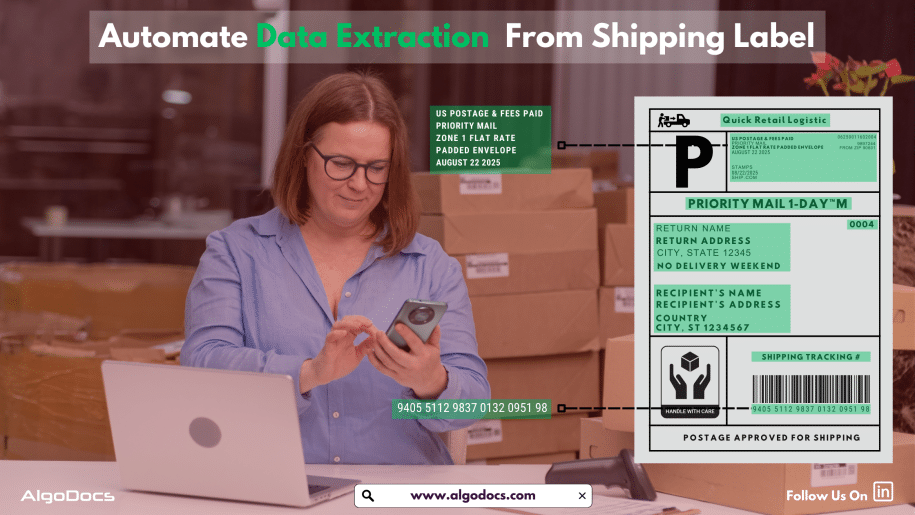
How Automate Shipping Label Data Extraction with AI & IDP: Faster, Smarter & Error-Free.

Back to Blog Table of contents On this page How Automate Shipping Label Data Extraction with AI & IDP: Faster, Smarter & Error-Free. Home › Blog › Algodocs › How Automate Shipping Label Data Extraction with AI & IDP: Faster, Smarter & Error-Free. Categories Algodocs By Shubhankar Biswas Published September 1, 2025, 07:49 Updated July 10, 2026, 11:38 Struggling with manual shipping label data extraction? Imagine reducing errors, cutting costs, and processing thousands of labels in minutes—without lifting a finger! In today’s competitive logistics landscape, businesses of all sizes—from small e-commerce stores to massive distribution centres—face mounting pressure to improve operational efficiency. Manual data extraction is not only time-consuming but also prone to costly errors that can disrupt supply chains and customer satisfaction. Fortunately, Intelligent Document Processing (IDP) powered by Artificial Intelligence (AI) and machine learning (ML) is revolutionizing how shipping label data is extracted. By automating this process, companies can streamline workflows, minimize human error, and redirect valuable human resources toward strategic initiatives. In this in-depth guide, we’ll explore: What is a shipping label and how it works: A detailed explanation of shipping label and how it is used by different logistics companies. What Shipping Label Data Extraction Is: A comprehensive look at what data is captured and why it matters. The Need for Automation: Why traditional methods are failing in today’s fast-paced market. How IDP, AI & ML Work Together: A detailed, step-by-step explanation of the technology behind automation. Business Benefits: How faster processing, higher accuracy, and cost savings translate into tangible ROI. Real-World Applications: Case studies and examples demonstrating the impact on operations. Implementation Tips: Best practices for integrating an automated solution like Algodocs AI. FAQs & Future Trends: Answers to common questions and a peek into what’s next in the evolution of document processing. Let’s dive into how you can transform your shipping operations and gain a competitive edge. What is a shipping label ? A shipping label is a vital document attached to a package, providing key details to ensure it reaches its destination. It’s typically a printed sticker or paper that guides carriers through the delivery process, whether for a local envelope or an international shipment. The label contains human-readable text and machine-readable codes, making handling and tracking efficient. The process starts when a sender enters details—recipient address, sender info, and shipping method—into a system that generates the label. Once attached, the label directs the package through sorting facilities, distribution hubs, and delivery routes. Carriers scan it at each step to update its status and ensure proper routing. For example, a priority code on the label might speed up an overnight shipment. Essentially, it acts like a package’s passport, guiding it to the recipient while allowing tracking for peace of mind. The main components of a shipping label are straightforward but critical. First, the recipient’s information—name, full address, and sometimes a phone number—ensures accurate delivery. Errors here can derail the process, especially for international shipments requiring customs details. Second, the sender’s information, or return address, allows the package to be returned if delivery fails. This typically includes the sender’s name and address, often in the top-left corner. Third, the tracking number, a unique code, lets both sender and recipient monitor the package’s journey online. Generated by the carrier, it’s linked to updates like “In Transit” or “Delivered.” Fourth, carrier-specific details—like service level (e.g., “Ground” or “Express”) and routing codes (barcodes or QR codes)—tell handlers how fast to move the package and where it’s headed next. These codes are scanned to keep it on track. Finally, special instructions—like “Fragile” or “This Side Up”—guide handling, while international labels may include customs declarations listing contents and value. Together, these elements streamline shipping. For instance, when you order a book, the label’s details get it from the warehouse to your door, scanned at each stop. In short, a shipping label’s components—recipient and sender info, tracking number, carrier data, and instructions—make it the backbone of reliable delivery, keeping goods moving worldwide with clarity and precision. What Is Shipping Label Data Extraction? Shipping labels are much more than mere stickers attached to packages—they’re rich sources of data critical to every stage of the shipping process. Shipping label data extraction refers to converting this information from physical or digital labels into structured, machine-readable data that can be directly fed into your business systems. This conversion is pivotal because it eliminates the need for manual entry, reduces the risk of human error, and accelerates the data processing workflow. Manual vs. Automated – Shipping Label Data Extraction Imagine, you have 1000 delivery parcels you need to extract shipping label data from these packages one by one. How will you do this? traditionally, employees manually transcribe shipping label information into databases or spreadsheets—a process that is slow, inefficient, and prone to mistakes. Even a minor error in a tracking number or address can lead to misrouted packages, lost shipments, and customer dissatisfaction. In contrast, automated data extraction harnesses the power of OCR (Optical Character Recognition) and advanced AI to quickly, accurately, and consistently extract relevant details, regardless of the label’s format or quality. Why Automate Shipping Label Data Extraction? The Advantages of Automation Switching to an automated solution for shipping label data extraction brings several critical benefits such as: Speed: Automation can process hundreds of labels within just few minutes, drastically reducing turnaround times. Accuracy: Advanced AI systems significantly reduce human error, ensuring data is consistently accurate. This is essential for maintaining customer trust and operational efficiency. Cost Efficiency: By reducing the reliance on manual labor, businesses can cut costs, lower operational expenses, and reallocate resources to more strategic initiatives. Scalability: Automated systems easily scale to meet growing demands without a corresponding increase in labor costs. Whether your business is handling 100 or 10,000 labels a day, automation provides a reliable solution. Enhanced Workflow: Automation frees up your employees from repetitive tasks, allowing them to focus on higher-level tasks like strategy, customer service, and innovation. For example, consider a logistics firm processing thousands of labels daily. Switching from manual to automated data extraction could reduce

Algodocs

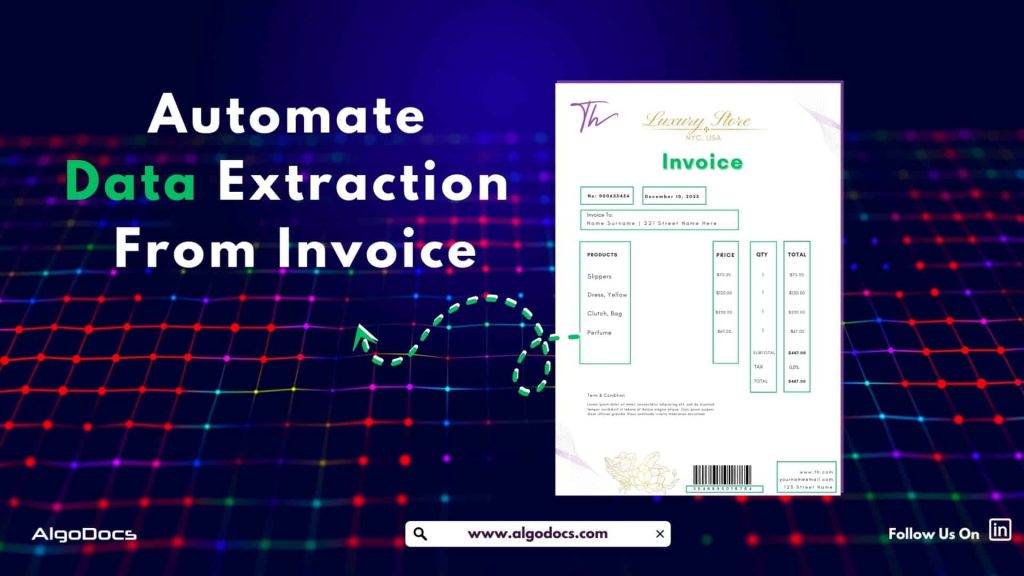
How to Extract Data from Invoice: Transforming Business Efficiency with AI In 2025

Back to Blog Table of contents On this page How to Extract Data from Invoice: Transforming Business Efficiency with AI In 2025 Home › Blog › Algodocs › How to Extract Data from Invoice: Transforming Business Efficiency with AI In 2025 Categories Algodocs Tags algodocs deep learning invoice automation Invoice Data Extraction By Shubhankar Biswas Published September 1, 2025, 07:46 Updated December 12, 2025, 19:42 In the modern, fast-paced digital world, businesses often handle a large volume of invoices and bills on a day-to-day basis. These invoices and bills contain critical information and financial details that must be extracted and processed accurately and efficiently to run the business smoothly. However, extracting data from invoices manually is both time-consuming and error-prone. This is where automated invoice data extraction becomes essential. By leveraging the power of Artificial Intelligence (AI) and Optical Character Recognition (OCR), businesses can extract data from invoices seamlessly, reducing manual efforts, enhancing accuracy, and improving operational efficiency. In this blog, we will explore the dimensions of how invoice data extraction works, the technology behind it, its benefits, challenges, and why AI-powered solutions like Algodocs are revolutionizing data extraction from invoices, saving time and cost. So, what is an invoice? An invoice is a document shared by the seller with the buyer to request payment for the service provided. In simple terms, when you, as a seller, offer services such as consultations, freelance work, or any other service, and you want the buyer to pay for the service provided, you will share a document with the buyer. This document contains essential information such as vendor details, buyer details, invoice date, payment details, service details, etc. Invoices are used in almost every industry, specifically by service providers, non-profit organizations, wholesalers, manufacturers, and other industries worldwide. What is invoice data extraction? Invoice data extraction is the process of capturing and extracting essential details from invoices and converting them into structured digital formats that can later be used for other business activities. This includes invoice numbers, dates, supplier details, line items, totals, and tax information. Automating this complex process helps businesses streamline financial operations, reduce human errors often associated with manual data extraction, and improve overall efficiency. An invoice can be a scanned image, a native PDF file, or a scanned image that has been converted into a single PDF file. How to Extract Data from Invoice Efficiently? The process of extracting data from invoices involves multiple steps to ensure accuracy and efficiency: Invoice Capture – Businesses receive invoices in various formats such as PDFs, scanned documents, and emails. AI-based systems can collect and organize these invoices for further processing. Preprocessing – Before extracting data, the system enhances the quality of scanned documents by removing noise, adjusting contrast, and correcting distortions. This step ensures better OCR accuracy. Optical Character Recognition (OCR) – The OCR technology scans the invoice to recognize and convert printed or handwritten text into machine-readable data. Data Structuring – AI-powered algorithms analyze the extracted text, identifying key fields like invoice numbers, dates, vendor names, and line-item details. The information is then formatted into a structured digital format. Validation & Verification – To ensure accuracy, the extracted data is cross-checked with predefined business rules, databases, and compliance standards. Any discrepancies are flagged for review. Integration & Storage – The verified data is stored in databases or seamlessly integrated into enterprise resource planning (ERP) systems, accounting software, or other financial management tools for further use. Technologies Used to Extract Data from Invoice AI and machine learning advancements have significantly improved invoice data extraction. The core technologies involved include: Optical Character Recognition (OCR): OCR is the core technology that converts printed and handwritten text into digital formats, enabling automated data extraction from invoices with high accuracy. Natural Language Processing (NLP): Helps the system understand invoice structures, identify key information, and improve data classification. Machine Learning (ML): Learns from past extractions to enhance accuracy, adapt to different invoice layouts, and predict missing data fields. Robotic Process Automation (RPA): Automates repetitive tasks such as invoice sorting, classification, and data entry into accounting systems. Intelligent Document Processing (IDP): Combines OCR with AI, NLP, and ML technologies to understand invoice context, extract relevant details, and organize structured data. IDP is a new phenomenon that handles challenges like skewed and blurry invoices, extracting data with precision and speed where traditional OCR fails. Benefits of Extracting Data from Invoice Automatically Looking For The Best All-In-One Invoice Data Extraction Tool? Try Algodocs Invoice Data Extraction Tool For Free and Access All The Paid Features For Free. Create A Free Account Today Create Free Account Automating invoice data extraction offers multiple advantages: Increased Efficiency – AI-driven automation eliminates the need for manual data entry, significantly reducing processing time and improving workflow efficiency. Improved Accuracy – Automated systems minimize human errors in data extraction, ensuring high precision and reliable financial records. Cost Savings – Businesses can cut down labor costs and operational expenses associated with manual invoice processing. Faster Payments & Approvals – Streamlined data extraction allows for quicker invoice approvals, enabling faster payments and improving vendor relationships. Scalability – AI-powered tools can handle thousands of invoices per day, making them ideal for businesses experiencing rapid growth. Better Compliance & Security – Automated extraction ensures adherence to financial regulations, reduces fraud risks, and provides a secure audit trail. Seamless Integration – Extracted data can be effortlessly integrated with ERP, accounting, and financial management software, enhancing workflow automation. Challenges in Extracting Data from Invoice Despite its benefits, invoice data extraction presents certain challenges: Invoice Format Variability: Different vendors use different invoice formats, which can complicate automated data extraction. AI-based solutions continuously learn and adapt to various templates. Handwritten Text Recognition: While OCR can process printed text efficiently, handwritten invoices, poor-quality scans, and smudged text may reduce extraction accuracy. Complex Data Structures: Some invoices contain intricate tables, multiple tax categories, and detailed line items that require advanced data processing capabilities. Integration Issues: Businesses may face technical difficulties integrating extracted data with existing accounting or ERP systems without proper API support. Initial Setup Costs: Implementing AI-powered invoice extraction requires investment in software,

Algodocs

How to Use AI to Improve KYC Document Processing and Data Extraction: Features, Benefits, Challenges, and Tools

Back to Blog Table of contents On this page How to Use AI to Improve KYC Document Processing and Data Extraction: Features, Benefits, Challenges, and Tools Home › Blog › Algodocs › How to Use AI to Improve KYC Document Processing and Data Extraction: Features, Benefits, Challenges, and Tools Categories Algodocs Tags ai platform for data extraction algodocs KYC machine learning By Shubhankar Biswas Published September 1, 2025, 07:42 Updated July 13, 2026, 09:54 KYC is one of the most important processes in sectors such as banking, finance, travel, and more. With the help of KYC documents, businesses ensure the proper and smooth transaction of services to their customers. However, KYC data extraction and document processing is a delicate and challenging task, and manually performing such a crucial process has many drawbacks, such as data inaccuracy, slow data processing, and human errors, which can create significant problems. But with the help of technologies such as artificial intelligence, machine learning, and intelligent document processing, businesses can improve data extraction accuracy, reduce time, and handle more customers in less time. In this blog, we will explore how AI can improve KYC document verification processing by effectively extracting data from ID cards, passports, and other identity documents. We will also discuss the challenges associated mainly with manual data extraction, how to overcome them with AI and IDP, the best tools available in the market, and how Algodocs is a great tool for KYC document processing and data extraction. Understanding KYC Verification and KYC Document Processing and Data Extraction KYC, or Know Your Customer, is the process of identifying personal details from identity documents such as ID cards, government-issued documents, passports, or other documents used by a company to provide various types of services to its customers. The sole purpose of KYC verification is to check the legitimacy of customer data provided to the company to avail of a service. These services may include approving a bank loan for a customer by a financial institution or granting a visa for travel by some countries’ border agencies. KYC verification or KYC data extraction is used by many organizations and businesses worldwide to access useful information about a person or customer. KYC document processing involves extracting data from identity documents such as ID cards, passports, and government-issued documents. These details include a customer’s name, DOB, address, financial details, age, country, etc. Extracting data can be done either manually or using sophisticated technologies such as intelligent document processing tools, AI, and machine learning to automate the entire process. How AI Enhances KYC Data Extraction and Document Processing With the help of AI, KYC document processing and data extraction can be greatly improved. Below are a few features of AI that help improve KYC data extraction and processing: 1. Document Classification AI can automatically identify and sort documents—passports, utility bills, or tax forms—using ML models trained on vast datasets. This eliminates manual categorization, paving the way for seamless KYC data extraction. 2. Advanced OCR for KYC Data Extraction Traditional OCR technology is limited as it only converts images to text, but AI-powered OCR excels at KYC data extraction by pinpointing specific fields—like names or ID numbers—despite poor image quality or varied layouts. This is especially useful for ID card data extraction, where precision is critical. One of the biggest advantages of AI-powered OCR is that it delivers 100% data accuracy, while traditional OCR fails to do so. 3. Data Validation and Cross-Checking Once KYC data extraction is done, AI can accurately validate the information against databases (e.g., government records or credit bureaus). It flags inconsistencies—like mismatched addresses—ensuring identity data processing is reliable and compliant. This saves time, whereas manual data extraction for KYC takes a significant amount of time. 4. Fraud Detection AI analyzes patterns to detect fraud, such as forged IDs or synthetic identities. Techniques like computer vision scrutinize document details during KYC data extraction, identifying tampering that human reviewers might miss. 5. Continuous Learning AI models adapt over time and are continuously trained on vast amounts of data, which improves accuracy in KYC data extraction and document verification as they process more data. This ensures they stay effective even as document types evolve. 6. Workflow Automation By integrating with robotic process automation (RPA), AI orchestrates the entire KYC pipeline—from ID card data extraction to data entry—reducing human effort and accelerating onboarding. Benefits of AI in KYC Data Extraction AI-driven KYC data extraction delivers significant advantages for businesses, customers, and regulators. Here’s why: Try Algodocs Free KYC Data Extraction Tool For Free 1. Increased Efficiency Manual KYC data extraction can take hours to extract data from a single document, but AI reduces this to minutes. By automating the entire process, organizations can improve the efficiency of KYC document processing and extraction. 2. Enhanced Accuracy The manual approach is prone to errors, which can create big issues with data accuracy. Errors in manual KYC data extraction—like typos in ID numbers—can lead to compliance issues. AI’s precision in ID card data extraction and validation minimizes mistakes, ensuring accurate results. 3. Cost Reduction Hiring staff for document verification and KYC data extraction is costly. AI reduces labor dependency, lowering expenses while maintaining quality—a clear win for scalability. 4. Improved Customer Experience Slow KYC document processing can lead to slow onboarding, frustrating customers, and harming a company’s reputation. AI’s fast KYC data extraction—such as real-time ID card data extraction—creates a seamless process, boosting satisfaction and retention. 5. Stronger Compliance Regulations like those from the Financial Action Task Force (FATF) demand rigorous identity data processing. AI ensures compliance by flagging risks and maintaining auditable records during KYC data extraction. 6. Scalability As customer bases grow, so do KYC demands. AI scales effortlessly, handling thousands of KYC data extraction tasks daily without added overhead. 7. Fraud Prevention With financial crime rising, AI’s ability to authenticate documents during KYC data extraction strengthens security, protecting businesses from fraud-related losses. Challenges of Implementing AI for KYC Data Extraction Despite its promising features and benefits, integrating

packing list data extraction
Algodocs

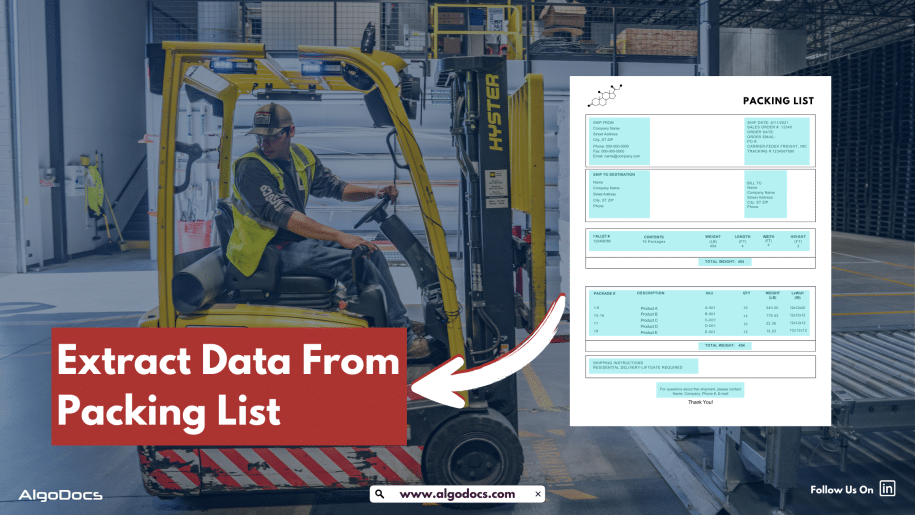
How to Automate Packing List Data Extraction: A Practical Guide

Back to Blog Table of contents On this page How to Automate Packing List Data Extraction: A Practical Guide Home › Blog › Algodocs › How to Automate Packing List Data Extraction: A Practical Guide Categories Algodocs Tags ai platform for data extraction algodocs invoice Logistics machine learning packing list ocr By Shubhankar Biswas Published September 1, 2025, 07:38 Updated July 21, 2026, 05:30 A packing list document is essential in freight, cargo, logistics, warehousing, and other industries worldwide. This document contains information about the items, such as their weight, quantity, seller information, buyer information, and destination. Packing list data extraction might not seem like the most exciting task in the world, but if you’re part of a business dealing with logistics, shipping, or supply chain operations, you already know how important these documents are. As straightforward as it sounds, extracting data from these lists can quickly turn into a time-consuming and error-prone chore, especially when done manually. Manual data extraction is slow and full of human errors, which can lead to many organizational troubles, such as increased costs for data extraction. However, using AI-based tools such as Intelligent Document Processing can improve data extraction accuracy, speed, and elevate work efficiency from packing list documents. In this article, we will discuss what a packing list document is, where it is used, the challenges of extracting data from packing lists, how AI-based tools such as Intelligent Document Processing can solve this issue and automate packing list data extraction, and how Algodocs is a game changer for automating packing list data extraction using AI and ML technology. What is a packing list document? A packing list document is a detailed checklist used in shipping to show what’s inside a package or shipment. It includes the product names, quantities, and descriptions of items, along with packaging details (like boxes or bags). Unlike an invoice, it focuses only on the shipment’s contents without mentioning prices. Packing lists help avoid errors, ease customs checks for international shipments, and allow receivers to verify their goods. For senders, it ensures everything planned is shipped; for transporters, it offers clarity for delivery; for receivers, it provides a quick confirmation of their items. It’s a simple yet vital tool in logistics. Where Packing List Document is Used? Packing list documents are widely used in industries involved in shipping, logistics, and trade. Here are some key industries where they play a vital role: Manufacturing: To ensure the safe and accurate delivery of products to customers or distributors. Retail and E-commerce: For tracking and verifying items during order fulfilment and delivery. Import and Export: To comply with customs regulations and ensure smooth international shipping. Freight and Logistics: For managing cargo and verifying shipment contents. Construction: To track materials and equipment deliveries to project sites. Packing lists are crucial for maintaining transparency and accuracy in these industries. So, What is Packing List Data Extraction? Packing list data extraction refers to the process of extracting key information from packing list documents. This data includes product names, item quantities, weights, buyer and seller information, packing details, etc. Packing list documents are used in logistics, shipping, and supply chain operations. You can manually extract data from a packing list, which involves a human doing this, or you can use automated tools such as a packing list OCR tool or AI-based intelligent document processing to automate data extraction from packing list. The Challenges With Manual Data Extraction from Packing List Manually extracting data from packing lists might work when you’re dealing with just a handful of shipments, but scale that up, and it becomes a nightmare. Here’s why manual methods are often more trouble than they’re worth: It Takes Forever: You have to carefully comb through each document, hunting for the information you need. It’s boring and eats up tons of time. Mistakes Happen: Humans get tired, and it’s easy to misread numbers, miss details, or make typos. It’s Expensive: Paying people to sit and type data all day isn’t exactly cost-effective. It’s Hard to Keep Up: As your business grows and you handle more shipments, the workload becomes unmanageable. Packing Lists Aren’t Standardized: They come in all shapes and sizes, so it’s not always clear where to find the info you need. Clearly, manual data entry isn’t the best way to go. Thankfully, technology offers a better option. Automate Packing List Data Extraction With AI When it comes to automating packing list data extraction, two key technologies do most of the heavy lifting: Optical Character Recognition (OCR) and Artificial Intelligence (AI). Try Algodocs Packing List AI OCR For Free What’s OCR? OCR is a technology that turns text in scanned documents (or even photos) into machine-readable data. So, if you’ve got a packing list in PDF or image format, OCR can “read” it and pull out the info you need. Pretty cool, right? Here’s what makes OCR so useful: Recognizes Text: It doesn’t matter if the text is printed, typed, or handwritten—OCR can handle it. Works with Templates: You can tell it what fields to look for (like product names or quantities), and it’ll find them. Supports Different Formats: Whether it’s a clean digital PDF or a scanned, slightly crooked image, OCR can adapt. How AI Makes It Even Better AI takes OCR to the next level with solution like intelligent document processing, the entire data extraction from packing list document can be automated with one click. Instead of just following templates, AI can actually “understand” the data it’s extracting, adapting to different layouts and contexts. Here’s what AI brings to the table: Smarter Extraction: It can recognize patterns and figure out where specific info is located, even in unstructured documents. Learning Capabilities: The more it’s used, the better it gets. Language Support: Perfect for businesses that deal with global shipments. Together, OCR and AI make automating packing list data extraction not just possible but incredibly efficient. Why Automate Packing List Data Extraction Automation isn’t just a buzzword—it actually solves a lot of the issues we talked about earlier. Here’s what you get by automating your packing list data

Algodocs

Making Bank Cheque Data Extraction Easy: With AI and ML

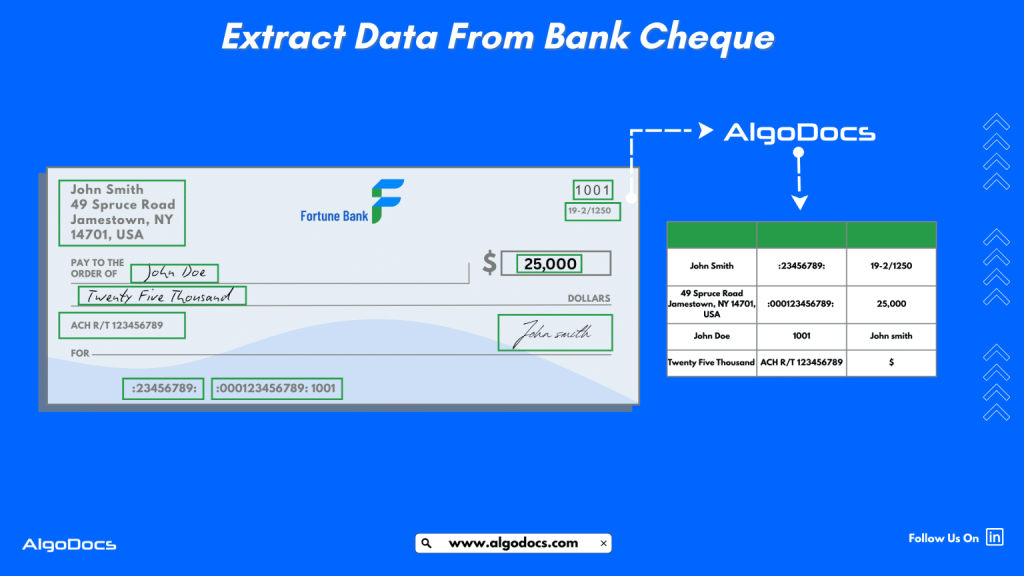
Back to Blog Table of contents On this page Making Bank Cheque Data Extraction Easy: With AI and ML Home › Blog › Algodocs › Making Bank Cheque Data Extraction Easy: With AI and ML Categories Algodocs Tags algodocs bank ocr data extraction from images Finance ocr machine learning ocr api By Shubhankar Biswas Published September 1, 2025, 07:35 Updated July 13, 2026, 09:21 Imagine this: you visit your bank to deposit a cheque, only to find out it’ll take days to process because every data validation and processing from the cheque will be done manually. Frustrating, right? Now, picture a world where that same cheque is scanned, analysed, and processed in seconds—all without a single human hand touching it. That’s the magic of AI, which makes bank cheque data extraction smooth and more efficient. This is technology that’s quietly transforming the way banks operate. In today’s fast-paced digital age, where time is money, automating data extraction from bank cheques has become a necessity for financial businesses. Whether you’re a banker, a business owner, or just someone who occasionally uses cheques, understanding this process can save you time, effort, and headaches. In this blog, we’ll dive deep into what bank cheque data extraction is all about, how it works, and why cutting-edge tools like AI and ML are improving bank cheque data extraction. We’ll also explore challenges associated with bank cheque data extraction and how tools like Algodocs are game-changers for these types of operations. So, let’s get started! What is a Bank Cheque? Before we dive into the world of bank cheque data extraction, we need to understand what a bank cheque is. So, let’s cover its basics. Basically, a bank cheque is like a promise on paper. It’s a document you write and sign, telling your bank to take money from your account and give it to someone else—or even yourself if it’s a self-cheque. Think of it as a secure, old-school way to move money around without carrying cash. Cheques have been around for centuries, and even in today’s world of digital payments, they’re still widely used, especially for big transactions like paying rent, settling bills, or business deals, etc. They’re simple, reliable, and trusted. But processing them manually? That’s where things get slow and messy. That’s why we need smarter solutions—like automated bank cheque data extraction solutions—to keep up with modern demands. So What are the Components of a Bank Cheque? So, what makes up a cheque? It’s not just a random piece of paper—it’s packed with important details that tell the bank what to do. Here’s a quick rundown of the key parts: Payee Name: This refers to the individual, business, or entity receiving the payment. On a cheque, it’s typically written following the phrase “Pay to the order of” on a designated line. Accuracy is key here—any misspelling or incorrect naming could lead to processing issues or the cheque being rejected by the payee’s bank. Amount: The exact sum of money being transferred, recorded in two distinct formats for clarity and security. The courtesy amount is written in numerals (e.g., $50.75) in a box or space provided, making it quick to read. The legal amount is spelled out in words (e.g., “Fifty dollars and 75/100”) on a separate line, serving as the official figure in case of disputes or discrepancies. This dual notation helps prevent alterations or misinterpretation. Date: The specific day the cheque is written or issued, usually entered in a format like MM/DD/YYYY (e.g., 04/04/2025). This is critical because banks may not honor cheques deemed “stale-dated”—typically those older than six months—though policies can vary by institution. Some cheques can also be postdated (dated for a future day), but acceptance depends on the payee and bank. Account Number: A unique identifier assigned to your bank account, printed at the bottom of the cheque as part of the MICR line (Magnetic Ink Character Recognition). This string of digits, often following the routing and cheque numbers, tells the bank which account to debit. The MICR line uses special magnetic ink, enabling automated processing by bank machines for efficiency and accuracy. Routing Number: A 9-digit code that identifies your financial institution within the banking system, also located in the MICR line (usually the first set of numbers). This number ensures the cheque is routed to the correct bank or credit union for processing. It’s standardized across the U.S. by the American Bankers Association (ABA) and is essential for domestic transactions. Cheque Number: A unique serial number assigned to each cheque, typically printed at the top-right corner and/or within the MICR line. This identifier helps you, your bank, and the payee track the specific cheque, especially useful for record-keeping, reconciling accounts, or investigating issues like lost or disputed payments. Signature: Your handwritten authorization, usually placed on a line at the bottom-right of the cheque. This acts as your official approval for the bank to release funds, making it a critical security feature. Without a valid signature matching the one on file with your bank, the cheque is considered invalid and will not be processed. Bank Name and Address: The name and often the physical or mailing address of the financial institution issuing the cheque, printed prominently on the document. This information identifies which bank or credit union is responsible for honoring the payment, providing transparency to the payee and facilitating communication if issues arise during processing. What is Bank Cheque Data Extraction? Bank cheque data extraction is the process of pulling out all those key details—such as the payee’s name, amount, account number, cheque number, and other important information—from a cheque with the help of automated tools or manually by humans. Instead of a bank employee squinting at handwriting or typing numbers into a system, machines do the heavy lifting. It’s like giving the cheque a quick scan, and the computer captures and extracts all the information from a bank cheque. A bank cheque can be a physical paper on which all the details are written,

Scroll to Top