Compliance-First Identity Data Extraction:Protecting Personal Data at Every Step
Extracting identity data from Identity documents such as passports, driving licences, national ID cards, and tax documents is a common process across many industries. Financial institutions, healthcare providers, telecom operators, and HR departments worldwide rely on fast document processing to meet Know Your Customer (KYC), Anti-Money Laundering (AML), age-verification, and right-to-work requirements. However, the growing volume of digital onboarding has introduced a major challenge: protecting personal information. Stolen identity data can expose individuals to privacy risks and enable various forms of financial and digital crime.
A recent article in TIME magazinehighlights that Americans lost nearly $18 billion to financial scams in which criminals exploited personal information to gain access to banking details. A report by the International Monetary Fund (IMF) also explains how personal data can be manipulated and used in financial fraud and other criminal activities.
According to Fortune Business Insights, the global identity verification market reached USD 13.75 billion in 2025 and is projected to grow from USD 15.84 billion in 2026 to USD 50.58 billion by 2034, at a compound annual growth rate (CAGR) of 15.60%. North America accounts for the largest regional share, valued at USD 4.93 billion in 2026. The United States market alone is expected to reach USD 2.93 billion, while the European market is projected to reach USD 3.95 billion, led by Germany at USD 0.72 billion and the United Kingdom at USD 0.58 billion.
At the same time, the financial impact of failing to protect extracted identity data continues to grow. Research compiled from IBM's Cost of a Data Breach reports indicates that the global average cost of a data breach reached USD 4.99 million in 2026, a 12% year-over-year increase. In the United States, the average cost exceeded USD 10.22 million per incident. Adopting a compliance-first architecture for identity data extraction is no longer just an IT security objective. It is a fundamental requirement for business continuity and long-term resilience.
In this article, we will explain what compliance-ready identity data extraction means, how the process works, and which regional data protection regulations help safeguard personal information. We will also cover the key practices to follow when handling sensitive identity data, why compliance-first data extraction matters, what to consider before choosing a KYC or identity data extraction tool, and how AI, intelligent document processing (IDP), and machine learning (ML) can help protect personal data throughout the extraction process.
TL;DR Summary
Compliance-first identity data extraction means building privacy and legal controls into every stage of reading passports, driving licences, and ID cards, rather than adding them later. Extract only the fields you need, process data in the appropriate region, encrypt it, restrict access, delete it according to a defined schedule, and maintain audit logs. The United States relies on sector-specific and state privacy laws. The United Kingdom follows UK GDPR and the Data (Use and Access) Act 2025. Germany applies the Personalausweisgesetz alongside GDPR, while the European Union has GDPR, eIDAS 2.0, AML rules, and the AI Act. Choose a platform that supports data minimisation, signed processing agreements, and human review of exceptions.
What Is Compliance-First Identity Data Extraction?
Compliance-first identity data extraction is the process of using a compliance-ready data extraction platform to capture, extract, and process information from identity documents. These documents may include passports, driving licences, national ID cards, residence permits, and other official identification documents.
A compliance-first identity data extraction process follows regional and international data protection standards. These standards help organisations safeguard personal information when individuals share sensitive identity documents with third-party service providers and data extraction platforms.
Data protection frameworks such as the EU General Data Protection Regulation (GDPR), the Health Insurance Portability and Accountability Act (HIPAA), the California Privacy Rights Act (CPRA), the California Consumer Privacy Act (CCPA), and the Digital Personal Data Protection Act (DPDP Act) are among the laws introduced to protect personal information.
Why Compliance Matters More Than Ever
The growing importance of compliance is closely linked to the type of information people share online and how organisations access it. In the past, identity and personal data were often stored in physical documents. Today, the same sensitive information is commonly stored in digital formats, including PDFs, Excel files, images, Word documents, and databases used by website back-end systems.
People also share personal details, photographs, birthdays, and other information on social media platforms, e-commerce websites, and job portals. If this information is exposed or stolen, criminals can misuse it in many different ways.
A study by Swif reports traditional identity fraud losses of $27.3 billion in 2025. The Identity Theft Resource Center recorded a record 3,322 data compromises, while the Federal Trade Commission (FTC) received more than 1.3 million identity theft reports in 2025, according to Experian's analysis of FTC data.
In the United Kingdom, Cifas Fraudscape 2026 recorded more than 444,000 cases in 2025. More than 242,000 involved identity fraud, accounting for 54% of the total. Cifas has also warned that criminals are using AI to create fake identities and forge documents that can bypass onboarding checks, as Identity Week reported.
Data breach costs add further pressure. IBM's 2025 report, covered by CyberScoop, found that the average cost of a breach in the United States reached $10.22 million, while the global average was $4.44 million. Organisations using extensive AI and automation saved an average of $1.9 million per breach, according to Swif's breach summary.
How Compliance-First Identity Data Extraction Works
A non-compliant data extraction workflow may focus only on capturing information from a document, without protecting confidential data throughout the process. A compliance-first data extraction model, in contrast, follows a defined data protection and security framework. It helps prevent unauthorised users from accessing, changing, or misusing personal information. Here is how a compliance-first identity data extraction workflow works.
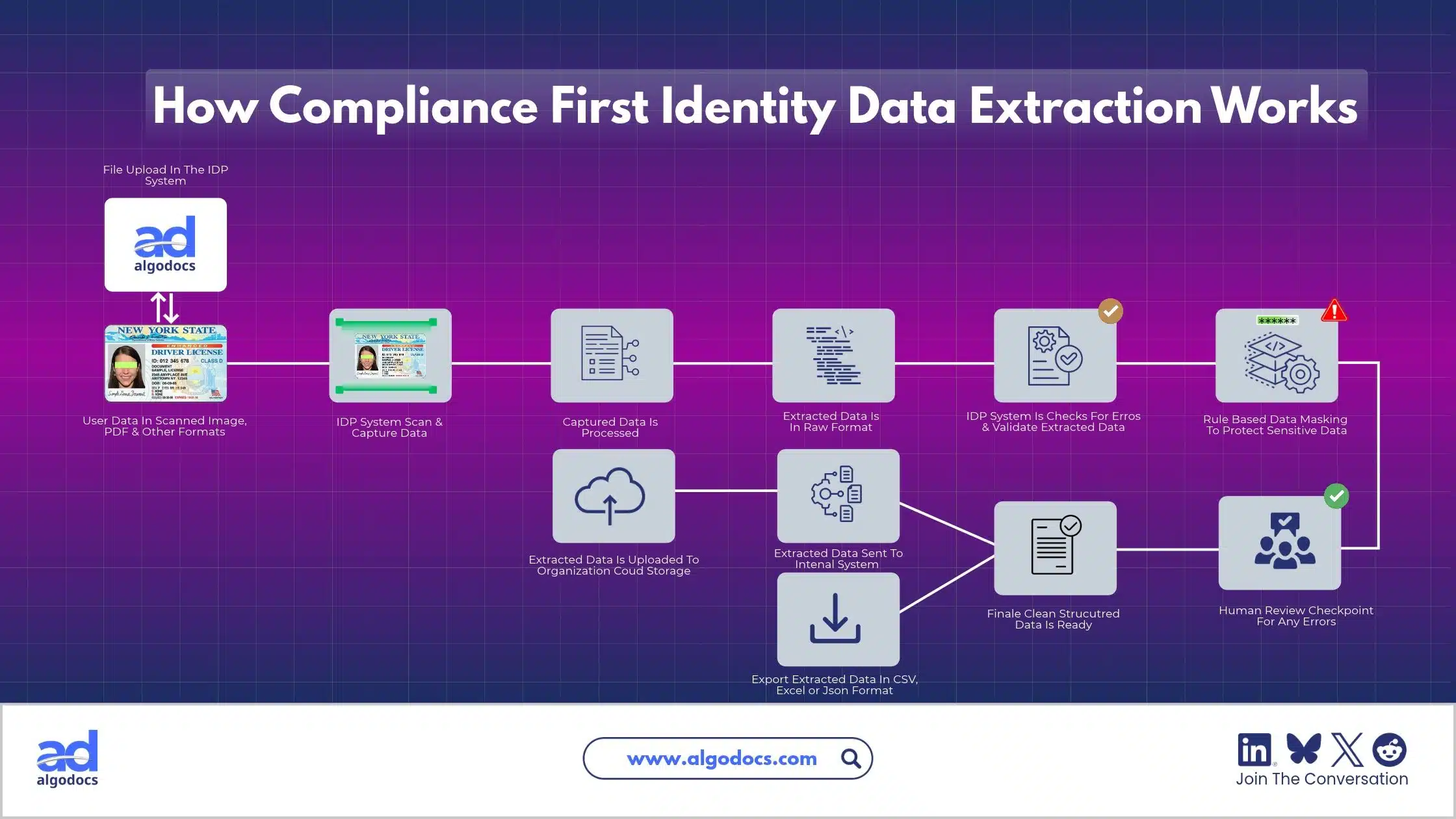
Acquiring Unstructured Data
Unstructured data may arrive as PDFs, images, Word documents, handwritten notes, or scanned files. These files may contain passports, driving licences, tax documents, ID cards, or other sensitive records.
Uploading Files to a Compliance-First AI Data Extraction Platform
Once the unstructured data is available in PDF, image, or another supported format, the files are uploaded to a compliance-ready AI data extraction and automation platform.
Scanning Unstructured Documents
After the file is uploaded, the AI document processing platform uses optical character recognition (OCR) to scan the document and identify its layout and content.
Capturing the Data
Once the scanning process is complete, the AI document processing platform identifies and captures the required information from the document.
Converting Captured Data into a Structured Format
After the information is captured, the AI system converts it into a structured format that the document processing platform can analyse, validate, and use in downstream workflows.
Checks and Validation
The extracted data is checked and validated using AI, ML, and IDP capabilities to identify anomalies, inconsistencies, and possible errors. If the system detects an issue, it can trigger a warning and pause the workflow for further review. If the data passes the validation checks, it moves to the next stage.
Rule-Based Data Masking
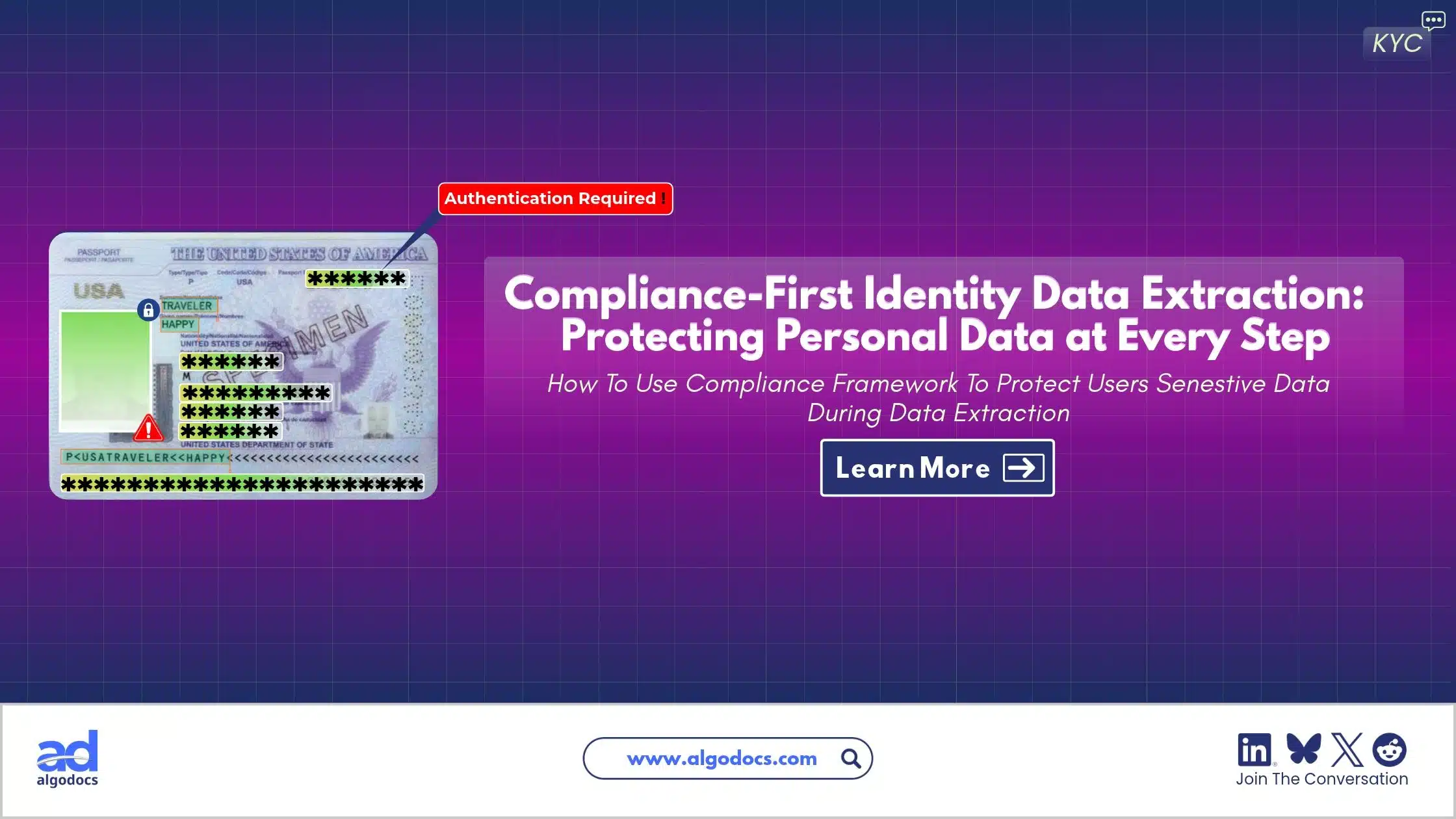
After the checks and validation are complete, the AI and IDP system can mask sensitive information according to the data protection rules configured on the platform. Depending on the user's requirements, this may include bank account details, passwords, Social Security numbers, passport numbers, and other sensitive fields.
Human Review Checkpoints
At this stage, users or authorised employees can review the extracted data and check whether any corrections are needed. After rule-based masking, sensitive information remains hidden from users who do not have the required access permissions.
Export and Third-Party Automation
Once the final review is complete, the extracted data is ready to be exported in formats such as Excel, CSV, or XML. Organisations can also send the extracted information to connected business systems through AI automation and third-party integrations.
The Regional Rulebook for Identity Data Extraction
Countries around the world have introduced data protection and privacy laws to protect personal information from online theft, misuse, and financial fraud. These laws establish requirements for how organisations collect, store, process, and share customer data. Here are some of the major regulations that affect identity data extraction.
United States: A Patchwork of Federal and State Rules
The United States does not have one comprehensive federal privacy law covering all identity documents and personal data. Instead, organisations must consider a combination of sector-specific and state-level requirements. States such as California have introduced privacy laws, while other states have adopted their own approaches. Financial institutions must also follow Know Your Customer (KYC) and customer identification requirements. State laws such as the California Consumer Privacy Act give residents rights to know, delete, and limit the use of certain sensitive personal information. Illinois' Biometric Information Privacy Act (BIPA) adds consent and retention requirements when biometric identifiers, such as face geometry, are collected. This is particularly relevant when a verification process compares a selfie with a photograph on a driving licence.
United Kingdom: UK GDPR, ICO Guidance and Digital Verification
The UK General Data Protection Regulation (UK GDPR) and the Data Protection Act 2018 set out how organisations must collect, process, store, use, and share personal information. The Data Protection Act 2018 supplements the UK GDPR with additional requirements for protecting personal data. Together, these laws cover information such as names, email addresses, phone numbers, bank details, IP addresses, and identity documents. Organisations need a lawful basis for processing personal data, must be transparent about how they use it, and must apply appropriate security measures while respecting individuals' privacy rights. For serious infringements, fines can reach £17.5 million or 4% of global annual turnover, whichever is higher.
The Data Act 2025(Use and Access) adds a framework for digital verification services, including a government register and a trust mark. UK organisations should check whether their providers are registered where relevant. The framework is intended to make digital identity verification easier, more affordable, and more secure.
Germany: GDPR Plus the Personalausweisgesetz
The General Data Protection Regulation(GDPR) and Germany's Personalausweisgesetz (PAuswG), or Identity Card Act, govern the protection and processing of personal information and the use of German national identity cards. GDPR sets out rules for collecting, processing, storing, and sharing personal data. The Personalausweisgesetz regulates the issuance, use, electronic identification, and processing of information from German identity cards. It also restricts how organisations and individuals may collect, copy, store, and share identity card information. Businesses must have a lawful basis for processing personal data, obtain consent where required, protect identity information, and meet applicable security obligations. These rules are especially relevant to organisations handling German identity cards and other personal identification documents.
European Union: GDPR, eIDAS 2.0, AML Rules and the AI Act
The European Union's GDPR ,eIDAS 2.0, Anti-Money Laundering (AML) rules, and AI Act establish a regulatory framework for protecting personal data, supporting trusted digital identities, and reducing financial crime. GDPR governs how organisations collect, process, store, and share personal information. eIDAS 2.0 provides a framework for secure digital identities, electronic identification, electronic signatures, and the European Digital Identity Wallet. Businesses covered by AML requirements must verify customer identities, conduct customer due diligence (KYC), monitor suspicious transactions, and help prevent money laundering and terrorist financing. The AI Act establishes rules for developing and using artificial intelligence systems through a risk-based approach. Its requirements for transparency, safety, accountability, and human oversight depend on the level of risk posed by the AI system. Together, these regulations are particularly relevant to businesses handling identity documents, financial records, customer information, and AI-powered document processing.
The AI Act timeline has changed.Regulation (EU) 2026/1744, known as the Digital Omnibus, entered into force on 27 July 2026 and moved the Annex III obligations for standalone high-risk systems to 2 December 2027. Annex III includes certain biometric identification uses, so any face-matching step needs careful classification. Plain text extraction generally falls outside that specific category, but organisations should assess each use case and consult their legal teams. Fines for certain high-risk violations can reach EUR 15 million or 3% of global turnover, according to Legiscope.
Regional Comparison at a Glance
| Region | Core rules | What it means for identity data extraction |
| United States | State privacy laws, BIPA, DPPA, and KYC rules | Requirements vary by state; check consent and biometric rules |
| United Kingdom | UK GDPR, DPA 2018, DUA Act 2025, and ICO guidance | Biometric data used for identification may be special category data |
| Germany | GDPR, BDSG, and Personalausweisgesetz | Identity card copies are subject to specific requirements, including consent where applicable |
| European Union | GDPR, eIDAS 2.0, AML rules, and the AI Act | Minimise data, sign processor agreements, and classify AI use |
Challenges of Compliance-Ready Identity Data Extraction
Even after building a compliance-ready data extraction platform, organisations and users may still face several challenges.
- Document variety. Document formats can vary by state, country, and issuing authority. An article by Algodocs on the challenges of ID card extraction explains that regional document differences are among the major hurdles in identity document processing.
- Over-collection. Extracting every available field and retaining every document image may be easy, but it is rarely necessary. Collecting more information than required also increases the potential impact of a data breach.
- Different legal requirements. Germany places specific conditions on copying identity cards, the UK treats biometric data used for identification as special category data, and requirements in the United States can vary by state.
- Data residency. Parseur's GDPR guide explains that keeping EU data within the European Economic Area (EEA) during extraction can reduce reliance on complex international data transfer mechanisms.
- Vendor model training. The same guide warns that some platforms may reuse customer data to train shared models, which can create GDPR and data protection risks. Organisations should confirm how each provider uses customer data.
- Forgery and AI-generated fakes. Without appropriate validation, an identity data extraction system may accept convincing forged or AI-generated documents and pass inaccurate information into business systems.
How to Extract Identity Data the Compliance-First Way
Follow these eight steps when extracting data from identity documents.
- Define the purpose and lawful basis. Document why you need the identity document, which law requires or permits the processing, and whether a data protection impact assessment is necessary. Processing biometric data may require additional assessment.
- Map documents and fields. List the fields each process genuinely needs. A KYC check may require a name, date of birth, document number, and expiry date, but it may not need an address or personal identification number.
- Choose the processing region and provider. Where possible, choose a processing region appropriate for your users and regulatory obligations. Sign a data processing agreement and review the provider's subprocessor list.
- Capture documents securely. Use encrypted file uploads and avoid sending identity document images through ordinary email. Where German identity card copies are involved, follow the applicable rules for consent and marking copies.
- Extract and validate information. Combine OCR with checks such as machine-readable zone (MRZ) checksums, barcode cross-checks, date logic, and document-specific format rules.
- Review exceptions with minimal exposure. Send only low-confidence fields or flagged records to authorised reviewers (Human In the Loop), and mask information that they do not need to see.
- Store, restrict, and delete data. Encrypt stored information, grant access according to user roles, set retention periods, and delete document images when they are no longer required.
- Monitor and demonstrate compliance. Maintain audit logs, respond to access and deletion requests, test incident response procedures, and review the process regularly.
How IDP, AI and ML Make Compliance Easier
Intelligent document processing (IDP), artificial intelligence (AI), and machine learning (ML) can support compliance-first identity data extraction by bringing file ingestion, classification, extraction, validation, and export together in a controlled workflow.
AI and ML can strengthen the identity data extraction process in several ways:
- Classification identifies the document type so the appropriate template and validation rules can be applied.
- OCR enhanced with machine learning can read different document layouts, fonts, and image quality levels more effectively than fixed templates alone.
- Confidence scoring sends only uncertain fields to a human reviewer (Human In the Loop).
- MRZ and barcode parsing produce structured values that can be checked against document rules.
- Anomaly detection flags inconsistent dates, altered fonts, and values that do not make sense.
- Masking and redaction hide fields that a process or reviewer does not need.
Automation can also improve security outcomes. IBM research found that AI and automation reduced breach costs by an average of $1.9 million. The average time to identify and contain a breach was 241 days, as CyberScoop reported. Keep people involved in exception handling, and document which models you use and why.
How to Safeguard Sensitive Identity Data
- Encrypt data throughout the process. Use TLS to protect information in transit and strong encryption to protect stored data. The Information Commissioner's Office (ICO) expects organisations to apply appropriate security measures to biometric data.
- Minimise and mask information. Collect only the fields you need, hide unnecessary details, and avoid retaining full document images when a field value is sufficient.
- Control access. Use role-based access controls, single sign-on, and short-lived credentials. Log access events, including document views and data exports.
- Limit data retention. Set separate deletion periods for document images and extracted fields, based on the legal and business requirements that apply.
- Prohibit unauthorised secondary use. Confirm in writing that your provider will not use your documents to train models unless you have explicitly authorised that use and it is legally permitted.
- Prepare for security incidents. Practise detection, response, and notification procedures. A timely response can help limit the impact and cost of a breach.
Choosing a Tool: What a Compliance-Ready Platform Needs
| Capability | Why it matters | Question to ask a vendor |
| Field-level extraction | Supports data minimisation | Can we choose which fields to extract and export? |
| Data processing agreement | Required under GDPR Article 28 where applicable | Will you sign an agreement and provide a list of subprocessors? |
| Encryption and certifications | Demonstrates security practices | Do you encrypt data in transit and at rest, and what certifications do you hold? |
| Retention controls | Supports storage limitation | Can we configure deletion periods for document images and extracted data? |
| Validation and review | Helps reduce fraud and extraction errors | Do you offer validation checks, confidence scores, and human review steps? |
| No model training on customer data | Helps prevent unauthorised secondary use | Is our data excluded from model training by default? |
How Algodocs Extracts Identity Data with a Compliance-Ready Approach
Algodocs is an AI-native document intelligence and automation platform that processes identity documents and other business files using AI agents and machine learning models. Its passport document processing capabilities can capture details such as names, passport numbers, countries of origin, and machine-readable zone (MRZ) information across supported formats. The platform also offers key-value pair extraction, document classification, validation checks, and custom model training using a small set of labelled documents. Algodocs follows EU GDPR and HIPAA-related data protection practices to help safeguard personal information and prevent unauthorised access or use. Organisations should review the platform's current privacy and security documentation to understand the specific controls and commitments that apply to their use case.
Key Highlights of Algodocs' Compliance-First Data Extraction Approach
- Data masking: Algodocs supports data masking during the extraction process, helping prevent unauthorised users from viewing sensitive personal information.
- Data minimisation: You can control which fields the platform extracts. This allows you to focus on the information required for a specific workflow and exclude sensitive fields that are not needed.
- Validation: AI-based validation can help identify compromised, inconsistent, or potentially fraudulent data. Data matching and validation features can also help cross-check extracted information against an approved data source, where configured.
- Security: Encrypted data transfer and ISO 27001-related controls support the platform's technical security measures. Review the relevant documentation for details about the scope of certification and controls.
- Purpose limitation: Algodocs' stated commitment not to reuse or resell customer data supports responsible data handling. Review the applicable terms and privacy documentation for the exact commitments.
- AI, ML For Agents: Algodocs use AI, machine learning and AI agents for automating document processing which delivers unmatched accuracy.
Expert Tips
Treat the identity document image as a temporary input and the extracted fields as the working record. Use separate encryption keys for image storage and extracted data so that a single security incident is less likely to expose both. Use 2FA authentication method to make your login more secure. Review the classification of AI features whenever you introduce a new processing step.
Conclusion
Compliance-first identity data extraction is essential for protecting sensitive personal information from digital theft, misuse, and financial fraud. The growth of AI has introduced new risks, including more convincing fake identities and forged documents. At the same time, AI and ML can help organisations and government agencies detect suspicious activity and strengthen identity verification. Organisations must invest in secure data extraction workflows and identity protection frameworks. Before choosing an identity data extraction platform, businesses should understand whether it follows the relevant data protection, privacy, and security requirements.
When you define the purpose first, extract only the information you need, process data in the appropriate region, validate the results, and delete information according to a clear schedule, you can reduce both legal exposure and fraud risk. Platforms such as Algodocs bring agentic AI and IDP capabilities into document workflows, while supporting structured data extraction and controlled data handling.
Note: Always review the platform's documented security measures and privacy commitments before processing sensitive identity information.
Key Takeaways
- Identity fraud and data breach costs make careless identity data extraction expensive.
- The United States, United Kingdom, Germany, and European Union each have distinct rules that affect identity document processing.
- Biometric identification generally carries stricter requirements than ordinary text extraction.
- Follow eight steps, from defining the purpose and lawful basis to monitoring the process.
- Use IDP, AI, and ML for document validation, data masking, and exception handling.
- Choose providers with appropriate processing agreements, encryption, relevant certifications, clear retention controls, and transparent policies on model training.
Frequently Asked Questions
Is extracting data from a passport legal under GDPR?
Yes, provided you have a lawful basis, a clear purpose, data minimisation measures, appropriate security controls, and transparency. Verification duties under AML rules may provide a lawful basis in some circumstances.
Is OCR text extraction considered biometric processing?
Usually not. Reading printed text and MRZ lines is generally the processing of personal data, rather than biometric identification. Face matching is different and may trigger special category data requirements in the UK and EU.
Does the EU AI Act apply to identity data extraction?
It depends on the system's purpose and functionality. Certain biometric identification uses are listed as high-risk under Annex III. Text extraction alone will not usually fall into that specific category, but each feature and use case should be assessed separately.
How long should I retain identity data?
It depends on the system's purpose and functionality. Certain biometric identification uses are listed as high-risk under Annex III. Text extraction alone will not usually fall into that specific category, but each feature and use case should be assessed separately.