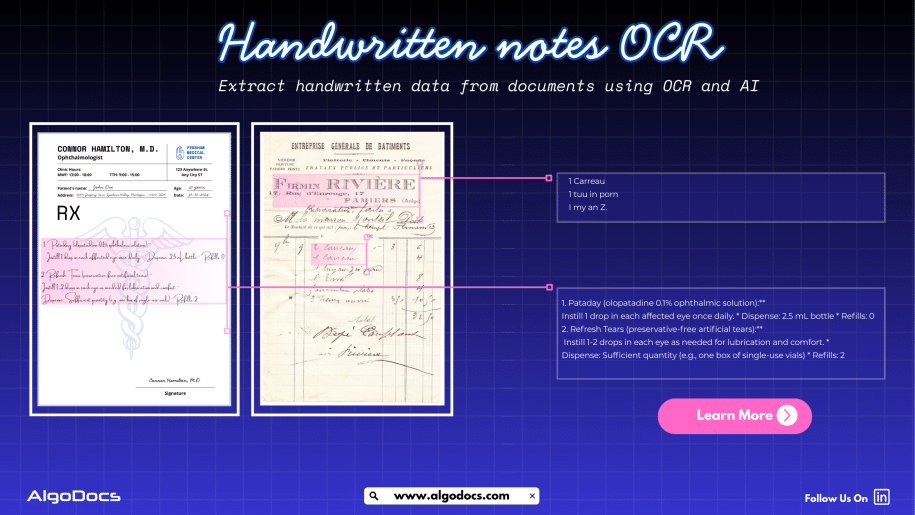
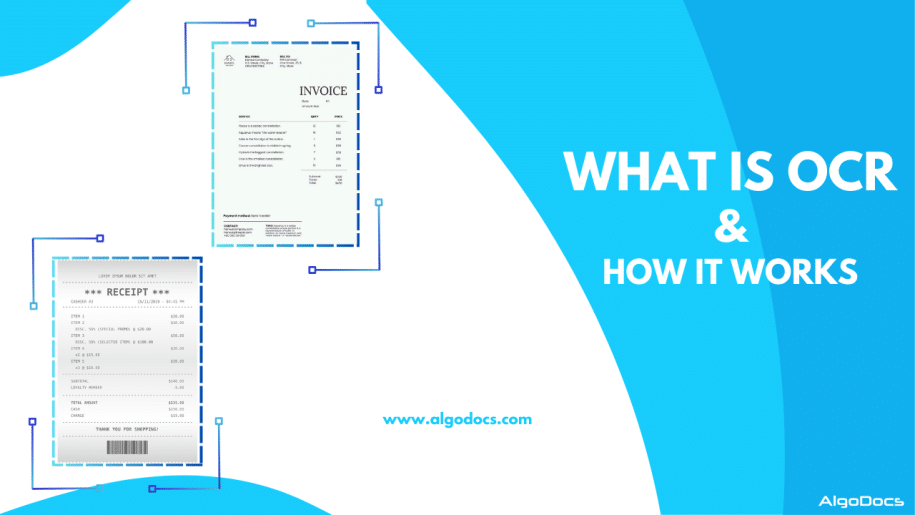
What is OCR and How Does it Work? A Comprehensive Guide to Understand Optical Character Recognition
Back to Blog Table of contents On this page What is OCR and How Does it Work? A Comprehensive Guide to Understand Optical Character Recognition Home › Blog › Algodocs › What is OCR and How Does it Work? A Comprehensive Guide to Understand Optical Character Recognition Categories Algodocs Tags data extraction guide machine learning OCR ocr api By Shubhankar Biswas Published September 1, 2025, 09:29 Updated July 21, 2026, 05:24 When it comes to data extraction, you have multiple options, including IDP, OCR, ICR, and more. OCR (Optical Character Recognition) is a widely used technology for extracting data from various types of documents, such as PDFs, scanned images, and Word files. While manual data extraction methods like copy-pasting are still used, they are less reliable and can be time-consuming. In today’s data-driven business landscape, effective data extraction tools have become essential for successful decision-making. This comprehensive guide delves deep into the world of OCR, exploring its intricacies, applications, benefits, and other aspects. Whether you’re a seasoned tech enthusiast or just starting to explore the possibilities of data extraction, this article will provide you with a thorough understanding of OCR and how it can revolutionize your data management processes. What is OCR? OCR is a technology that converts different types of documents, such as scanned papers, PDF files, or images, into editable machine-readable text. In simpler terms, it can extract unstructured data from scanned images, PDFs, and Word files into a structured data format. Imagine a super-efficient assistant who can tirelessly read through piles of documents and convert them into a format your computer can understand. Consider this scenario: you have a mountain of invoices in various formats – some are printed, some are handwritten, and others are even photographs of documents. Manually entering all that data into your system would be a logistical nightmare, prone to errors and incredibly time-consuming. OCR simplifies this process by automatically extracting the text from these documents, saving you countless hours and resources. History of OCR The history of Optical Character Recognition (OCR) is a fascinating journey that spans over a century, evolving from early mechanical devices to sophisticated artificial intelligence-powered systems. In the early 1900s, pioneers like Emanuel Goldberg envisioned machines that could read characters and convert them into telegraph code, marking the first steps towards OCR. These early efforts focused on specialized tasks like reading specific fonts or recognizing machine-readable characters. The mid-20th century witnessed significant advancements with the development of electronic computers. Researchers began exploring ways to use computers to analyze images and recognize patterns, laying the foundation for modern OCR technology. Early OCR systems were limited in their capabilities, often struggling to recognize complex fonts, handwritten text, and low-quality images. However, with the rise of artificial intelligence and machine learning in the late 20th and early 21st centuries, OCR technology experienced a dramatic transformation. Researchers developed sophisticated algorithms that could learn to recognize patterns in text, adapt to different fonts and styles, and even handle handwritten input. These advancements have led to significant improvements in accuracy, speed, and reliability, making OCR a valuable tool in various applications. Today, OCR technology is widely used in a variety of fields, including data entry, document management, archival research, and accessibility for the visually impaired. From digitizing historical documents to automating invoice processing, OCR plays a crucial role in streamlining workflows and improving efficiency across numerous industries. As technology continues to evolve, we can expect further advancements in OCR, such as improved accuracy for handwritten text, support for more languages, and integration with other emerging technologies like natural language processing and computer vision. These advancements will further expand the potential of OCR, making it an even more powerful and indispensable tool in the digital age. How Does OCR Work? At its core, OCR technology mimics the human process of reading. It analyzes the structure of an image, identifies characters, and then converts them into machine-encoded text. This seemingly simple process involves several intricate steps: Image Pre-processing: Before the actual character recognition takes place, the input image is prepared for analysis. This often involves techniques like noise reduction, skew correction, and binarization to remove unwanted artifacts, straighten the image, and enhance contrast. Character Segmentation: Once the image is pre-processed, it’s divided into individual characters or glyphs. This step is crucial for accurate recognition, as it isolates each character for subsequent analysis. Feature Extraction: In this step, unique features of each character are extracted and analysed. These features might include lines, curves, loops, and other distinguishing characteristics that differentiate one character from another. Character Recognition: The extracted features are then compared to a database of known characters. The system uses sophisticated algorithms, often based on machine learning or neural networks, to determine the closest match for each character. Post-processing: The recognized text is further refined to correct any errors and improve accuracy. This may involve using dictionaries, contextual analysis, grammatical rules, or even machine learning algorithms to identify and correct misspellings, incorrect spacing, or other inconsistencies. The Benefits of OCR OCR offers a multitude of benefits across various industries and applications, but here are some of the essential benefits that suit all industry and business needs: Improved Efficiency: OCR automates data entry, eliminating the need for manual input and freeing up valuable time and resources that can be redirected to more strategic tasks. This eventually improves work efficiency and allows you to focus on more important work. Reduced Costs: By automating manual tasks, OCR can significantly reduce labor costs associated with data extraction. This can lead to substantial cost savings, especially for organizations that handle large volumes of documents. Enhanced Accuracy: OCR systems can achieve high accuracy rates, minimizing errors associated with manual data extraction. This ensures data integrity and reliability. Better Searchability: OCR converts scanned documents and images into searchable text, making it easier to find information within large volumes of data. This can significantly improve information retrieval and knowledge management. Improved Data Management: OCR helps organize and manage data more efficiently. By converting unstructured data into structured formats, OCR facilitates data analysis, reporting, and decision-making.