Algodocs

ocr api

Algodocs

What Is Intelligent Document Processing (IDP) and How Can It Revolutionize Your Business in 2026?

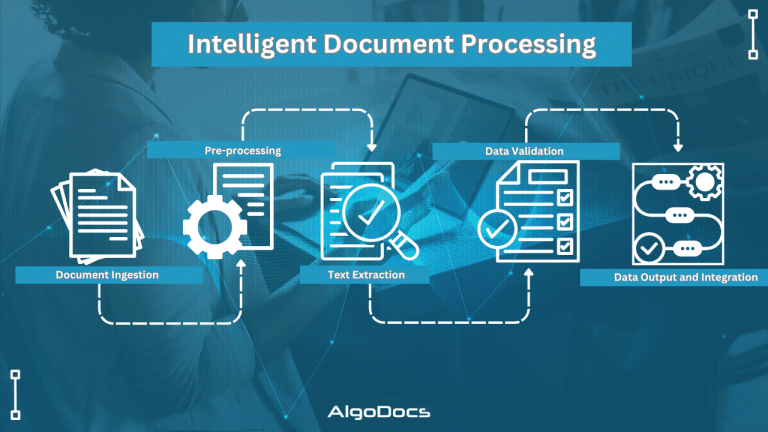
Back to Blog Table of contents On this page What Is Intelligent Document Processing (IDP) and How Can It Revolutionize Your Business in 2026? Home › Blog › Algodocs › What Is Intelligent Document Processing (IDP) and How Can It Revolutionize Your Business in 2026? Categories Algodocs Tags ai platform for data extraction algodocs deep learning guide IDP intelligent document processing machine learning ocr api By Shubhankar Biswas Published October 12, 2025, 18:51 Updated July 13, 2026, 06:16 In today’s digital age, data is crucial for every organization. However, a significant portion of this data resides within unstructured documents, such as contracts, invoices, forms, emails, and more. Manually processing data from these documents is time-consuming, error-prone, and costly for any business. Intelligent Document Processing (IDP) has emerged as a game-changing solution by leveraging the power of artificial intelligence (AI) and machine learning (ML). Document workflows and data extraction from these unstructured documents have become very easy. This comprehensive guide will explore the landscape of IDP platforms, their benefits, how they can be applied across various industries, key considerations for choosing an IDP solution, emerging trends, and how Algodocs can empower your business. What is Intelligent Document Processing (IDP)? A Deep Dive The IDP (Intelligent Document Processing) market is expected to reach $46.59 billion USD by the end of 2035, according to a report. As businesses heavily rely on, extraction, sorting, and managing data. These types of operations require a robust and reliable tool to that can provide useful insights about business metrics. That’s why the need for intelligent document processing tools is rising day by day. So, what is intelligent document processing? IDP is a sophisticated technology that automates the extraction, classification, and processing of data from various document types, regardless of format or structure. It achieves this by combining several core technologies: Optical Character Recognition (OCR): OCR converts images of text into machine-readable text. Modern OCR, often referred to as Intelligent Character Recognition (ICR), goes beyond basic character recognition by using deep learning models like Convolutional Neural Networks (CNNs) and Recurrent Neural Networks (RNNs). This allows it to handle complex layouts, handwritten text, low-quality images, multiple languages, and specialized fonts used in industries like healthcare (medical prescriptions) and law (legal documents). Accuracy is often measured using metrics like character error rate (CER) and word error rate (WER), with advanced systems achieving very low error rates. Natural Language Processing (NLP): NLP analyzes the extracted text to understand its meaning and context. It employs techniques like tokenization (breaking text into individual words or phrases), stemming and lemmatization (reducing words to their root form), Named Entity Recognition (NER) (identifying specific entities like names, dates, and locations), Part-of-Speech (POS) tagging (identifying the grammatical role of each word), sentiment analysis (determining the emotional tone of the text), topic modelling (discovering underlying topics within a collection of documents), text summarization (creating concise summaries of longer texts), relationship extraction (identifying relationships between entities), and semantic analysis (understanding the meaning of words and phrases in context). Machine Learning (ML): ML is the engine that drives IDP’s adaptability and continuous improvement. Supervised learning involves training the system on labelled data to recognize specific document types and extract relevant fields. Unsupervised learning helps discover patterns and structures in unlabelled data for improved classification and clustering. Reinforcement learning allows the system to learn through feedback and iterative improvement. Training data quality and quantity are crucial for model accuracy. Techniques like cross-validation and hyperparameter tuning are used to optimize model performance. Active learning allows the system to request human input for ambiguous cases, further improving its accuracy over time. Computer Vision: Computer vision enables IDP to “see” and interpret visual elements within documents. Techniques like image classification (categorizing images), object detection (identifying specific objects within images), image segmentation (dividing an image into multiple segments), table and form extraction (accurately extracting data from structured tables and forms), barcode and QR code recognition (automating data capture from barcodes and QR codes), signature verification (authenticating signatures), and logo detection (identifying company logos) are used. Robotic Process Automation (RPA): RPA acts as the orchestrator for IDP workflows, automating downstream processes based on the extracted data. It integrates IDP with other enterprise systems like CRM, ERP, and ECM, automating data validation, routing documents to appropriate departments, and triggering subsequent actions. IDP Workflow: A Detailed Breakdown: Document Ingestion: Documents are ingested through various channels: scanning, uploading files, APIs, email attachments, and more. Pre-processing: Images are optimized for OCR through techniques like noise reduction, skew correction, and image enhancement. OCR and Text Extraction: OCR extracts text from the document. NLP and Data Understanding: NLP analyzes the extracted text. Data Extraction and Validation: Relevant data is extracted and validated against predefined rules or databases. Human-in-the-Loop (HITL): Human reviewers handle exceptions and complex cases where the system has low confidence. Data Output and Integration: Extracted data is delivered in structured formats (CSV, JSON, XML) or directly integrated into business applications. The Benefits of IDP: Quantifiable Impacts Efficiency Gains: IDP can dramatically reduce document processing time, often by up to 90%. For example, processing hundreds of invoices that previously took several days can be completed in just a few minutes or hours. This increased throughput allows businesses to handle higher volumes of documents without increasing staffing. Cost Reduction: By eliminating manual data entry and reducing errors, IDP can lower operational costs by up to 70%. Reduced rework, fewer errors requiring correction, and optimized resource utilization contribute to significant cost savings. Accuracy Improvement: IDP achieves data extraction accuracy rates of 99% or higher, significantly minimizing data entry errors and improving data quality and consistency. This reduces costly downstream errors and improves compliance. Enhanced Security and Compliance: IDP systems offer robust security features like data encryption, access control, and audit trails, ensuring compliance with data privacy regulations like GDPR, HIPAA, and others. Improved Customer Experience: Faster processing times translate to quicker service delivery, leading to improved customer satisfaction. For example, faster loan approvals or insurance claims processing can significantly enhance the customer
Healthcare

Healthcare Data Extraction: Improving Healthcare Document Workflow with AI and IDP In 2025: A Case Study

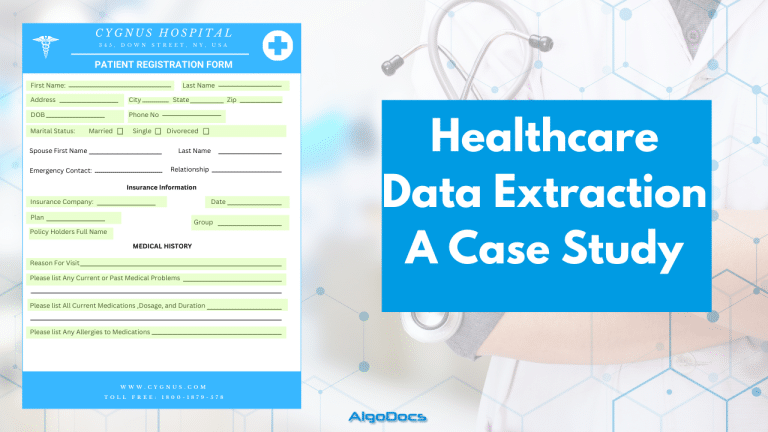
Back to Blog Table of contents On this page Healthcare Data Extraction: Improving Healthcare Document Workflow with AI and IDP In 2025: A Case Study Home › Blog › Healthcare › Healthcare Data Extraction: Improving Healthcare Document Workflow with AI and IDP In 2025: A Case Study Categories Healthcare Tags algodocs data extraction deep learning healthcare intelligent document processing machine learning ocr api By Shubhankar Biswas Published October 12, 2025, 16:30 Updated July 20, 2026, 10:11 Healthcare data extraction has always been a challenge for hospitals, healthcare providers, and insurance companies. Extracting data from multiple documents was a complex task. However, the advent of AI and Intelligent Document Processing (IDP) technologies has significantly impacted how the healthcare industry processes data from various healthcare documents. The healthcare industry is a vast sea of data. Every patient interaction, medical procedure, and insurance claim relies on information. This data, locked within various document formats, holds immense potential to improve patient care, streamline healthcare operations, and drive innovation. However, extracting this valuable information from diverse healthcare documents has traditionally been laborious, error-prone, costly, and inefficient. This is where technologies like IDP, AI, Machine Learning (ML), Large Language Models (LLM), and Optical Character Recognition (OCR) come into play. With these innovative technologies, we have improved data extraction for the healthcare industry. According to a recent report, the healthcare industry is a USD 5,862.1 billion industry and is expected to reach USD 9,245.8 billion by 2033. Another report by Deloitte suggests that AI technologies can save USD 360 billion in costs in the USA by next year. The healthcare industry generated up to 2.3 zettabytes of data worldwide in 2020. In this blog, we will discuss how AI is changing data extraction for the healthcare industry across the globe and the technologies and tools behind this technological advancement. The Diverse Landscape of Healthcare Documents The healthcare industry is inundated with various documents, each containing critical information crucial for patient care, administration, and research. Understanding these documents is the first step in effectively leveraging data extraction. Let’s delve into the key document types: Medical Bills Medical bills are more than just invoices; they are detailed records of services rendered to a patient. They contain crucial information, including: Patient Demographics: First Name, Last Name, address, date of birth, insurance, and other crucial details. Provider Information: Name, address, National Provider Identifier (NPI), etc. Service Details: Procedure codes (CPT/HCPCS), diagnosis codes (ICD-10), dates of service, quantities, and descriptions. Charges and Payments: Itemized charges, adjustments, insurance payments, patient responsibility, payment methods, tax details, etc. Efficiently extracting data from medical bills is vital for revenue cycle management, claims processing, cost analysis, and identifying trends in healthcare spending. Accurate data extraction ensures timely reimbursements, reduces claim denials, and provides insights into cost-effective care delivery. Handwritten Bills Despite the growing adoption of Electronic Health Records (EHRs), handwritten bills persist in many healthcare settings, particularly in smaller practices or during field visits. Many developing Asian countries, as well as developed countries, still rely on handwritten bills. These bills often contain information such as: Patient Information: Basic details like first name, last name, sometimes age or contact information, dates, etc. Treatment Details: Brief descriptions of services provided, often in abbreviated form. Charges: Handwritten amounts for each service or an overall total. Extracting data from handwritten bills presents a unique challenge due to variations in handwriting styles, abbreviations, and the potential for smudges or illegible entries. Advanced OCR coupled with Natural Language Processing (NLP) is essential for accurate data extraction from these documents. Patient Forms Patient forms are the cornerstone of patient intake and data collection. They gather essential information that forms the basis of a patient’s medical record. Sometimes these forms are filled with handwritten data, which presents a challenge for data extraction. Though the majority of patient forms are computer-generated, in many cases, they are handwritten. Common types of patient forms include: Registration Forms: Collect basic demographics, insurance information, and emergency contacts. Medical History Forms: Document past illnesses, surgeries, allergies, medications, and family history. Consent Forms: Obtain patient authorization for treatment, procedures, or release of information. HIPAA Forms: Ensure compliance with the Health Insurance Portability and Accountability Act regarding patient privacy. These forms often contain valuable information such as first name, last name, address, body weight, blood group details, current health issues, and previous diagnoses. They often contain a mix of structured (checkboxes, multiple-choice) and unstructured (free-text) data. Effective data extraction from these forms relies on advanced form recognition and NLP techniques to capture both types of information accurately. Health Insurance Documents Health insurance documents, including Explanation of Benefits (EOBs) and insurance cards, are crucial for understanding a patient’s coverage, verifying eligibility, and processing claims. They contain: Insurance Cards: Provide member ID, group number, plan type, contact details, and other information. Explanation of Benefits (EOBs): Detail how a claim was processed, including allowed amounts, co-pays, deductibles, and reasons for any denials. Data extraction from insurance documents enables accurate billing, reduces claim rejections, and helps patients understand their financial responsibilities. It also provides valuable data for insurance companies to analyze utilization patterns and manage risk. Other Vital Documents Beyond these core document types; the healthcare ecosystem encompasses a multitude of other documents: Lab Reports: Contain results of diagnostic tests, including blood work, imaging, and pathology reports. Prescription Forms: Detail medication name, dosage, frequency, and refill information. Referral Forms: Facilitate specialist consultations and continuity of care. Discharge Summaries: Provide a comprehensive overview of a patient’s hospital stay, including diagnosis, treatment, and follow-up instructions. Clinical Notes: Document physician observations, assessments, and treatment plans. Each document plays a unique role in patient care and administration. This diverse range provides a holistic view of a patient’s journey, enabling better care coordination, research, and population health management. How AI, ML, and IDP Leverage Healthcare Data Extraction The traditional approach to extracting data from these diverse healthcare documents has been manual data entry, a process fraught with challenges. However, the emergence of AI, ML, and IDP has revolutionized data extraction, offering a more efficient, accurate, and scalable solution. Try Algodocs AI data extraction platform to extract data from variou types of documents. Sign up

ID Card Data Extraction
Algodocs

ID Card Data Extraction: Transforming Identity Verification with AI and OCR In 2025

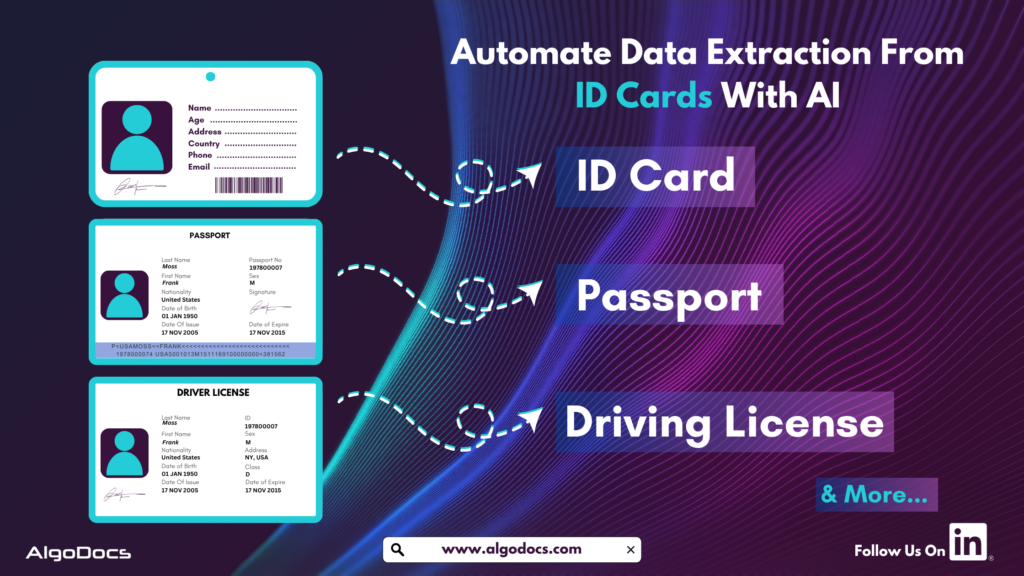
Back to Blog Table of contents On this page ID Card Data Extraction: Transforming Identity Verification with AI and OCR In 2025 Home › Blog › Algodocs › ID Card Data Extraction: Transforming Identity Verification with AI and OCR In 2025 Categories Algodocs Tags ai platform for data extraction algodocs character recognition data extraction from images id card data extraction machine learning ocr api By Shubhankar Biswas Published September 1, 2025, 09:46 Updated July 10, 2026, 11:57 ID cards are crucial for individuals and corporate organizations for various reasons. In today’s fast-paced digital world, businesses and organizations need efficient ways to extract data from various types of identity cards for KYC, security, compliance, and customer onboarding. However, manual data entry is slow and prone to errors. This is where Artificial Intelligence (AI) and Optical Character Recognition (OCR) come into play, making the process faster, more accurate, and seamless across different industries. This blog explores the essentials of ID card data extraction, how it works, the technologies behind it, its real-world applications, challenges, and how Algodocs AI is leading the way in intelligent data extraction. What is ID Card Data Extraction? ID card data extraction involves capturing and extracting information from various types of identity documents, such as passports, driver’s licenses, national ID cards, employee badges, and student IDs. These extracted data are later used for identity verification, KYC (Know Your Customer), automated form-filling, and record management in different organizations. Businesses use ID card data extraction to enhance security, improve and streamline customer interactions, and boost operational efficiency. Some of the key data points extracted from an ID card include: Full Name Date of Birth Address Identification Number Expiry Date Issuing Authority Signature QR Codes or Barcodes Biometric Data (such as Photos) ID card data extraction is a multi-step process designed to deliver accurate and efficient results. It begins with capturing a clear image of the ID card using a scanner, smartphone camera, or document upload. Next, AI enhances the image through preprocessing by improving contrast, reducing noise, and correcting any distortions or angles. OCR technology then detects and extracts the text from the image, followed by AI-powered algorithms that organize the extracted text into structured fields like name, date of birth, and ID number. The data is then verified by cross-checking it against predefined parameters to ensure accuracy. Finally, the structured data is securely stored or seamlessly integrated into business applications, making it readily available for use with precision and reliability. What Types of ID Card and what types of data Can Be Extracted with AI and OCR? You can extract data from passports, driving licenses, and corporate ID cards using AI OCR apps. The following information can be extracted with ID card OCR apps, including: Personal Details: Full name, gender, date of birth. Document Information: ID number, issue and expiry date. Address Information: Residential or office address. Biometric Data: Signatures and photos. Security Features: Watermarks, holograms, QR codes, and barcodes. Organizational Details: Employer name, student ID, and membership numbers. Signup for Algodocs AI free ID card data extraction app today and access all the paid features for free. Sign Up Now Extracting these details helps businesses with verification, compliance, fraud prevention, and automated onboarding. Technology Behind ID Card Data Extraction: OCR & AI To achieve high accuracy and efficiency, ID card data extraction relies on a combination of Optical Character Recognition (OCR) and Artificial Intelligence (AI). These technologies work together to automate the process of identifying, extracting, and digitizing data from ID cards, eliminating the need for manual data entry and reducing human errors. How OCR Works for ID Card Data Extraction Optical Character Recognition (OCR) is a sophisticated technology designed to scan and convert printed or handwritten text into machine-readable digital data. It is the backbone of ID card data extraction, enabling businesses, financial institutions, and government agencies to streamline identity verification and document processing. The OCR Process for ID Card Data Extraction OCR follows a structured workflow to ensure accurate and efficient extraction of text from ID cards. The process involves multiple steps, as outlined below: Capturing an Image of the ID Card The process begins with scanning or photographing the ID card using a scanner, mobile camera, or document imaging device. High-quality images with proper lighting and minimal glare improve OCR accuracy. Image preprocessing techniques, such as noise reduction, contrast enhancement, and skew correction, are applied to improve readability. Detecting Text Regions Using AI AI-powered OCR systems analyze the scanned image to identify and segment text areas from graphical elements such as logos, watermarks, and holograms. Machine learning models help differentiate between text and non-text elements, ensuring only relevant data is extracted. Recognizing Character Patterns & Extracting Data OCR algorithms process each text segment, identifying individual characters, numbers, and symbols. AI-powered pattern recognition improves accuracy, allowing the system to recognize different fonts, languages, and even stylized text. Some advanced OCR solutions incorporate Intelligent Character Recognition (ICR), enabling the extraction of handwritten text. Converting the Text into a Structured Digital Format The extracted text is converted into structured digital formats such as JSON, CSV, XML, or databases. This allows businesses to easily integrate ID card data with customer management systems, banking applications, HR platforms, and other databases. Validating Extracted Data for Accuracy AI-powered post-processing techniques are used to validate and correct any potential errors in the extracted text. This step ensures that information such as names, ID numbers, and expiration dates are correctly interpreted and formatted. AI models compare extracted data with predefined templates, helping detect discrepancies or inconsistencies. Capabilities of Modern OCR Solutions With the rapid advancements in AI and machine learning, modern OCR solutions have evolved to offer greater accuracy and versatility. Some key capabilities include: Multi-Language Recognition: OCR can extract data from ID cards in various languages, including complex scripts such as Arabic, Chinese, and Cyrillic. Support for Different Fonts & Formats: Advanced OCR models can handle various font styles, text orientations, and formatting styles commonly found in global ID cards. Handwriting Recognition (ICR): Intelligent Character Recognition (ICR) enables the extraction of handwritten details, such as signatures or handwritten notes on IDs. Fraud Detection & Security Enhancements: AI-driven OCR can detect altered or fraudulent

what is ocr
Algodocs

What is OCR and How Does it Work? A Comprehensive Guide to Understand Optical Character Recognition

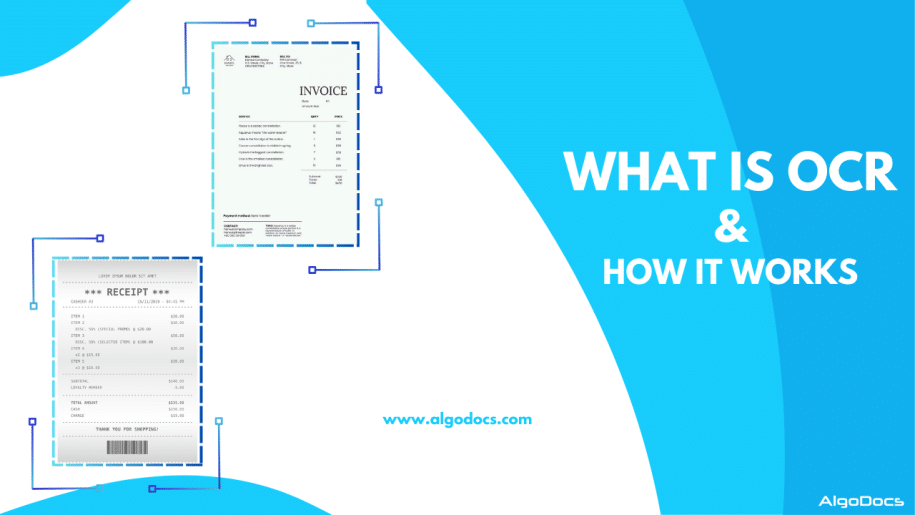
Back to Blog Table of contents On this page What is OCR and How Does it Work? A Comprehensive Guide to Understand Optical Character Recognition Home › Blog › Algodocs › What is OCR and How Does it Work? A Comprehensive Guide to Understand Optical Character Recognition Categories Algodocs Tags data extraction guide machine learning OCR ocr api By Shubhankar Biswas Published September 1, 2025, 09:29 Updated July 21, 2026, 05:24 When it comes to data extraction, you have multiple options, including IDP, OCR, ICR, and more. OCR (Optical Character Recognition) is a widely used technology for extracting data from various types of documents, such as PDFs, scanned images, and Word files. While manual data extraction methods like copy-pasting are still used, they are less reliable and can be time-consuming. In today’s data-driven business landscape, effective data extraction tools have become essential for successful decision-making. This comprehensive guide delves deep into the world of OCR, exploring its intricacies, applications, benefits, and other aspects. Whether you’re a seasoned tech enthusiast or just starting to explore the possibilities of data extraction, this article will provide you with a thorough understanding of OCR and how it can revolutionize your data management processes. What is OCR? OCR is a technology that converts different types of documents, such as scanned papers, PDF files, or images, into editable machine-readable text. In simpler terms, it can extract unstructured data from scanned images, PDFs, and Word files into a structured data format. Imagine a super-efficient assistant who can tirelessly read through piles of documents and convert them into a format your computer can understand. Consider this scenario: you have a mountain of invoices in various formats – some are printed, some are handwritten, and others are even photographs of documents. Manually entering all that data into your system would be a logistical nightmare, prone to errors and incredibly time-consuming. OCR simplifies this process by automatically extracting the text from these documents, saving you countless hours and resources. History of OCR The history of Optical Character Recognition (OCR) is a fascinating journey that spans over a century, evolving from early mechanical devices to sophisticated artificial intelligence-powered systems. In the early 1900s, pioneers like Emanuel Goldberg envisioned machines that could read characters and convert them into telegraph code, marking the first steps towards OCR. These early efforts focused on specialized tasks like reading specific fonts or recognizing machine-readable characters. The mid-20th century witnessed significant advancements with the development of electronic computers. Researchers began exploring ways to use computers to analyze images and recognize patterns, laying the foundation for modern OCR technology. Early OCR systems were limited in their capabilities, often struggling to recognize complex fonts, handwritten text, and low-quality images. However, with the rise of artificial intelligence and machine learning in the late 20th and early 21st centuries, OCR technology experienced a dramatic transformation. Researchers developed sophisticated algorithms that could learn to recognize patterns in text, adapt to different fonts and styles, and even handle handwritten input. These advancements have led to significant improvements in accuracy, speed, and reliability, making OCR a valuable tool in various applications. Today, OCR technology is widely used in a variety of fields, including data entry, document management, archival research, and accessibility for the visually impaired. From digitizing historical documents to automating invoice processing, OCR plays a crucial role in streamlining workflows and improving efficiency across numerous industries. As technology continues to evolve, we can expect further advancements in OCR, such as improved accuracy for handwritten text, support for more languages, and integration with other emerging technologies like natural language processing and computer vision. These advancements will further expand the potential of OCR, making it an even more powerful and indispensable tool in the digital age. How Does OCR Work? At its core, OCR technology mimics the human process of reading. It analyzes the structure of an image, identifies characters, and then converts them into machine-encoded text. This seemingly simple process involves several intricate steps: Image Pre-processing: Before the actual character recognition takes place, the input image is prepared for analysis. This often involves techniques like noise reduction, skew correction, and binarization to remove unwanted artifacts, straighten the image, and enhance contrast. Character Segmentation: Once the image is pre-processed, it’s divided into individual characters or glyphs. This step is crucial for accurate recognition, as it isolates each character for subsequent analysis. Feature Extraction: In this step, unique features of each character are extracted and analysed. These features might include lines, curves, loops, and other distinguishing characteristics that differentiate one character from another. Character Recognition: The extracted features are then compared to a database of known characters. The system uses sophisticated algorithms, often based on machine learning or neural networks, to determine the closest match for each character. Post-processing: The recognized text is further refined to correct any errors and improve accuracy. This may involve using dictionaries, contextual analysis, grammatical rules, or even machine learning algorithms to identify and correct misspellings, incorrect spacing, or other inconsistencies. The Benefits of OCR OCR offers a multitude of benefits across various industries and applications, but here are some of the essential benefits that suit all industry and business needs: Improved Efficiency: OCR automates data entry, eliminating the need for manual input and freeing up valuable time and resources that can be redirected to more strategic tasks. This eventually improves work efficiency and allows you to focus on more important work. Reduced Costs: By automating manual tasks, OCR can significantly reduce labor costs associated with data extraction. This can lead to substantial cost savings, especially for organizations that handle large volumes of documents. Enhanced Accuracy: OCR systems can achieve high accuracy rates, minimizing errors associated with manual data extraction. This ensures data integrity and reliability. Better Searchability: OCR converts scanned documents and images into searchable text, making it easier to find information within large volumes of data. This can significantly improve information retrieval and knowledge management. Improved Data Management: OCR helps organize and manage data more efficiently. By converting unstructured data into structured formats, OCR facilitates data analysis, reporting, and decision-making.

Aadhar Card Data Extraction using AI
Algodocs

Aadhar Card OCR: Extracting Data From Aadhar Card Using AI

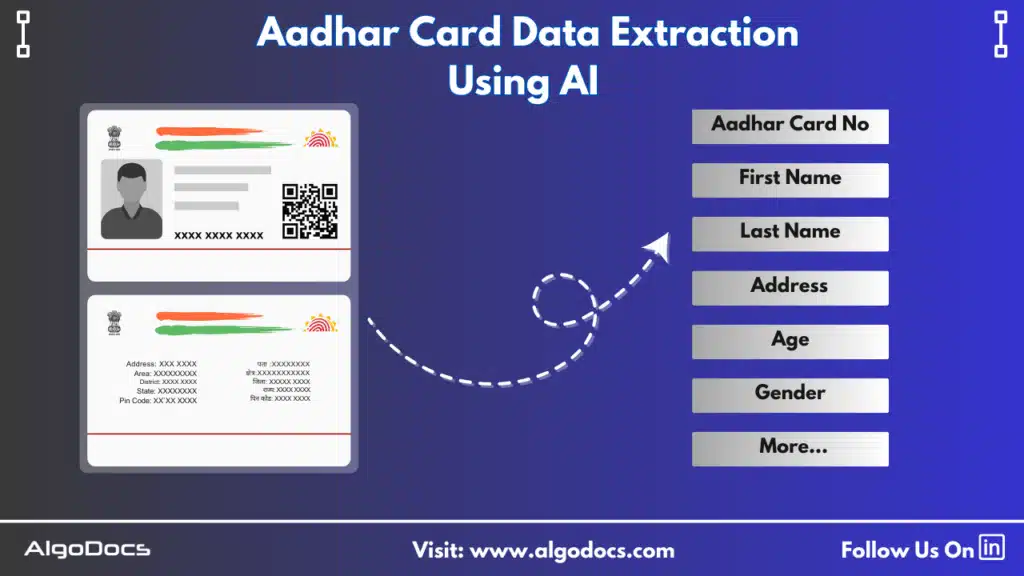
Back to Blog Table of contents On this page Aadhar Card OCR: Extracting Data From Aadhar Card Using AI Home › Blog › Algodocs › Aadhar Card OCR: Extracting Data From Aadhar Card Using AI Categories Algodocs Tags ai platform for data extraction algodocs data extraction from images id card extraction id card ocr machine learning ocr api web-based ai platform for data extraction By Shubhankar Biswas Published September 1, 2025, 08:50 Updated July 20, 2026, 05:40   In today’s fast-paced digital era, automation and artificial intelligence (AI) have transformed data extraction processes across various industries. One of the most critical use cases in India is Aadhar Card data extraction, where Optical Character Recognition (OCR) and AI technology are used to extract data from Aadhar cards with higher accuracy. Since the Aadhar card serves as a crucial identity document (ID) for Indian citizens, automating data extraction can significantly enhance work efficiency in many industries such as finance, telecom, healthcare, and e-governance. With the growing need for faster and more reliable document processing, AI-powered OCR solutions (IDP) are becoming essential tools for businesses in India. By eliminating manual data entry, businesses can reduce errors, enhance efficiency, and improve data management. In this blog, we will explore how Aadhar Card OCR works, its advantages, and how AI-driven solutions like Algodocs streamline the data extraction process. So What is Aadhar Card OCR? Aadhar Card OCR is an Optical Character Recognition (OCR) technology used to capture and extract details from a scanned image or PDF format of an Aadhar card. The key details extracted through this process include the 12-digit Aadhar card number, the full name of the cardholder, date of birth, gender, address, and QR code data. Extracting this information manually can be time-consuming and prone to errors. However, an AI-based OCR app can easily capture, extract, and sort the data with the help of AI, allowing you to automate the entire process. The best part of AI-based OCR tools is that they improve accuracy, speed, and efficiency by using sophisticated algorithms that analyze, recognize, and extract text even from low-quality images, which is not possible with manual data extraction approaches. Unlike traditional OCR systems, AI-powered solutions are trained on vast datasets, allowing them to recognize different fonts, complex formats, and text placements with greater precision and speed. How AI Elevates  Aadhar Card Data Extraction Efficiency Traditional OCR solutions often struggle with poor-quality images, handwritten text, or complex document layouts. However, AI-powered OCR can overcome these challenges by using machine learning (ML), natural language processing (NLP), artificial intelligence (AI), and advanced image preprocessing techniques. Machine learning algorithms and artificial intelligence enable OCR tools to recognize and extract text from Aadhar cards with a high degree of accuracy. These algorithms are trained to learn from large volumes of data, allowing them to improve their performance over time. Natural language processing (NLP) helps in interpreting and structuring the extracted information correctly, ensuring that fields such as names and addresses are properly identified. Image preprocessing techniques further enhance accuracy by removing background noise, adjusting contrast, and correcting distortions in scanned or photographed documents. This ensures that even low-quality images can be processed with minimal errors. Another significant advantage of AI-powered OCR is fraud detection. The system can identify forged or tampered Aadhar cards by analyzing patterns and inconsistencies within the document, thus ensuring data authenticity. The Aadhar Card Data Extraction Process Extracting data from an Aadhar card using AI-based OCR involves several key steps. The process begins with image acquisition, where a scanned copy or photograph of the Aadhar card is uploaded; the file can be a PDF as well. The AI-driven OCR software then processes the image to enhance readability by removing any background noise and correcting distortions. Once the image is pre-processed, the OCR engine scans the document and recognizes the text using deep learning algorithms. The extracted data is then structured into predefined fields, ensuring that each piece of information, such as the Aadhar number, name, age, gender, and address, is correctly categorized. After the text is extracted, the system validates the information by cross-checking it with predefined data formats. Finally, the structured data is exported for integration into various applications, such as customer onboarding systems, KYC verification processes, and digital record management solutions. Benefits of AI-Powered Aadhar Card OCR platforms AI-powered Aadhar Card OCR apps offer numerous advantages over manual data entry or traditional OCR apps. One of the primary benefits of AI-powered Aadhar Card OCR apps is their enhanced data extraction accuracy and increased extraction speed. AI models trained specifically for Aadhar card data extraction ensure precision, minimizing errors that could occur due to manual input. This high accuracy is particularly beneficial for businesses that require large-scale data processing, such as banks, telecom companies, and government agencies. Try Algodocs AI-based Aadhar Card OCR for all types of ID card data extraction and KYC document data extraction work for free. Another key advantage is speed. The automation of data extraction significantly reduces processing times, allowing businesses to complete customer verifications, document submissions, and other administrative tasks much faster. This improved efficiency translates into cost savings, as organizations no longer need to rely on extensive human labour for data entry tasks. One of the most important benefits of AI-powered Aadhar Card data extraction is fraud prevention and data security, which are crucial factors in safeguarding personal information as the Aadhar card is an important ID card. Unauthorized access to this information can lead to many negative consequences for users and the organization. AI-powered OCR systems can detect forged or tampered documents by analyzing subtle inconsistencies in text alignment, font variations, and background patterns. This ensures that only genuine Aadhar card data is processed, enhancing security and compliance. Furthermore, AI-based OCR tools integrate seamlessly with existing systems. Whether it’s a CRM platform, banking application, or government database, the extracted data can be automatically transferred to ensure smooth workflow automation. Applications of Aadhar Card OCR Across Industries Though Aadhar Card OCR has a wide range of applications across

Algodocs

Making Bank Cheque Data Extraction Easy: With AI and ML

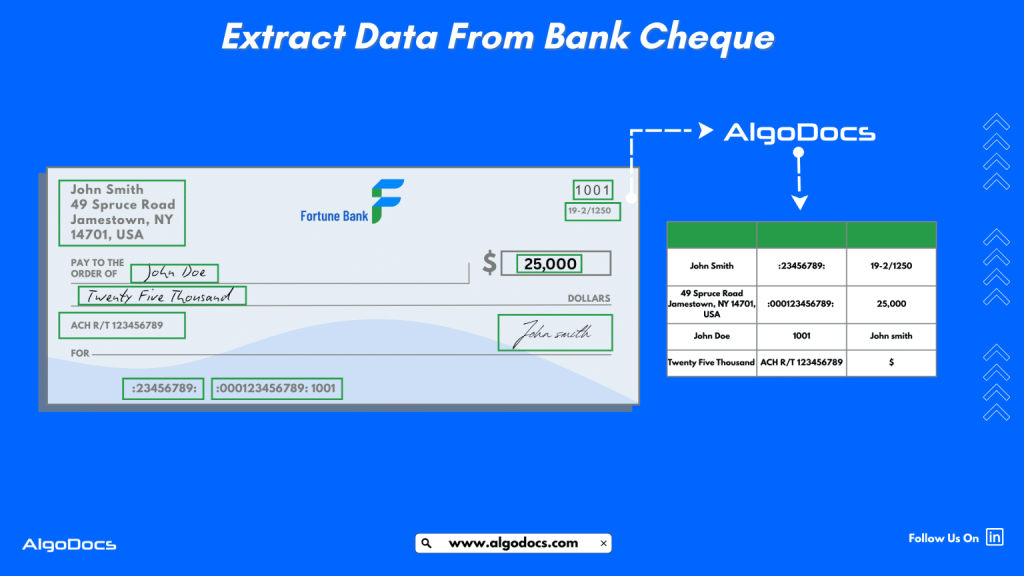
Back to Blog Table of contents On this page Making Bank Cheque Data Extraction Easy: With AI and ML Home › Blog › Algodocs › Making Bank Cheque Data Extraction Easy: With AI and ML Categories Algodocs Tags algodocs bank ocr data extraction from images Finance ocr machine learning ocr api By Shubhankar Biswas Published September 1, 2025, 07:35 Updated July 13, 2026, 09:21 Imagine this: you visit your bank to deposit a cheque, only to find out it’ll take days to process because every data validation and processing from the cheque will be done manually. Frustrating, right? Now, picture a world where that same cheque is scanned, analysed, and processed in seconds—all without a single human hand touching it. That’s the magic of AI, which makes bank cheque data extraction smooth and more efficient. This is technology that’s quietly transforming the way banks operate. In today’s fast-paced digital age, where time is money, automating data extraction from bank cheques has become a necessity for financial businesses. Whether you’re a banker, a business owner, or just someone who occasionally uses cheques, understanding this process can save you time, effort, and headaches. In this blog, we’ll dive deep into what bank cheque data extraction is all about, how it works, and why cutting-edge tools like AI and ML are improving bank cheque data extraction. We’ll also explore challenges associated with bank cheque data extraction and how tools like Algodocs are game-changers for these types of operations. So, let’s get started! What is a Bank Cheque? Before we dive into the world of bank cheque data extraction, we need to understand what a bank cheque is. So, let’s cover its basics. Basically, a bank cheque is like a promise on paper. It’s a document you write and sign, telling your bank to take money from your account and give it to someone else—or even yourself if it’s a self-cheque. Think of it as a secure, old-school way to move money around without carrying cash. Cheques have been around for centuries, and even in today’s world of digital payments, they’re still widely used, especially for big transactions like paying rent, settling bills, or business deals, etc. They’re simple, reliable, and trusted. But processing them manually? That’s where things get slow and messy. That’s why we need smarter solutions—like automated bank cheque data extraction solutions—to keep up with modern demands. So What are the Components of a Bank Cheque? So, what makes up a cheque? It’s not just a random piece of paper—it’s packed with important details that tell the bank what to do. Here’s a quick rundown of the key parts: Payee Name: This refers to the individual, business, or entity receiving the payment. On a cheque, it’s typically written following the phrase “Pay to the order of” on a designated line. Accuracy is key here—any misspelling or incorrect naming could lead to processing issues or the cheque being rejected by the payee’s bank. Amount: The exact sum of money being transferred, recorded in two distinct formats for clarity and security. The courtesy amount is written in numerals (e.g., $50.75) in a box or space provided, making it quick to read. The legal amount is spelled out in words (e.g., “Fifty dollars and 75/100”) on a separate line, serving as the official figure in case of disputes or discrepancies. This dual notation helps prevent alterations or misinterpretation. Date: The specific day the cheque is written or issued, usually entered in a format like MM/DD/YYYY (e.g., 04/04/2025). This is critical because banks may not honor cheques deemed “stale-dated”—typically those older than six months—though policies can vary by institution. Some cheques can also be postdated (dated for a future day), but acceptance depends on the payee and bank. Account Number: A unique identifier assigned to your bank account, printed at the bottom of the cheque as part of the MICR line (Magnetic Ink Character Recognition). This string of digits, often following the routing and cheque numbers, tells the bank which account to debit. The MICR line uses special magnetic ink, enabling automated processing by bank machines for efficiency and accuracy. Routing Number: A 9-digit code that identifies your financial institution within the banking system, also located in the MICR line (usually the first set of numbers). This number ensures the cheque is routed to the correct bank or credit union for processing. It’s standardized across the U.S. by the American Bankers Association (ABA) and is essential for domestic transactions. Cheque Number: A unique serial number assigned to each cheque, typically printed at the top-right corner and/or within the MICR line. This identifier helps you, your bank, and the payee track the specific cheque, especially useful for record-keeping, reconciling accounts, or investigating issues like lost or disputed payments. Signature: Your handwritten authorization, usually placed on a line at the bottom-right of the cheque. This acts as your official approval for the bank to release funds, making it a critical security feature. Without a valid signature matching the one on file with your bank, the cheque is considered invalid and will not be processed. Bank Name and Address: The name and often the physical or mailing address of the financial institution issuing the cheque, printed prominently on the document. This information identifies which bank or credit union is responsible for honoring the payment, providing transparency to the payee and facilitating communication if issues arise during processing. What is Bank Cheque Data Extraction? Bank cheque data extraction is the process of pulling out all those key details—such as the payee’s name, amount, account number, cheque number, and other important information—from a cheque with the help of automated tools or manually by humans. Instead of a bank employee squinting at handwriting or typing numbers into a system, machines do the heavy lifting. It’s like giving the cheque a quick scan, and the computer captures and extracts all the information from a bank cheque. A bank cheque can be a physical paper on which all the details are written,

Data Extraction, Optical Character Recognition

What Is Zonal OCR? An Easy Guide to Understanding Zonal OCR and How It Works.

Back to Blog Table of contents On this page What Is Zonal OCR? An Easy Guide to Understanding Zonal OCR and How It Works. Home › Blog › Data Extraction › What Is Zonal OCR? An Easy Guide to Understanding Zonal OCR and How It Works. Categories Data Extraction Optical Character Recognition Tags character recognition ocr api By Shubhankar Biswas Published September 1, 2025, 07:27 Updated July 20, 2026, 11:11   Processing data from bulk documents can be an annoying and time-consuming task if you have to extract this data manually. But with the help of modern technology such as optical character recognition, you can extract data from these documents easily. There is another part of OCR technology known as zonal OCR, which lets you extract specific data from specific sections of a PDF or scanned image. That is known as zonal OCR. So, what is Zonal OCR, and how does it work? We will discuss more in detail below. Understanding the Basics: OCR VS Zonal OCR? Before we explain what zonal OCR is, we first need to understand what OCR technology is and how it works.OCR stands for Optical Character Recognition. It was developed in the late 70s and started to gain traction in the late 80s. One of the main reasons it gained popularity in the 80s was because it started to be used by banks to extract data from various types of documents, which helped them save time and improve data extraction quality. Later, OCR was adopted in business, marketing, and other industries all around the world.The main function of traditional OCR technology is to convert different types of documents such as scanned paper documents, PDFs, or images into editable and searchable data. An OCR tool “reads” text on an image and turns it into digital letters that are editable on a computer. For example, if you scan a printed invoice and use OCR software, the software can pull out the name, address, and price from that scanned image and turn it into usable text. But classic OCR tools extract all the presented data in a document, and you can’t control what to extract and what not to—that’s where zonal OCR comes into play. What Is Zonal OCR? Now that we know what OCR is, let’s answer the main question—what is zonal OCR?Zonal OCR is a more focused and intelligent version of regular OCR. Instead of scanning an entire document and pulling out all the text, zonal OCR extracts data from specific areas or “zones” of a document. That’s why it is called zonal OCR or is known as template OCR as well. These zones are predefined sections where certain types of information always appear.Think of it like this: if every invoice you receive has the “Invoice Number” in the top right corner, Zonal OCR can be trained to look at just that area and pull the number out automatically. It ignores everything else and goes straight to the point. That makes it incredibly efficient and reliable for high-volume document processing. One of the major highlights of zonal OCR is that it is more accurate compared to traditional OCR. So, How Does Zonal OCR Work? Let’s break down how Zonal OCR works in a step-by-step process: Template Definition: First, you define zones on a document template. These zones are rectangular areas where key data lives—like names, dates, invoice numbers, etc. Document Scanning: When a new document comes in, it is scanned or uploaded to the system. Zone Detection: The Zonal OCR engine locates the defined zones on the document. Data Extraction: The engine reads the text from those zones and extracts it into a structured format like CSV, JSON, or directly into a database. Post-Processing: Extracted data can be validated, verified, or even pushed into downstream workflows like CRMs, ERPs, or RPA systems. Features of Zonal OCR What makes zonal OCR so powerful is its accuracy. Traditional OCR might pick up irrelevant text or make errors when faced with complex layouts. But zonal OCR knows exactly where to look because we have already defined the zone from where data needs to be picked and extracted. That means fewer errors, faster processing, and smoother workflows. Real-World Example: Zonal OCR For Medical Billing Imagine a hospital that receives thousands of medical bills every month. These documents have patient names, billing codes, diagnosis details, health insurance info, and payment terms.Using zonal OCR, the hospital can define zones on its standard bill layout:• Top left for patient name• Top right for bill number• Centre zone for treatment codes and costs• Bottom section for insurance informationEach incoming bill gets processed automatically. The software reads just those parts and enters the data into the hospital’s billing system. No manual typing. No human errors. Just fast, accurate data extraction. Where Zonal OCR Is Used Zonal OCR is widely used in different industries that handle large volumes of documents with structured layouts. Here are some common use cases:• Healthcare: Extracting patient data, diagnosis reports, medical codes, and insurance details from forms and bills.• Finance: Pulling out transaction info, invoice numbers, and payment dates from bank statements or receipts.• Logistics: Reading shipping labels, barcodes, and delivery addresses.• Legal: Extracting case numbers, parties involved, or dates from legal filings.• Retail: Processing receipts and purchase orders for inventory management. Why Businesses Need Zonal OCR Now that you understand what zonal OCR is, let’s explore why it’s such a vital tool for modern businesses.Saves TimeManual data entry is slow and expensive. Zonal OCR does in seconds what might take a person several minutes or hours.Reduces ErrorsHumans make mistakes, especially when tired or rushed. Zonal OCR provides consistent and accurate results.Scales EasilyWhether you process 10 or 10,000 documents a day, zonal OCR can handle it. It grows with your needs.Easy IntegrationMost zonal OCR systems can plug right into your existing software—like CRMs, ERP tools, or cloud databases.Improves ComplianceAccurate document processing means better audit trails, stronger recordkeeping, and improved compliance with industry regulations. Zonal OCR vs Full-Page OCR You might be wondering, “Why not just use

Algodocs

The Role of Intelligent Document Processing for Real Estate Document Management and How AI Is Improving It

Back to Blog Table of contents On this page The Role of Intelligent Document Processing for Real Estate Document Management and How AI Is Improving It Home › Blog › Algodocs › The Role of Intelligent Document Processing for Real Estate Document Management and How AI Is Improving It Categories Algodocs Tags ai platform for data extraction algodocs deep learning ocr api real estate data extraction By Shubhankar Biswas Published September 1, 2025, 06:11 Updated July 10, 2026, 08:52 The real estate industry deals with lots of document in day-to-day operation. One of the most common documents are lease agreements, loan documents, mortgage documents, property evaluations, occupancy certificates etc. The volume of paperwork involved in managing real estate transactions is huge and Handling all of this with manual approach can be slow, costly, and full of errors. This is where intelligent document processing for real estate comes in to save the day. . Intelligent Document Processing (IDP) is changing how real estate professionals handle documents. It uses artificial intelligence (AI), machine learning (ML), and optical character recognition (OCR) to scan, read, and organize documents automatically. It helps companies process information faster, more accurately, and with less manual effort. In this blog, we will explore the importance of document management in real estate, how intelligent document processing makes it better, what challenges the industry faces, how AI is improving these processes, and why Algodocs is a great tool for managing real estate documents. What is Real Estate Document Management and data processing? Real estate document management is the process of storing, organizing, retrieving, and sharing documents related to real estate transactions. These documents include contracts, purchase agreements, mortgage documents, rental applications, financial records, property titles, insurance forms, and inspection reports. Managing these documents well is important for several reasons. It keeps transactions legal and traceable. It also protects both buyers and sellers by ensuring that information is correct and up-to-date. Proper document management can also improve customer service by making information easy to find and share. Traditionally, document management in real estate has been paper-based. Even when digital storage is used, it often involves scanning documents and saving them in folders without any automation. This approach makes it difficult to search for information, increases the chances of losing documents, and wastes time during every transaction. As real estate firms grow and deal with more clients and properties, manual document management becomes a bottleneck. There is a need for smarter solutions that can handle this workload efficiently. That is why intelligent document processing is becoming more popular in the real estate industry. How IDP Helps with Real Estate Document Management and Data Processing Intelligent document processing for real estate allows companies to manage documents more efficiently by automating the extraction of information from various types of documents. Whether the documents are scanned images, PDFs, or emails, IDP can read, understand, and classify them automatically. For example, when a rental application is received, an IDP platform can extract the tenant’s name, income details, and rental history. It can also identify the type of document and route it to the right person or system. This reduces manual effort, cuts down on errors, and speeds up the decision-making process. Here are a few ways IDP helps real estate professionals: It reduces the time spent on data entry and document review. It makes compliance easier by keeping accurate records. It enables faster approval cycles for loans, rentals, or property transfers. It improves the customer experience by speeding up communication. It allows for easier auditing and reporting of transactions. IDP systems can handle many different types of real estate documents, such as: Lease agreements Loan applications Deeds and titles Tax forms Appraisal reports Utility bills Financial statements These systems use AI to understand the context of the document and extract key data fields. The extracted data is then passed to a central database, CRM, or enterprise resource planning (ERP) system for further use. Challenges in Real Estate Document Management Even with modern tools, real estate companies still face many challenges when it comes to document management. Some of the most common issues include: 1. High Volume of Documents:Real estate companies deal with hundreds of documents every week. These documents often come from multiple sources such as email, courier, online portals, or clients directly. Organizing all of these files manually is time-consuming. 2. Unstructured Formats:Documents come in many formats. Some are PDFs, some are images, and others are scanned paper documents. Without intelligent tools, extracting data from these formats is hard. 3. Manual Errors:Data entry mistakes can lead to legal problems, lost sales, or financial losses. Manual review processes are slow and prone to human error. 4. Compliance Requirements:Real estate firms must follow legal and financial regulations. Keeping accurate records and audit trails is necessary. Manual systems make this difficult. 5. Storage and Retrieval Issues:Traditional storage systems make it hard to search for or retrieve documents when needed. This can delay transactions and frustrate clients. 6. Security Concerns:Real estate documents often contain sensitive data such as social security numbers, bank information, or credit scores. Storing these securely is a major concern. These challenges show the need for a smarter, more secure, and more scalable solution like intelligent document processing for real estate. What to Consider Before Choosing an IDP Tool for Real Estate Business Before adopting any IDP solution, real estate businesses should consider the following points to make the right choice: 1. Document Variety Support:The IDP tool should be able to process different types of documents, both digital and scanned. It should support PDFs, Word files, images, and email attachments. 2. Accuracy of Data Extraction:Choose a tool that has high accuracy in extracting data from unstructured documents. AI-based platforms improve accuracy over time as they learn from corrections. 3. Integration with Existing Systems:The IDP solution should easily integrate with your existing CRM, ERP, or document management system. This will help automate the entire workflow. 4. Security and Compliance:Look for platforms that follow global security standards such as GDPR or ISO

Algodocs

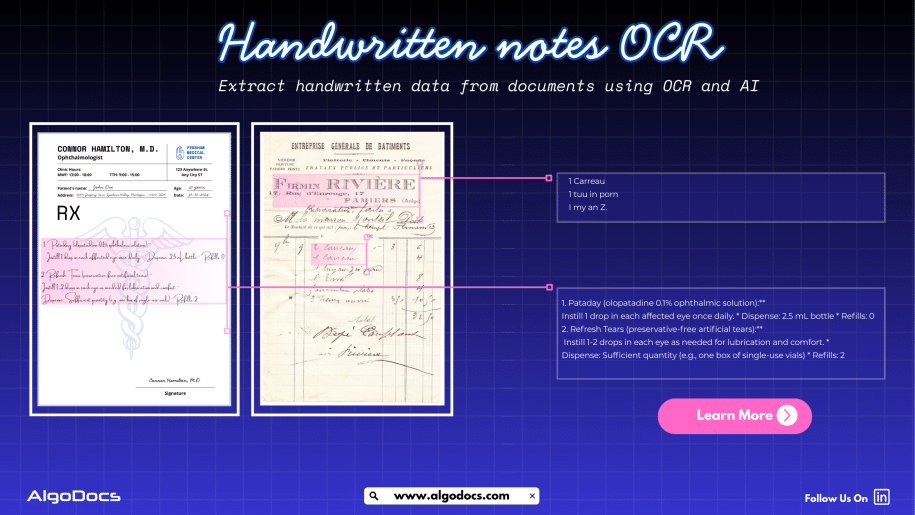
How To Extract Handwriting Data With Handwritten Notes OCR

Back to Blog Table of contents On this page How To Extract Handwriting Data With Handwritten Notes OCR Home › Blog › Algodocs › How To Extract Handwriting Data With Handwritten Notes OCR Categories Algodocs Tags algodocs data extraction deep learning Handwriting data extraction handwriting recognition machine learning OCR ocr api By Shubhankar Biswas Published August 31, 2025, 18:20 Updated July 13, 2026, 07:16 Handwritten notes capture some of our most important ideas, such as meeting minutes, classroom assignments, diary entries, handwritten invoices, medical forms, and much more. But when these valuable insights are trapped on paper, sharing, searching, or analyzing them can be a major challenge. But what if we could instantly turn stacks of handwritten sheets, sticky notes, or scanned handwritten image documents into searchable, editable data? It would surely make our work much easier and more productive. All this can be achieved with the technology called handwritten notes OCR, an advanced data extraction technology that brings the power of optical character recognition (OCR) with AI and ML to process handwritten data from various types of documents with accuracy. In this blog, you will discover how handwritten notes OCR works, why it is now more powerful than ever thanks to AI and machine learning, how modern handwritten notes OCR technology such as intelligent document processing revolutionizes data extraction, and practical tips for digitizing handwritten information in your business or personal life What Is Handwritten Notes OCR? Handwritten notes OCR is a specialized form of optical character recognition designed to capture, convert, and extract handwritten text from various types of documents. These documents are either in scanned image formats or can be PDF documents as well. Handwritten notes OCR turns document data into a digital, machine-readable format. Unlike standard OCR, which works well on clear, formatted images or document data, handwritten notes OCR can recognize the complex and unique nature of individual handwriting styles, even when the text is messy, faded, or uses old-fashioned scripts. With a high-performing handwritten notes OCR tool, you can:• Scan and digitize handwritten assignments, meeting notes, and personal memos.• Preserve historical letters, diaries, and legacy records for research and genealogy.• Archive and search medical forms, receipts, or contracts with handwritten details.• Export transcribed data to systems like Excel, Word, or your business platform — all in seconds. Handwriting vs. Traditional OCR: Why Is It Hard? Older OCR systems struggled to read handwriting, often failing to produce useful results. Anyone who has tried to scan a doctor’s prescription knows the frustration. This is where advanced handwritten notes OCR solutions powered by artificial intelligence come in. How Handwritten Notes OCR Works Modern handwritten notes OCR combines several powerful technologies to capture and convert handwriting into text: Image CaptureThe process starts with a scanned image or photo of your handwritten document — anything from a notebook scan to a smartphone snapshot of a meeting agenda. PreprocessingTo enhance recognition accuracy, the system may adjust brightness and contrast, remove background noise, and straighten text lines. Character RecognitionAI-based OCR analyzes each character, word, and phrase using machine learning models trained on countless samples of handwritten text. Unlike rigid, template-based systems, these models can identify even highly variable writing. Context UnderstandingNewer systems use natural language processing (NLP) and large language models (LLMs) to predict words and recognize context when text is unclear, filling in gaps with intelligent guesses. Data ExportFinally, the transcribed text is exported to your chosen software, converted into a searchable PDF, or sent directly to a database or document management system. Intelligent Document Processing: Putting AI and ML to Work Today, OCR for handwritten notes is supercharged by intelligent document processing (IDP), a blend of AI, machine learning (ML), computer vision, and NLP that turns “just text” into actionable data. Here is what makes IDP so powerful:• Automates data entry from scanned forms, notes, contracts, and even sticky notes.• Learns and adapts to new handwriting styles, layouts, and languages over time.• Classifies documents by type and context, not just by keywords or layout.• Extracts unstructured data, even from non-standard or messy notes.• Reduces manual work, errors, and operational costs, in some cases by up to 32 percent. For example, a handwritten meeting note attached to a scanned invoice is not just digitized for archiving. AI-powered IDP can link the note to the correct customer record and make the content searchable for everyone on your team in seconds. AI and ML: Raising the Bar in Handwritten Notes Data Extraction Artificial intelligence and machine learning have transformed handwritten notes OCR:• Machine Learning Models: By training on thousands or even millions of handwriting samples, these models can recognize a wider variety of writing styles, languages, and scripts.• Neural Networks: Mimicking how human brains read, deep learning models adapt over time, improving accuracy as they process more documents.• Large Language Models (LLMs): When OCR struggles with a word or phrase, LLMs use context clues to predict the correct transcription, boosting results beyond basic pattern matching.• Document Layout Analysis: Advanced IDP tools understand page layouts, tables, forms, and structures, allowing even heavily formatted notes to be converted accurately.• Continuous Learning: Every correction or manual review helps the system improve for the next time. Practical Use Cases and Benefits of Handwritten Notes OCR: • Education: Teachers and students can archive and search assignment notes, grade papers faster, and collaborate on shared materials.• Healthcare: Transcribe doctors’ handwritten notes, prescriptions, and patient forms for secure digital records.• Finance & Legal: Convert contracts, receipts, and case notes into searchable, compliant formats.• Business Operations: Make meeting notes, idea sketches, and legacy documents accessible across the company.• Historical Research: Preserve and analyze old letters, diaries, and census records for genealogy or academic studies. Digitized handwritten notes are easier to search, analyze, share, and back up, making your organization more agile and data-driven. How to Digitize Handwritten Notes: Simple Steps Choose the Right OCR ToolLook for systems that advertise dedicated handwritten notes OCR, ideally with AI-powered data extraction. Platforms such as Algodocs, Transkribus, Adobe Scan, and Google Document AI offer specialized handwriting recognition features. Scan or Photograph Your NotesUse a smartphone, scanner, or dedicated app to capture images of your handwritten documents. Clear, well-lit images with straight lines

Scroll to Top