Algodocs

OCR

Algodocs

OCR vs IDP: Which one is better? How to choose the right technology to elevate your business.

Back to Blog Table of contents On this page OCR vs IDP: Which one is better? How to choose the right technology to elevate your business. Home › Blog › Algodocs › OCR vs IDP: Which one is better? How to choose the right technology to elevate your business. Categories Algodocs Tags AI ai platform for data extraction algodocs IDP ML OCR By Shubhankar Biswas Published October 12, 2025, 18:41 Updated July 13, 2026, 08:04 The debate OCR VS IDP—often sparks conflicting opinions, as the choice depends on the specific needs and nature of the technology required. Both technologies serve the purpose of extracting data from various types of documents for business and personal use. In today’s data-driven world, businesses face the challenge of managing vast amounts of information stored in physical and digital documents. Efficient and accurate data extraction has become essential for streamlining operations, enhancing decision-making, and maintaining a competitive edge. Two technologies are leading this data extraction revolution: Optical Character Recognition (OCR) and Intelligent Document Processing (IDP). Although often used interchangeably, these technologies offer distinct capabilities and serve different purposes. This comprehensive guide will explore the key differences between OCR and IDP, their ideal use cases, and how to determine the right solution for your business needs. What is OCR? Optical Character Recognition (OCR) is a technology that converts images into machine-readable text data. These documents can be handwritten notes, typed, or printed in the form of PDFs, word documents, or image files. It works by analyzing the visual patterns of characters and comparing them to stored character sets. Once recognized, the text can be edited, searched, and stored electronically. Think of it as a digital eye that scans a document and translates visual characters into a digital language that computers can understand. OCR technology helps save time, reduce human errors during data extraction, and lower operational costs. Although OCR technology has been around for a long time, it has gained significant traction in recent years. Businesses increasingly rely on OCR-based tools for various data extraction and document processing tasks, driven by the growing need to manage and extract large volumes of data efficiently. What is IDP? Intelligent Document Processing (IDP) is a revolutionary advancement that leverages Artificial Intelligence (AI) and Machine Learning (ML) to enhance document processing workflows. Unlike OCR, which is limited to reading and extracting text from documents, IDP takes things a step further by analyzing, filtering, sorting, and automating data extraction from a variety of sources, including emails and other digital platforms. IDP builds on OCR by integrating AI and ML to automate the entire document processing lifecycle. It doesn’t just recognize characters; it understands the context and meaning of the extracted information. IDP systems can classify documents, extract specific data fields (such as names, dates, or invoice numbers), validate the data, and seamlessly integrate with other business systems. Think of it as a digital assistant that not only reads documents but also comprehends their purpose and extracts the most relevant information, making your workflows smarter and more efficient. Key Differences Between OCR Vs IDP The fundamental difference lies in their level of intelligence and automation. OCR focuses solely on character recognition, while IDP handles the entire document processing lifecycle. Here’s a breakdown: Feature OCR IDP Core Function Converts images of text to machine-readable text Automates the entire document processing workflow, including classification, data extraction, validation, and integration. Intelligence Basic character recognition Advanced AI and ML algorithms for context understanding, data validation, and learning from new document types. Automation Limited to text extraction High level of automation, capable of handling complex document layouts and variations. Data Extraction Extracts all text present in the image Extracts specific data points based on predefined rules or machine learning models. Document Types Simple, structured documents with consistent layouts Complex, semi-structured, and unstructured documents with varying layouts and formats. Error Handling Prone to errors with low-quality images or complex layouts More robust error handling through data validation and human-in-the-loop verification. Scalability Limited scalability for complex document processing Highly scalable for large volumes of diverse documents. When is OCR a Good Choice? OCR is a suitable solution when dealing with: Simple, structured documents: Forms, scanned letters, or printed reports with consistent layouts. High-quality images: Clear, well-scanned documents with minimal noise or distortion. Basic text extraction: When the primary goal is to convert images to searchable text without the need for specific data extraction. Low document volume: When processing a small number of documents. When is IDP a Good Choice? IDP is the preferred choice for: Complex, semi-structured, and unstructured documents: Invoices, contracts, medical records, passports, and other documents with varying layouts and formats. Specific data extraction: When extracting key information like dates, names, addresses, or financial figures is crucial. High document volume: When processing large quantities of diverse documents. Automated workflows: When integrating document processing into existing business systems. Improved accuracy: When high accuracy is essential due to the use of AI and ML. Types of Documents Can Be Processed by OCR OCR excels at processing: Scanned documents Printed reports Typed letters Simple forms Images containing text Types of Documents Can Be Processed By IDP IDP can handle a wider range of documents, including: Invoices Purchase orders Contracts Medical records Financial statements Legal documents Emails Handwritten notes (with varying accuracy) Industries Benefiting from OCR Industries that can benefit from OCR include: Libraries and archives: Digitizing historical documents. Publishing: Converting printed books and articles into digital formats. Data entry: Automating basic data entry tasks. Industries Benefiting from IDP IDP offers significant advantages to industries dealing with large volumes of complex documents: Finance: Automating invoice processing, loan applications, and KYC (Know Your Customer) procedures. Healthcare: Managing patient records, processing insurance claims, and extracting data from medical reports. Legal: Reviewing contracts, managing legal documents, and conducting e-discovery. Insurance: Processing claims, managing policy documents, and automating underwriting. Logistics: Processing shipping documents, tracking shipments, and automating customs clearance. How To Choosing Between OCR Vs IDP Confusion The choice between OCR and IDP depends on your specific business needs and document processing requirements. OCR is a suitable option for small businesses that handle a

Algodocs

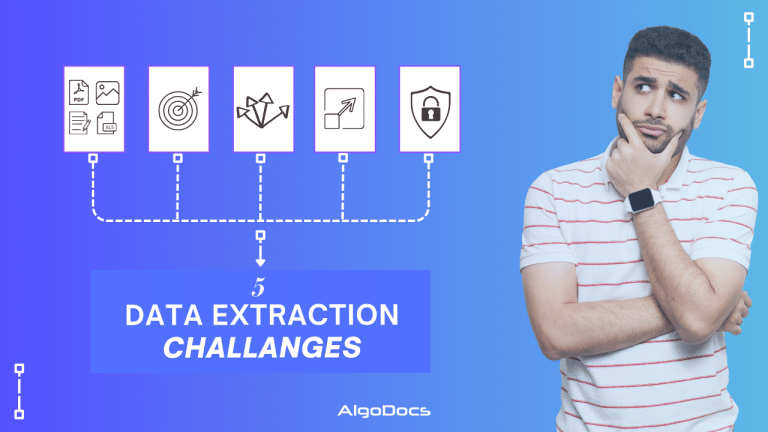
Top 5 Challenges in Document Data Extraction and How to Overcome Them With Algodocs

Back to Blog Table of contents On this page Top 5 Challenges in Document Data Extraction and How to Overcome Them With Algodocs Home › Blog › Algodocs › Top 5 Challenges in Document Data Extraction and How to Overcome Them With Algodocs Categories Algodocs Tags AI Data Extraction ai platform for data extraction algodocs data extraction Document Automation IDP OCR By Shubhankar Biswas Published October 12, 2025, 18:32 Updated July 13, 2026, 06:37 In today’s fast-paced digital world, document data extraction has become an essential process for businesses across various industries. Whether it’s extracting data from invoices, medical records, contracts, or financial reports, the need for efficient and accurate document processing has never been greater. As the need for data in business grows, so does the requirement for intelligent document processing platforms and other AI technologies for document data extraction. However, the path to seamless document data extraction is not without its challenges. In this blog, we will explore the top five challenges in document data extraction and how Algodocs can help overcome them. By the end, you’ll gain a comprehensive understanding of how to streamline your workflows and achieve better efficiency. What is Document Data Extraction? Document data extraction refers to the process of extracting structured or unstructured data from various document formats, such as PDFs, scanned images, or handwritten forms. This data is often critical for making business decisions, automating workflows, or maintaining accurate records. With advancements in technology, many organizations rely on automated tools for data extraction. However, the complexity of handling diverse document formats and ensuring data accuracy remains a significant hurdle. Before we dive into the top challenges faced by businesses in this domain, we need to understand the two major types of data extraction from documents. Types of Document Data Extraction: Manual Vs Automated Extracting data from documents is a complex task with both advantages and disadvantages. In recent years, the advent of artificial intelligence and machine learning has made data extraction smoother and more accurate. When it comes to data extraction, you have two options: manual data extraction and automated data extraction. Manual Document Data Extraction: In manual document data extraction, we copy and paste data from one document to another file. This basic method is considered very time-consuming and prone to errors. Manual data extraction is limited to a few document types and cannot process data from a variety of document formats. Automated Document Data Extraction: Automated document data extraction uses technologies such as OCR and Intelligent Document Processing (IDP) to automate the extraction of data from various types of documents and data sources. This method employs advanced technologies such as AI, ML, and NLP to capture and process data from both structured and unstructured document types. One key feature of automated data extraction is the speed and accuracy of the technology, and it can be scaled according to operational needs. Algodocs is an excellent example of an automated data extraction tool that allows you to extract data from both structured and unstructured documents. The Top 5 Challenges in Document Data Extraction Diverse Document Formats: Businesses deal with a wide range of document types, including PDFs, images, scanned forms, and handwritten notes. Each document format comes with its own set of challenges. For example: PDFs may contain hidden text layers or embedded images that are difficult to extract. The complexity of PDFs can vary greatly depending on how they were created, making it challenging to extract data accurately. Scanned documents often suffer from poor quality or inconsistent alignment. Issues such as low resolution, skewed scans, and variations in lighting can all affect the accuracy of data extraction from scanned documents. Handwritten documents pose significant challenges due to varying handwriting styles and legibility. The diversity in handwriting can lead to errors in recognizing characters and extracting correct information. These issues make it difficult to standardize data extraction processes and require tools that can adapt to diverse formats. Advanced technologies like AI and Machine Learning are essential to handle these variations effectively, ensuring that the extracted data is accurate and reliable. Solution: Algodocs’ AI-powered algorithms are designed to handle diverse document formats seamlessly. It uses Artificial Intelligence (AI) and Machine Learning to extract text from images and scanned documents while maintaining high accuracy. The platform’s adaptability ensures that even complex documents are processed efficiently. 2. Data Accuracy and Consistency Accuracy is paramount in document data extraction, especially when dealing with critical information like medical records, financial statements, or legal documents. Errors in data extraction can lead to serious consequences, including financial loss or compliance issues. While manual data extraction is one of the most common methods prone to data inaccuracies, basic OCR extraction tools sometimes fail to extract data accurately, leading to various operational issues. Common causes of inaccuracy include: Poor Document Quality: Poor document quality, such as smudged or faded text, often creates issues when scanned documents are in PDF or image formats. Scanning documents with scanners frequently results in blurry images, making data extraction from these documents a significant challenge.   Misinterpretation of Symbols, Fonts, or Layouts: Misinterpretation of symbols, fonts, or layouts in documents is one of the reasons why inaccuracies in data extraction occur. OCR technology or manual data extraction methods sometimes can’t read and understand these complex symbols or fonts, leading to errors. Variations in Document Templates and Structure: Variations in document templates and structure can also create issues with data extraction accuracy and consistency. Different formats such as PDF, Image, and Word documents offer different layouts, and extracting data from these varying layouts can sometimes cause accuracy issues. Maintaining consistency across multiple documents or batches is another challenge. Without a reliable system, errors can propagate and undermine data integrity. Solution: Algodocs employs advanced machine learning models that continuously improve accuracy by learning from data patterns. Its robust validation features allow users to cross-check extracted data against predefined templates, ensuring consistency and reliability. 3. Dealing with Unstructured Data One of the major challenges businesses face when extracting data from documents is dealing with unstructured

what is ocr
Algodocs

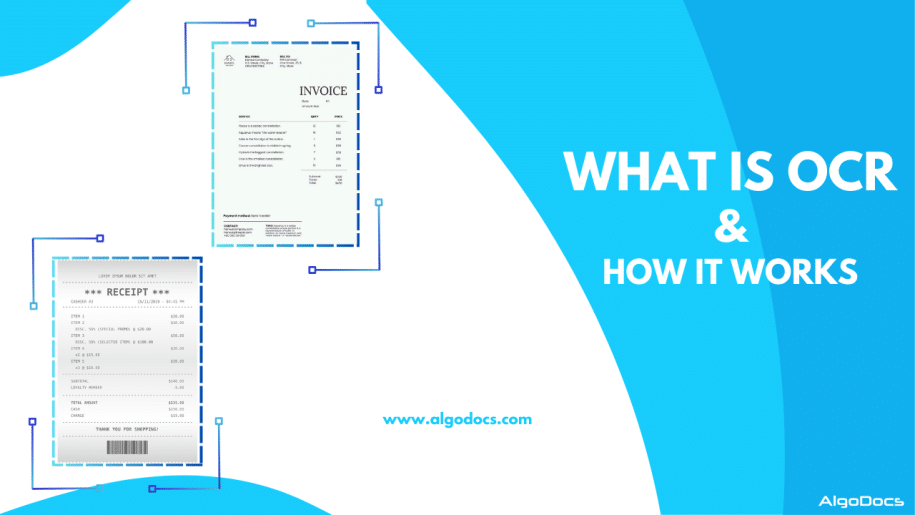
What is OCR and How Does it Work? A Comprehensive Guide to Understand Optical Character Recognition

Back to Blog Table of contents On this page What is OCR and How Does it Work? A Comprehensive Guide to Understand Optical Character Recognition Home › Blog › Algodocs › What is OCR and How Does it Work? A Comprehensive Guide to Understand Optical Character Recognition Categories Algodocs Tags data extraction guide machine learning OCR ocr api By Shubhankar Biswas Published September 1, 2025, 09:29 Updated July 21, 2026, 05:24 When it comes to data extraction, you have multiple options, including IDP, OCR, ICR, and more. OCR (Optical Character Recognition) is a widely used technology for extracting data from various types of documents, such as PDFs, scanned images, and Word files. While manual data extraction methods like copy-pasting are still used, they are less reliable and can be time-consuming. In today’s data-driven business landscape, effective data extraction tools have become essential for successful decision-making. This comprehensive guide delves deep into the world of OCR, exploring its intricacies, applications, benefits, and other aspects. Whether you’re a seasoned tech enthusiast or just starting to explore the possibilities of data extraction, this article will provide you with a thorough understanding of OCR and how it can revolutionize your data management processes. What is OCR? OCR is a technology that converts different types of documents, such as scanned papers, PDF files, or images, into editable machine-readable text. In simpler terms, it can extract unstructured data from scanned images, PDFs, and Word files into a structured data format. Imagine a super-efficient assistant who can tirelessly read through piles of documents and convert them into a format your computer can understand. Consider this scenario: you have a mountain of invoices in various formats – some are printed, some are handwritten, and others are even photographs of documents. Manually entering all that data into your system would be a logistical nightmare, prone to errors and incredibly time-consuming. OCR simplifies this process by automatically extracting the text from these documents, saving you countless hours and resources. History of OCR The history of Optical Character Recognition (OCR) is a fascinating journey that spans over a century, evolving from early mechanical devices to sophisticated artificial intelligence-powered systems. In the early 1900s, pioneers like Emanuel Goldberg envisioned machines that could read characters and convert them into telegraph code, marking the first steps towards OCR. These early efforts focused on specialized tasks like reading specific fonts or recognizing machine-readable characters. The mid-20th century witnessed significant advancements with the development of electronic computers. Researchers began exploring ways to use computers to analyze images and recognize patterns, laying the foundation for modern OCR technology. Early OCR systems were limited in their capabilities, often struggling to recognize complex fonts, handwritten text, and low-quality images. However, with the rise of artificial intelligence and machine learning in the late 20th and early 21st centuries, OCR technology experienced a dramatic transformation. Researchers developed sophisticated algorithms that could learn to recognize patterns in text, adapt to different fonts and styles, and even handle handwritten input. These advancements have led to significant improvements in accuracy, speed, and reliability, making OCR a valuable tool in various applications. Today, OCR technology is widely used in a variety of fields, including data entry, document management, archival research, and accessibility for the visually impaired. From digitizing historical documents to automating invoice processing, OCR plays a crucial role in streamlining workflows and improving efficiency across numerous industries. As technology continues to evolve, we can expect further advancements in OCR, such as improved accuracy for handwritten text, support for more languages, and integration with other emerging technologies like natural language processing and computer vision. These advancements will further expand the potential of OCR, making it an even more powerful and indispensable tool in the digital age. How Does OCR Work? At its core, OCR technology mimics the human process of reading. It analyzes the structure of an image, identifies characters, and then converts them into machine-encoded text. This seemingly simple process involves several intricate steps: Image Pre-processing: Before the actual character recognition takes place, the input image is prepared for analysis. This often involves techniques like noise reduction, skew correction, and binarization to remove unwanted artifacts, straighten the image, and enhance contrast. Character Segmentation: Once the image is pre-processed, it’s divided into individual characters or glyphs. This step is crucial for accurate recognition, as it isolates each character for subsequent analysis. Feature Extraction: In this step, unique features of each character are extracted and analysed. These features might include lines, curves, loops, and other distinguishing characteristics that differentiate one character from another. Character Recognition: The extracted features are then compared to a database of known characters. The system uses sophisticated algorithms, often based on machine learning or neural networks, to determine the closest match for each character. Post-processing: The recognized text is further refined to correct any errors and improve accuracy. This may involve using dictionaries, contextual analysis, grammatical rules, or even machine learning algorithms to identify and correct misspellings, incorrect spacing, or other inconsistencies. The Benefits of OCR OCR offers a multitude of benefits across various industries and applications, but here are some of the essential benefits that suit all industry and business needs: Improved Efficiency: OCR automates data entry, eliminating the need for manual input and freeing up valuable time and resources that can be redirected to more strategic tasks. This eventually improves work efficiency and allows you to focus on more important work. Reduced Costs: By automating manual tasks, OCR can significantly reduce labor costs associated with data extraction. This can lead to substantial cost savings, especially for organizations that handle large volumes of documents. Enhanced Accuracy: OCR systems can achieve high accuracy rates, minimizing errors associated with manual data extraction. This ensures data integrity and reliability. Better Searchability: OCR converts scanned documents and images into searchable text, making it easier to find information within large volumes of data. This can significantly improve information retrieval and knowledge management. Improved Data Management: OCR helps organize and manage data more efficiently. By converting unstructured data into structured formats, OCR facilitates data analysis, reporting, and decision-making.

Algodocs

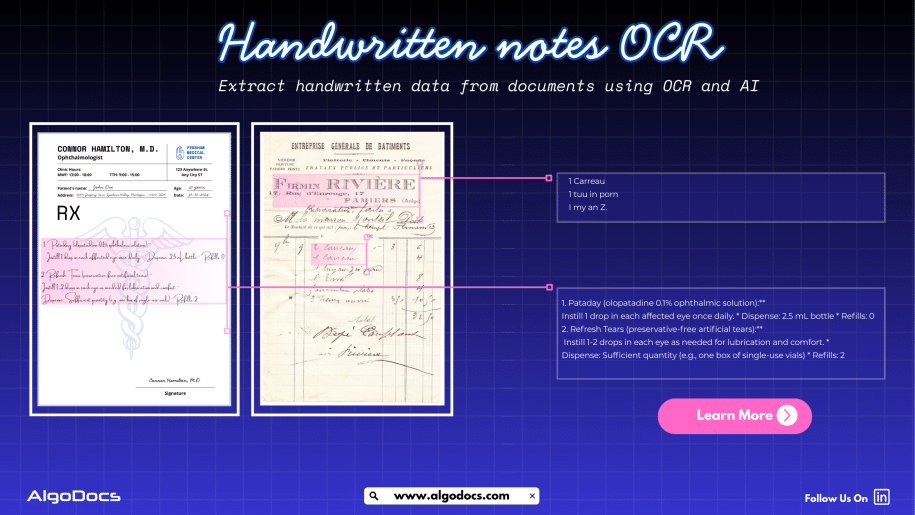
How To Extract Handwriting Data With Handwritten Notes OCR

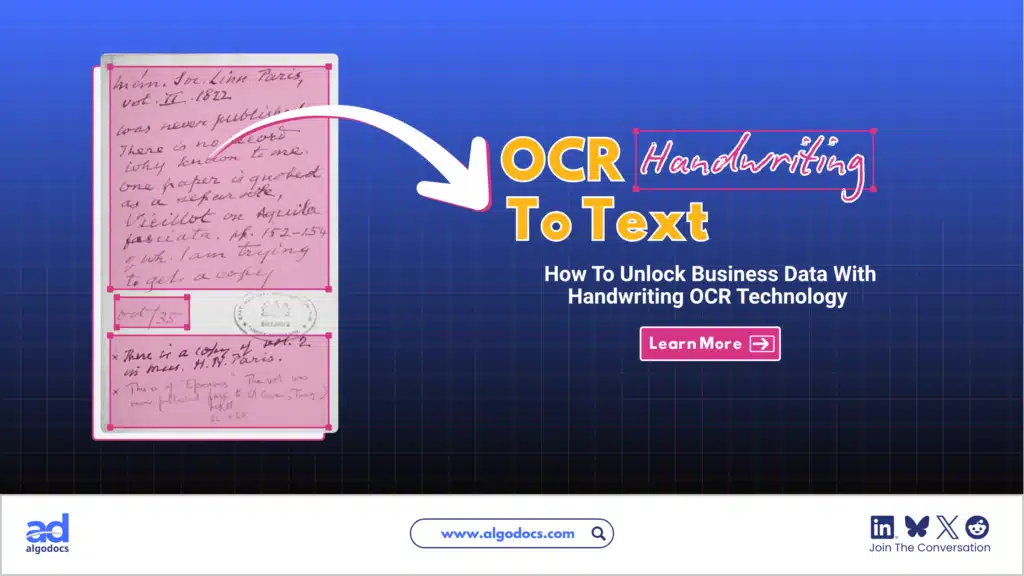
Back to Blog Table of contents On this page How To Extract Handwriting Data With Handwritten Notes OCR Home › Blog › Algodocs › How To Extract Handwriting Data With Handwritten Notes OCR Categories Algodocs Tags algodocs data extraction deep learning Handwriting data extraction handwriting recognition machine learning OCR ocr api By Shubhankar Biswas Published August 31, 2025, 18:20 Updated July 13, 2026, 07:16 Handwritten notes capture some of our most important ideas, such as meeting minutes, classroom assignments, diary entries, handwritten invoices, medical forms, and much more. But when these valuable insights are trapped on paper, sharing, searching, or analyzing them can be a major challenge. But what if we could instantly turn stacks of handwritten sheets, sticky notes, or scanned handwritten image documents into searchable, editable data? It would surely make our work much easier and more productive. All this can be achieved with the technology called handwritten notes OCR, an advanced data extraction technology that brings the power of optical character recognition (OCR) with AI and ML to process handwritten data from various types of documents with accuracy. In this blog, you will discover how handwritten notes OCR works, why it is now more powerful than ever thanks to AI and machine learning, how modern handwritten notes OCR technology such as intelligent document processing revolutionizes data extraction, and practical tips for digitizing handwritten information in your business or personal life What Is Handwritten Notes OCR? Handwritten notes OCR is a specialized form of optical character recognition designed to capture, convert, and extract handwritten text from various types of documents. These documents are either in scanned image formats or can be PDF documents as well. Handwritten notes OCR turns document data into a digital, machine-readable format. Unlike standard OCR, which works well on clear, formatted images or document data, handwritten notes OCR can recognize the complex and unique nature of individual handwriting styles, even when the text is messy, faded, or uses old-fashioned scripts. With a high-performing handwritten notes OCR tool, you can:• Scan and digitize handwritten assignments, meeting notes, and personal memos.• Preserve historical letters, diaries, and legacy records for research and genealogy.• Archive and search medical forms, receipts, or contracts with handwritten details.• Export transcribed data to systems like Excel, Word, or your business platform — all in seconds. Handwriting vs. Traditional OCR: Why Is It Hard? Older OCR systems struggled to read handwriting, often failing to produce useful results. Anyone who has tried to scan a doctor’s prescription knows the frustration. This is where advanced handwritten notes OCR solutions powered by artificial intelligence come in. How Handwritten Notes OCR Works Modern handwritten notes OCR combines several powerful technologies to capture and convert handwriting into text: Image CaptureThe process starts with a scanned image or photo of your handwritten document — anything from a notebook scan to a smartphone snapshot of a meeting agenda. PreprocessingTo enhance recognition accuracy, the system may adjust brightness and contrast, remove background noise, and straighten text lines. Character RecognitionAI-based OCR analyzes each character, word, and phrase using machine learning models trained on countless samples of handwritten text. Unlike rigid, template-based systems, these models can identify even highly variable writing. Context UnderstandingNewer systems use natural language processing (NLP) and large language models (LLMs) to predict words and recognize context when text is unclear, filling in gaps with intelligent guesses. Data ExportFinally, the transcribed text is exported to your chosen software, converted into a searchable PDF, or sent directly to a database or document management system. Intelligent Document Processing: Putting AI and ML to Work Today, OCR for handwritten notes is supercharged by intelligent document processing (IDP), a blend of AI, machine learning (ML), computer vision, and NLP that turns “just text” into actionable data. Here is what makes IDP so powerful:• Automates data entry from scanned forms, notes, contracts, and even sticky notes.• Learns and adapts to new handwriting styles, layouts, and languages over time.• Classifies documents by type and context, not just by keywords or layout.• Extracts unstructured data, even from non-standard or messy notes.• Reduces manual work, errors, and operational costs, in some cases by up to 32 percent. For example, a handwritten meeting note attached to a scanned invoice is not just digitized for archiving. AI-powered IDP can link the note to the correct customer record and make the content searchable for everyone on your team in seconds. AI and ML: Raising the Bar in Handwritten Notes Data Extraction Artificial intelligence and machine learning have transformed handwritten notes OCR:• Machine Learning Models: By training on thousands or even millions of handwriting samples, these models can recognize a wider variety of writing styles, languages, and scripts.• Neural Networks: Mimicking how human brains read, deep learning models adapt over time, improving accuracy as they process more documents.• Large Language Models (LLMs): When OCR struggles with a word or phrase, LLMs use context clues to predict the correct transcription, boosting results beyond basic pattern matching.• Document Layout Analysis: Advanced IDP tools understand page layouts, tables, forms, and structures, allowing even heavily formatted notes to be converted accurately.• Continuous Learning: Every correction or manual review helps the system improve for the next time. Practical Use Cases and Benefits of Handwritten Notes OCR: • Education: Teachers and students can archive and search assignment notes, grade papers faster, and collaborate on shared materials.• Healthcare: Transcribe doctors’ handwritten notes, prescriptions, and patient forms for secure digital records.• Finance & Legal: Convert contracts, receipts, and case notes into searchable, compliant formats.• Business Operations: Make meeting notes, idea sketches, and legacy documents accessible across the company.• Historical Research: Preserve and analyze old letters, diaries, and census records for genealogy or academic studies. Digitized handwritten notes are easier to search, analyze, share, and back up, making your organization more agile and data-driven. How to Digitize Handwritten Notes: Simple Steps Choose the Right OCR ToolLook for systems that advertise dedicated handwritten notes OCR, ideally with AI-powered data extraction. Platforms such as Algodocs, Transkribus, Adobe Scan, and Google Document AI offer specialized handwriting recognition features. Scan or Photograph Your NotesUse a smartphone, scanner, or dedicated app to capture images of your handwritten documents. Clear, well-lit images with straight lines

Data Extraction, purchase order

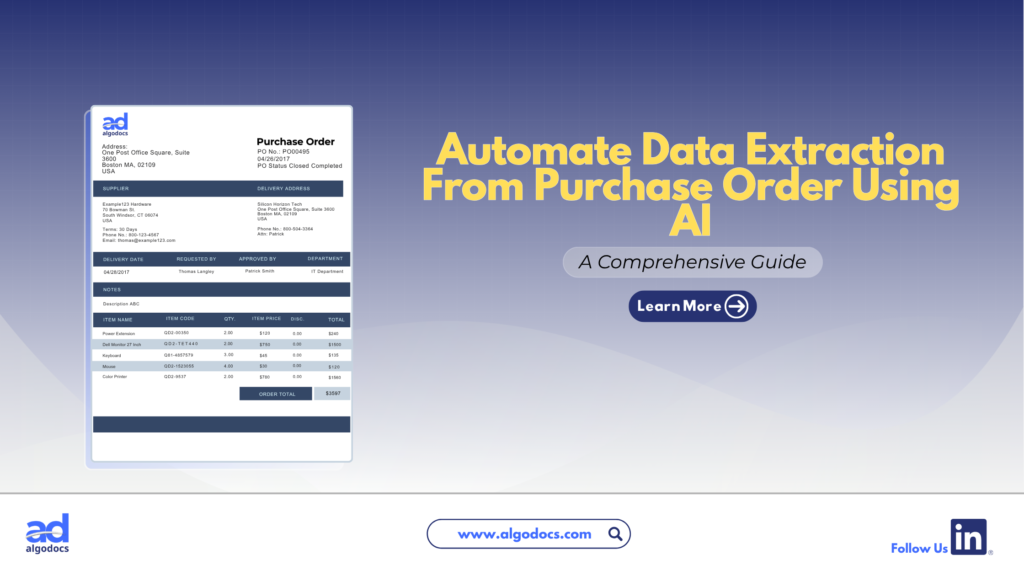
How to Extract Data from Purchase Orders With AlgoDocs Purchase Order OCR. A Comprehensive Guide For 2025

Back to Blog Table of contents On this page How to Extract Data from Purchase Orders With AlgoDocs Purchase Order OCR. A Comprehensive Guide For 2025 Home › Blog › Algodocs › How to Extract Data from Purchase Orders With AlgoDocs Purchase Order OCR. A Comprehensive Guide For 2025 Categories Algodocs Tags algodocs data extraction IDP intelligent document processing machine learning OCR Optical Character Recognition Purchase Order OCR web-based ai platform for data extraction By Ibrahim Nalbant Published January 2, 2025, 07:18 Updated July 10, 2026, 09:25 Purchase orders (POs) are critical documents in business operations, which makes purchase order data extraction and automation an important step in processing purchase orders. They ensure clear communication between buyers and sellers, detailing the goods or services, pricing, and other contractual terms. With the rise of digitization, extracting data from purchase orders efficiently has become essential for modern businesses. Both b2b and b2c business scenarios use a purchase order to facilitate clear communication between two parties. It helps in maintaining important information related to the transaction of goods between two parties. This guide explores how to extract data from purchase orders, focusing on tools like purchase order OCR and strategies to streamline the process. What is a Purchase Order?  A purchase order (PO) is a written document issued by a buyer to a seller that indicates the type, quantity, and agreed price for products or services by two parties. It plays a very crucial role in ensuring smooth procurement operations and is a legally binding document once accepted by the seller. In simple terms, a purchase order (PO) document describes what goods have been requested by the buyer to sellers to confirm their interest in procuring goods and services. Key Elements of a Purchase Order  PO Number: A unique identifier.  Buyer and Seller Information: Contact details and addresses.  Order Details: Description, quantity, and price of items.  Delivery Terms: Shipping method, destination, and date.  Payment Terms: Agreed payment timelines and methods.  Manually managing this information is time consuming, especially for businesses handling large volumes of POs. Challenges of Manually Extracting Data From Purchase Order  Relying on manual methods to extract and process data from purchase orders leads to many challenges for businesses. Time Consuming: Extracting data from a purchase order manually is a time-consuming task. If you have to extract data from a single page document, then manually it can take hours, but using a purchase order app for data extraction only takes 5 to 10 minutes. Error Prone: One of the biggest challenges with manually extracting data from a purchase order is that it is prone to error. The most common human errors, such as typos or missed fields, can disrupt workflows and lead to costly mistakes. Due to the high volume of data, errors tend to happen if data is being extracted with manual method. Scalability Issues: As businesses grow, manually processing hundreds or thousands of purchase orders becomes unsustainable. The manual processing of 100 purchase order documents can slow down the productivity of an organization, which can lead to other challenges, such as loss of profit and time. Resource Intensive Manual methods require significant labour, which leads to a rise in operational costs. To overcome these challenges, businesses are turning to automation tools like purchase order OCR technology. Since the purchase order OCR technology requires very little or no human intervention. What is a Purchase Order OCR Technology  Purchase Order OCR (Optical Character Recognition) is a technology that captures and converts a printed or handwritten text into machine-readable data. This type of OCR technology is built and trained to capture and extract data such as vendor name, buyer name, date, amount, address, and other information from a PO document. You can save this extracted data in Excel, CSV, JSON, or another file format. With the help of purchase order OCR technology, businesses can significantly save time and money and scale their business to greater heights. The advent of AI OCR tools such as AlgoDocs Purchase Order OCR has made data extraction from purchase orders more accurate and productive. How Does Purchase Order OCR Work?  Purchase Order OCR (Optical Character Recognition) is a technology that streamlines the extraction of information from purchase orders. It works by scanning documents in various formats—such as PDFs, images, or scanned papers—and recognizing text to extract key data like order numbers, item descriptions, quantities, prices, and delivery dates. The data is subsequently organized into a structured format, facilitating seamless integration into procurement systems. Automating this process allows Purchase Order OCR to decrease manual data entry, reduce errors, and improve the efficiency of the procurement workflow. Scanning Documents: Paper POs are digitized using scanners.  Data Recognition: The OCR engine identifies text fields such as PO numbers, item descriptions, and quantities.  Data Extraction: The software extracts relevant fields and organizes them into a structured format.  Integration: The extracted data is transferred into systems like ERP or accounting software. What Is AlgoDocs Purchase Order OCR AI App Algodocs is an AI-based purchase order OCR app that extracts data from PO documents. AlgoDocs uses AI technology to automate data extraction from pdfs, scanned documents, and handwritten notes. You can build your own extractor in Algodocs and train the AI model to capture, analyze, and process the data from a document. You can integrate Algodocs with third-party apps for document processing and data extraction. Signup for AlgoDocs Free-Forever plan and access all premium features for free Sign Up Real World Application of Purchase Order OCR Technology A purchase order OCR (Optical Character Recognition) app is a highly beneficial tool for industries of all types. Whether you are operating in a B2B (Business-to-Business) or B2C (Business-to-Consumer) environment, implementing a PO OCR solution can significantly enhance productivity and drive business growth. However, certain industries stand to gain the most from the adoption of OCR technology: Retail and E-commerce: In the fast-paced world of retail and e-commerce, businesses generate a high volume of purchase order documents daily. As customer transactions increase, so does the number

Scroll to Top