Algodocs

AI

Algodocs

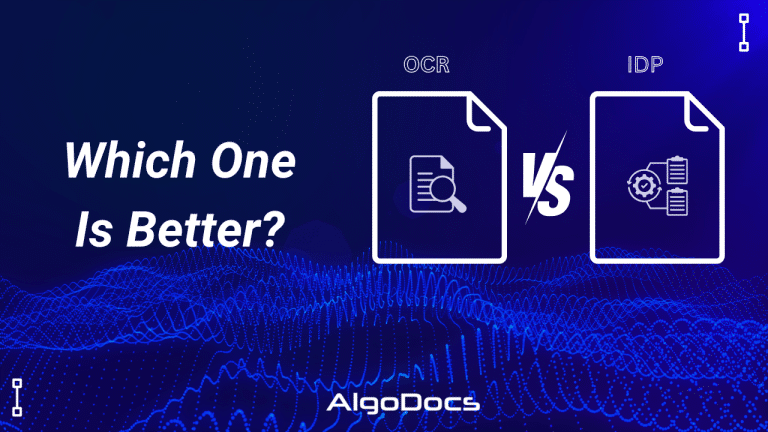
OCR vs IDP: Which one is better? How to choose the right technology to elevate your business.

Back to Blog Table of contents On this page OCR vs IDP: Which one is better? How to choose the right technology to elevate your business. Home › Blog › Algodocs › OCR vs IDP: Which one is better? How to choose the right technology to elevate your business. Categories Algodocs Tags AI ai platform for data extraction algodocs IDP ML OCR By Shubhankar Biswas Published October 12, 2025, 18:41 Updated July 13, 2026, 08:04 The debate OCR VS IDP—often sparks conflicting opinions, as the choice depends on the specific needs and nature of the technology required. Both technologies serve the purpose of extracting data from various types of documents for business and personal use. In today’s data-driven world, businesses face the challenge of managing vast amounts of information stored in physical and digital documents. Efficient and accurate data extraction has become essential for streamlining operations, enhancing decision-making, and maintaining a competitive edge. Two technologies are leading this data extraction revolution: Optical Character Recognition (OCR) and Intelligent Document Processing (IDP). Although often used interchangeably, these technologies offer distinct capabilities and serve different purposes. This comprehensive guide will explore the key differences between OCR and IDP, their ideal use cases, and how to determine the right solution for your business needs. What is OCR? Optical Character Recognition (OCR) is a technology that converts images into machine-readable text data. These documents can be handwritten notes, typed, or printed in the form of PDFs, word documents, or image files. It works by analyzing the visual patterns of characters and comparing them to stored character sets. Once recognized, the text can be edited, searched, and stored electronically. Think of it as a digital eye that scans a document and translates visual characters into a digital language that computers can understand. OCR technology helps save time, reduce human errors during data extraction, and lower operational costs. Although OCR technology has been around for a long time, it has gained significant traction in recent years. Businesses increasingly rely on OCR-based tools for various data extraction and document processing tasks, driven by the growing need to manage and extract large volumes of data efficiently. What is IDP? Intelligent Document Processing (IDP) is a revolutionary advancement that leverages Artificial Intelligence (AI) and Machine Learning (ML) to enhance document processing workflows. Unlike OCR, which is limited to reading and extracting text from documents, IDP takes things a step further by analyzing, filtering, sorting, and automating data extraction from a variety of sources, including emails and other digital platforms. IDP builds on OCR by integrating AI and ML to automate the entire document processing lifecycle. It doesn’t just recognize characters; it understands the context and meaning of the extracted information. IDP systems can classify documents, extract specific data fields (such as names, dates, or invoice numbers), validate the data, and seamlessly integrate with other business systems. Think of it as a digital assistant that not only reads documents but also comprehends their purpose and extracts the most relevant information, making your workflows smarter and more efficient. Key Differences Between OCR Vs IDP The fundamental difference lies in their level of intelligence and automation. OCR focuses solely on character recognition, while IDP handles the entire document processing lifecycle. Here’s a breakdown: Feature OCR IDP Core Function Converts images of text to machine-readable text Automates the entire document processing workflow, including classification, data extraction, validation, and integration. Intelligence Basic character recognition Advanced AI and ML algorithms for context understanding, data validation, and learning from new document types. Automation Limited to text extraction High level of automation, capable of handling complex document layouts and variations. Data Extraction Extracts all text present in the image Extracts specific data points based on predefined rules or machine learning models. Document Types Simple, structured documents with consistent layouts Complex, semi-structured, and unstructured documents with varying layouts and formats. Error Handling Prone to errors with low-quality images or complex layouts More robust error handling through data validation and human-in-the-loop verification. Scalability Limited scalability for complex document processing Highly scalable for large volumes of diverse documents. When is OCR a Good Choice? OCR is a suitable solution when dealing with: Simple, structured documents: Forms, scanned letters, or printed reports with consistent layouts. High-quality images: Clear, well-scanned documents with minimal noise or distortion. Basic text extraction: When the primary goal is to convert images to searchable text without the need for specific data extraction. Low document volume: When processing a small number of documents. When is IDP a Good Choice? IDP is the preferred choice for: Complex, semi-structured, and unstructured documents: Invoices, contracts, medical records, passports, and other documents with varying layouts and formats. Specific data extraction: When extracting key information like dates, names, addresses, or financial figures is crucial. High document volume: When processing large quantities of diverse documents. Automated workflows: When integrating document processing into existing business systems. Improved accuracy: When high accuracy is essential due to the use of AI and ML. Types of Documents Can Be Processed by OCR OCR excels at processing: Scanned documents Printed reports Typed letters Simple forms Images containing text Types of Documents Can Be Processed By IDP IDP can handle a wider range of documents, including: Invoices Purchase orders Contracts Medical records Financial statements Legal documents Emails Handwritten notes (with varying accuracy) Industries Benefiting from OCR Industries that can benefit from OCR include: Libraries and archives: Digitizing historical documents. Publishing: Converting printed books and articles into digital formats. Data entry: Automating basic data entry tasks. Industries Benefiting from IDP IDP offers significant advantages to industries dealing with large volumes of complex documents: Finance: Automating invoice processing, loan applications, and KYC (Know Your Customer) procedures. Healthcare: Managing patient records, processing insurance claims, and extracting data from medical reports. Legal: Reviewing contracts, managing legal documents, and conducting e-discovery. Insurance: Processing claims, managing policy documents, and automating underwriting. Logistics: Processing shipping documents, tracking shipments, and automating customs clearance. How To Choosing Between OCR Vs IDP Confusion The choice between OCR and IDP depends on your specific business needs and document processing requirements. OCR is a suitable option for small businesses that handle a

Data Extraction, Image Data Extraction, Legal Document Extraction

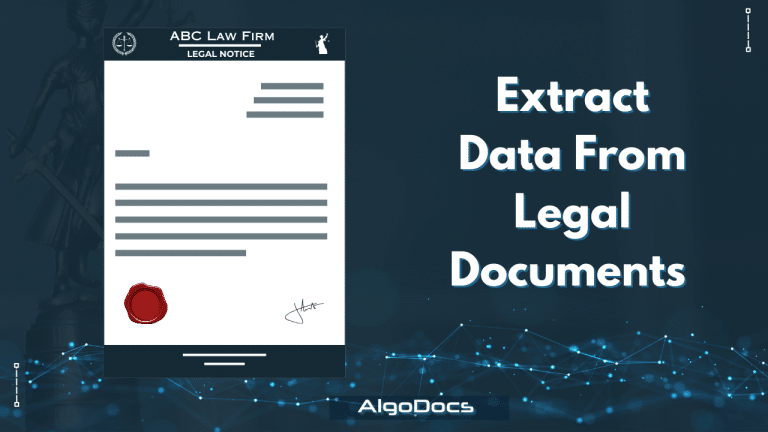
Data Extraction for Legal Industry : How Intelligent Document Processing (IDP) Can Transform Legal Industry Document Workflow

Back to Blog Table of contents On this page Data Extraction for Legal Industry : How Intelligent Document Processing (IDP) Can Transform Legal Industry Document Workflow Home › Blog › Data Extraction › Data Extraction for Legal Industry : How Intelligent Document Processing (IDP) Can Transform Legal Industry Document Workflow Categories Data Extraction Image Data Extraction Legal Document Extraction Tags AI algodocs data extraction IDP intelligent document processing Legal Industry machine learning By Shubhankar Biswas Published October 12, 2025, 16:36 Updated July 22, 2026, 10:08 The global law and legal services industry is expected to reach $1,591.56 billion by the end of 2032, according to a report. The legal industry primarily relies on information, with activities such as contracts, court filings, discovery documents, and legal research forming the foundation of every case and legal process. These tasks involve a significant amount of documentation and data. However, managing this mountain of data has always been a challenge for the legal industry. Traditional methods of manual review and data entry are time-consuming, expensive, and prone to human error. Fortunately, technologies such as Artificial Intelligence (AI) and Intelligent Document Processing (IDP) have revolutionized how law firms and legal departments handle data extraction from multiple documents and files, significantly improving their work efficiency. In this blog, we will discuss how IDP (Intelligent Document Processing) can enhance document processing efficiency for the legal industry and why Algodocs AI is an ideal document processing solution that can elevate data extraction and document management for legal service business owners. Data Extraction for Legal Industry : A Major Challenge for Law Firms and Legal Service Providers Data is the lifeblood of the legal profession and law firms. Whether it involves extracting key clauses from contracts, identifying vital information in discovery documents, or analyzing legal precedents, the ability to quickly and accurately extract data is critical. This is where IDP (Intelligent Document Processing) for the legal industry comes into play. IDP automates the process of identifying and extracting relevant information from various legal documents, transforming unstructured data into a structured, usable format. This process is vital for several reasons: Efficiency: Manual data extraction is notoriously slow and labor-intensive. IDP and AI automate this process, freeing legal professionals to focus on higher-value tasks like strategy and client interaction. Accuracy: Human error is inevitable when manually extracting data. IDP and AI solutions, such as Algodocs, significantly reduce errors, ensuring data integrity and reliability. Cost Savings: Manual data extraction is not cost-effective, especially when dealing with bulk documents, which are abundant in the legal industry. By automating data extraction, law firms and legal departments can reduce overhead costs and improve their bottom line. Improved Decision-Making: Extracted data can be analyzed to provide valuable insights, enabling lawyers to make more informed decisions and develop stronger legal strategies. The Limitations of Traditional Data Extraction Methods Before the advent of technologies like IDP, AI, or OCR, legal professionals relied heavily on manual methods for data extraction. These methods, while sometimes necessary, come with significant challenges: Time-Consuming: Sifting through hundreds or thousands of pages of legal documents to locate and extract specific information is tedious and time-intensive. Error-Prone: Manual data entry is susceptible to human error, which can have severe consequences in legal matters. Inconsistent: Manually extracted data can vary in format and accuracy depending on the individual performing the task, leading to inconsistencies and difficulties in analysis. Costly: Labor costs associated with manual data extraction can be significant, particularly for large-scale legal projects. These limitations highlight the need for a more efficient, accurate, and cost-effective solution for data extraction in the legal industry. This is where IDP steps in. How IDP Works IDP leverages the power of artificial intelligence (AI) technologies such as machine learning (ML), natural language processing (NLP), computer vision, and OCR to automate data extraction from legal documents. Here’s how it works: Document Ingestion: IDP solutions can ingest various document formats, including PDFs, scanned images, Word documents, handwritten notes, and emails. Pre-Processing: Documents undergo pre-processing steps like optical character recognition (OCR) to convert scanned images into machine-readable text and remove noise. Data Extraction: NLP and ML algorithms identify and extract relevant information based on pre-defined rules or learned patterns, such as clauses, dates, names, addresses, and financial figures. Data Validation: Extracted data is validated using techniques like cross-referencing and pattern matching to ensure accuracy. Output: The validated data is exported into a structured format, such as a spreadsheet or database, for easy analysis and use. The Benefits of IDP for Legal Data Extraction IDP offers numerous benefits for legal professionals seeking to streamline data extraction: Increased Efficiency: Automates the data extraction process, significantly reducing time and effort. Improved Accuracy: Minimizes human intervention, reducing errors and ensuring greater precision. Enhanced Consistency: Provides consistent data extraction across all documents, regardless of complexity. Reduced Costs: Cuts labor costs by automating repetitive tasks. Better Risk Management: Identifies potential risks and liabilities within documents. Improved Compliance: Ensures adherence to legal and regulatory requirements. Enhanced Client Service: Enables legal professionals to deliver faster, more accurate services. Use Cases of IDP in the Legal Industry Contract Analysis: Automatically extracts key details like parties, dates, payment terms, and clauses. Due Diligence: Speeds up the review process for mergers and acquisitions by analyzing contracts and financial statements. Discovery: Analyzes vast amounts of discovery data to identify relevant information and patterns. Legal Research: Automatically extracts relevant information from case law, statutes, and legal journals. Compliance Monitoring: Ensures documents adhere to regulations and internal policies. Choosing the Right IDP Solution To maximize its benefits, selecting the right IDP solution is crucial. Consider factors such as accuracy, scalability, integration, security, user-friendliness, and vendor support when making your choice. Algodocs: A Leading IDP Solution for Legal Industry Algodocs is a powerful IDP solution tailored to address the challenges of data extraction in the legal field. It automates document processing, ensures high accuracy, offers customizable data extraction, and integrates seamlessly with existing systems. By implementing Algodocs, law firms and legal departments can enhance efficiency, accuracy, and cost-effectiveness, enabling better outcomes for clients. Conclusion Intelligent Document Processing is transforming the legal industry by automating critical processes. By improving efficiency, accuracy, and cost-effectiveness, IDP empowers law firms and legal departments to

Scroll to Top