
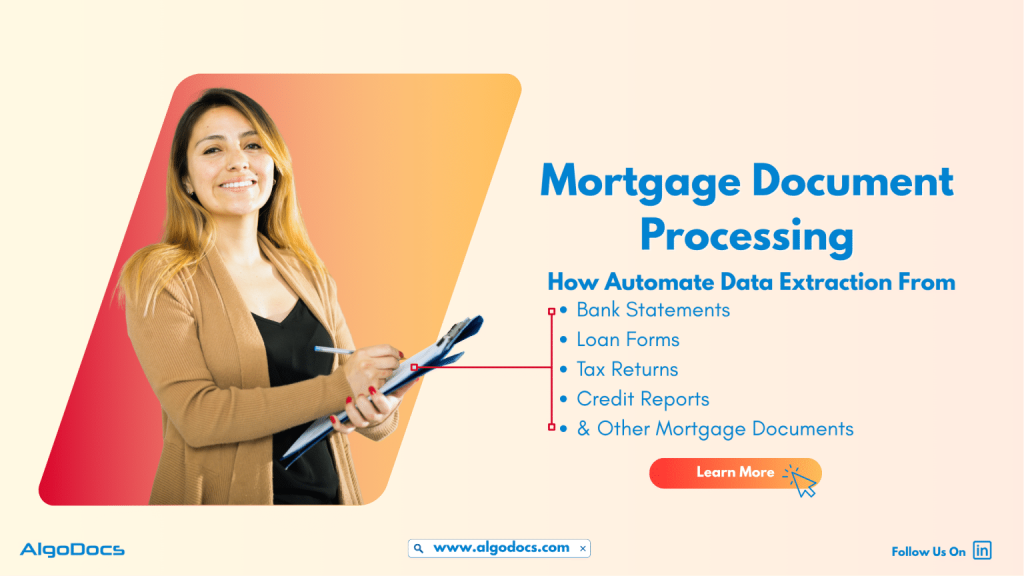
Mortgage Document Processing: How To Automate Data Extraction From Mortgage Documents Using AI
Back to Blog Table of contents On this page Mortgage Document Processing: How To Automate Data Extraction From Mortgage Documents Using AI Home › Blog › Algodocs › Mortgage Document Processing: How To Automate Data Extraction From Mortgage Documents Using AI Categories Algodocs Tags ai platform for data extraction algodocs By Shubhankar Biswas Published September 1, 2025, 06:27 Updated December 4, 2025, 21:45 Tasks such as document processing have always been a challenge for many industries for many years. One of the major industries that has been involved in this never-ending journey is the financial and mortgage industry. With tons of different types of mortgage documents such as loan application forms, bank statements, insurance documents, invoices, and the list goes on. But data extraction from these types of financial or mortgage documents has always been a mundane yet critical aspect of business growth. Why was it a mundane but challenging task? Because of the reliance on outdated data extraction methods like manual data extraction. This form of data extraction method is not only slow but also full of errors and other challenges which slow down data extraction efficiency and business growth. It also hampers the customer experience and the efficiency of the business as well.But the rise of technologies such as AI, ML, and Intelligent Document Processing technology has changed how banks, non-bank lenders, credit unions, and mortgage service providers automate the data extraction process with greater accuracy and speed. In this in-depth blog, we’ll explore what mortgage document processing entails, why it matters in today’s lending ecosystem, the types of documents involved, how AI and intelligent automation play a role, and how SaaS platforms are enabling this transformation. We will also refer to industry benchmarks and studies to offer a fact-driven perspective. Introduction The mortgage lending process involves a complex and time-consuming set of documentation tasks. Every loan application requires the handling of dozens, if not hundreds, of documents — from borrower income verification to title deeds and credit reports. Manually reviewing, validating, and organizing these documents introduces bottlenecks, increases the risk of error, and impacts borrower satisfaction. Mortgage document processing technology is addressing these inefficiencies by bringing automation and intelligence into the document lifecycle. The rise of intelligent document processing (IDP), machine learning (ML), and robotic process automation (RPA) has made it possible to handle large volumes of documents with speed and accuracy. What Is Mortgage Document Processing? Mortgage document processing refers to the digitization, extraction, classification, validation, and storage of documents related to the mortgage lifecycle. This includes automating data capture from scanned paper documents, PDFs, and digital forms, and transforming that unstructured data into structured formats that are machine-readable and easily integrated with loan origination systems (LOS) and customer relationship management (CRM) tools. A robust mortgage document processing system typically involves: Optical Character Recognition (OCR) Natural Language Processing (NLP) Data validation engines Compliance rule engines Integration with backend systems It plays a critical role from pre-qualification to underwriting, closing, and post-closing audits. Challenges in Traditional Mortgage Document Workflows Despite advancements in fintech, many mortgage processes still rely on manual workflows. According to a 2023 report by the Mortgage Bankers Association (MBA), more than 40% of lenders still rely on human-based document checks during underwriting. Key challenges include: High Error Rates: Manual data entry leads to typos and inconsistencies. Slow Turnaround: Loan processing can take 30–45 days due to document shuffling. Compliance Risk: Incomplete or missing documents may lead to regulatory issues. Customer Friction: Borrowers are required to resend or verify the same documents repeatedly. Operational Overhead: Loan processors spend 60–70% of their time managing paperwork. These inefficiencies result in delayed loan approvals, lost business opportunities, and poor borrower experiences. Key Mortgage Documents Involved Mortgage document processing covers a wide array of documents, including: Loan Application (Form 1003): The standard form capturing borrower information. W-2s and Pay Stubs: Used to verify income. Bank Statements: Needed to check assets and savings. Tax Returns: Offer insight into financial history. Credit Reports: Reflect creditworthiness. Title Documents: Confirm ownership and liens. Appraisal Reports: Assess property value. Disclosure Forms: Legal compliance and consumer protection. Closing Disclosure (CD): Final cost breakdown of the mortgage. Each document varies in structure, format, and critical data points, which makes manual processing highly error-prone. The Role of AI in Mortgage Document Processing Artificial Intelligence (AI) has fundamentally changed how mortgage document processing is done. AI-powered solutions use a combination of OCR, machine learning, and NLP to intelligently identify, extract, and validate data from structured and unstructured documents. Try Algodocs Free AI Data Extraction Tool To Automate Data Extraction From Mortgage Document Sign Up How AI Adds Value: Automated Classification: Classifies documents by type (e.g., W-2, tax return) even if mislabeled or scanned poorly. Data Extraction: Pulls out fields like name, income, address, SSN, and loan amount with high accuracy. Error Detection: Flags inconsistencies between documents (e.g., name mismatch). Learning Capabilities: AI models improve with training and feedback, offering higher accuracy over time. Leading SaaS providers now offer AI-enabled platforms with out-of-the-box mortgage document processing capabilities tailored for lending institutions. Benefits of Automated Mortgage Document Processing The impact of automation on mortgage processing is profound. According to a 2024 report by Deloitte, lenders using intelligent automation tools reduce loan processing time by 50% and cut document handling costs by up to 60%. Key benefits include: Faster Loan Turnaround: Automating document reviews significantly speeds up underwriting and approvals. Higher Accuracy: AI minimizes manual errors, improving data reliability. Better Compliance: Ensures all documents are complete, up to date, and audit-ready. Enhanced Scalability: Lenders can handle peak volumes without hiring temporary staff. Improved Customer Experience: Shorter wait times and fewer document requests create a frictionless journey. SaaS Solutions Transforming the Mortgage Landscape SaaS platforms are at the forefront of revolutionizing mortgage document processing. Cloud-based solutions offer real-time access, flexible scalability, and faster implementation compared to legacy on-premise systems. Features of Leading SaaS Mortgage Document Processing Platforms: Template-free data extraction Bulk document ingestion and auto-sorting APIs for integration with LOS and CRM systems Audit trail and document versioning Support for multiple file formats including scanned images, PDFs, DOC, etc. Custom validation rules and document checklists These solutions