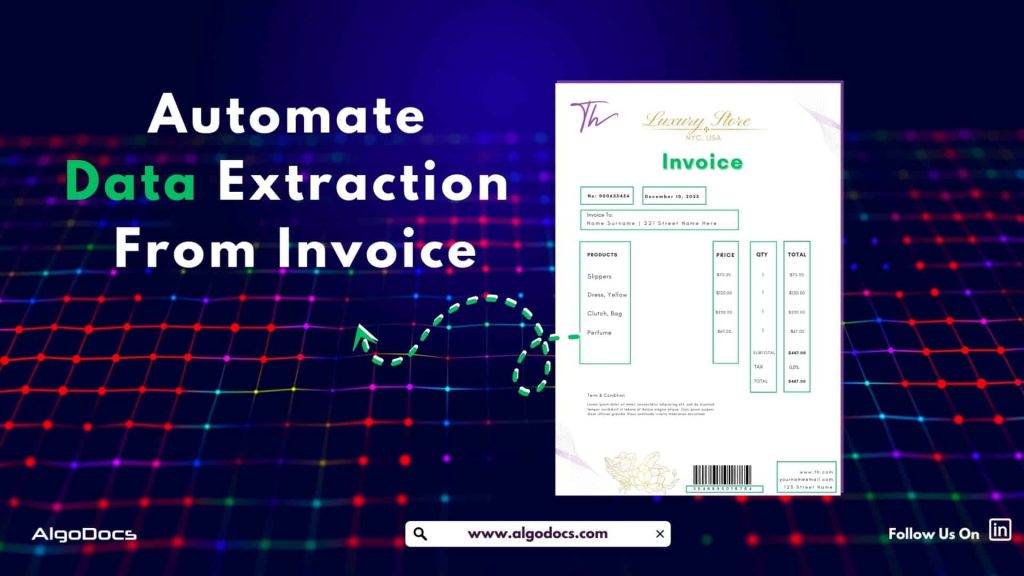
How to Extract Data from Invoice: Transforming Business Efficiency with AI In 2025
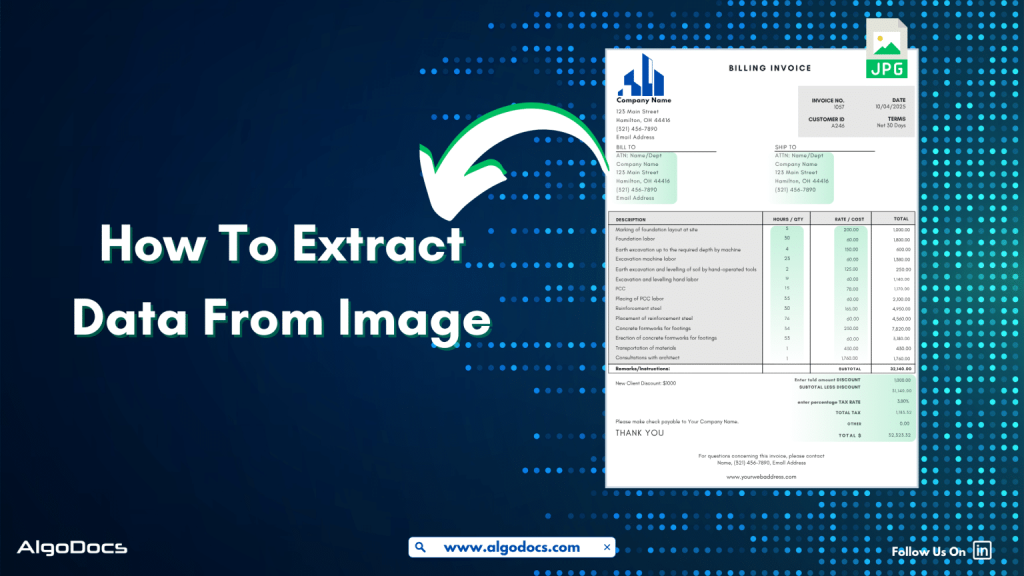
Back to Blog Table of contents On this page How to Extract Data from Invoice: Transforming Business Efficiency with AI In 2025 Home › Blog › Algodocs › How to Extract Data from Invoice: Transforming Business Efficiency with AI In 2025 Categories Algodocs Tags algodocs deep learning invoice automation Invoice Data Extraction By Shubhankar Biswas Published September 1, 2025, 07:46 Updated December 12, 2025, 19:42 In the modern, fast-paced digital world, businesses often handle a large volume of invoices and bills on a day-to-day basis. These invoices and bills contain critical information and financial details that must be extracted and processed accurately and efficiently to run the business smoothly. However, extracting data from invoices manually is both time-consuming and error-prone. This is where automated invoice data extraction becomes essential. By leveraging the power of Artificial Intelligence (AI) and Optical Character Recognition (OCR), businesses can extract data from invoices seamlessly, reducing manual efforts, enhancing accuracy, and improving operational efficiency. In this blog, we will explore the dimensions of how invoice data extraction works, the technology behind it, its benefits, challenges, and why AI-powered solutions like Algodocs are revolutionizing data extraction from invoices, saving time and cost. So, what is an invoice? An invoice is a document shared by the seller with the buyer to request payment for the service provided. In simple terms, when you, as a seller, offer services such as consultations, freelance work, or any other service, and you want the buyer to pay for the service provided, you will share a document with the buyer. This document contains essential information such as vendor details, buyer details, invoice date, payment details, service details, etc. Invoices are used in almost every industry, specifically by service providers, non-profit organizations, wholesalers, manufacturers, and other industries worldwide. What is invoice data extraction? Invoice data extraction is the process of capturing and extracting essential details from invoices and converting them into structured digital formats that can later be used for other business activities. This includes invoice numbers, dates, supplier details, line items, totals, and tax information. Automating this complex process helps businesses streamline financial operations, reduce human errors often associated with manual data extraction, and improve overall efficiency. An invoice can be a scanned image, a native PDF file, or a scanned image that has been converted into a single PDF file. How to Extract Data from Invoice Efficiently? The process of extracting data from invoices involves multiple steps to ensure accuracy and efficiency: Invoice Capture – Businesses receive invoices in various formats such as PDFs, scanned documents, and emails. AI-based systems can collect and organize these invoices for further processing. Preprocessing – Before extracting data, the system enhances the quality of scanned documents by removing noise, adjusting contrast, and correcting distortions. This step ensures better OCR accuracy. Optical Character Recognition (OCR) – The OCR technology scans the invoice to recognize and convert printed or handwritten text into machine-readable data. Data Structuring – AI-powered algorithms analyze the extracted text, identifying key fields like invoice numbers, dates, vendor names, and line-item details. The information is then formatted into a structured digital format. Validation & Verification – To ensure accuracy, the extracted data is cross-checked with predefined business rules, databases, and compliance standards. Any discrepancies are flagged for review. Integration & Storage – The verified data is stored in databases or seamlessly integrated into enterprise resource planning (ERP) systems, accounting software, or other financial management tools for further use. Technologies Used to Extract Data from Invoice AI and machine learning advancements have significantly improved invoice data extraction. The core technologies involved include: Optical Character Recognition (OCR): OCR is the core technology that converts printed and handwritten text into digital formats, enabling automated data extraction from invoices with high accuracy. Natural Language Processing (NLP): Helps the system understand invoice structures, identify key information, and improve data classification. Machine Learning (ML): Learns from past extractions to enhance accuracy, adapt to different invoice layouts, and predict missing data fields. Robotic Process Automation (RPA): Automates repetitive tasks such as invoice sorting, classification, and data entry into accounting systems. Intelligent Document Processing (IDP): Combines OCR with AI, NLP, and ML technologies to understand invoice context, extract relevant details, and organize structured data. IDP is a new phenomenon that handles challenges like skewed and blurry invoices, extracting data with precision and speed where traditional OCR fails. Benefits of Extracting Data from Invoice Automatically Looking For The Best All-In-One Invoice Data Extraction Tool? Try Algodocs Invoice Data Extraction Tool For Free and Access All The Paid Features For Free. Create A Free Account Today Create Free Account Automating invoice data extraction offers multiple advantages: Increased Efficiency – AI-driven automation eliminates the need for manual data entry, significantly reducing processing time and improving workflow efficiency. Improved Accuracy – Automated systems minimize human errors in data extraction, ensuring high precision and reliable financial records. Cost Savings – Businesses can cut down labor costs and operational expenses associated with manual invoice processing. Faster Payments & Approvals – Streamlined data extraction allows for quicker invoice approvals, enabling faster payments and improving vendor relationships. Scalability – AI-powered tools can handle thousands of invoices per day, making them ideal for businesses experiencing rapid growth. Better Compliance & Security – Automated extraction ensures adherence to financial regulations, reduces fraud risks, and provides a secure audit trail. Seamless Integration – Extracted data can be effortlessly integrated with ERP, accounting, and financial management software, enhancing workflow automation. Challenges in Extracting Data from Invoice Despite its benefits, invoice data extraction presents certain challenges: Invoice Format Variability: Different vendors use different invoice formats, which can complicate automated data extraction. AI-based solutions continuously learn and adapt to various templates. Handwritten Text Recognition: While OCR can process printed text efficiently, handwritten invoices, poor-quality scans, and smudged text may reduce extraction accuracy. Complex Data Structures: Some invoices contain intricate tables, multiple tax categories, and detailed line items that require advanced data processing capabilities. Integration Issues: Businesses may face technical difficulties integrating extracted data with existing accounting or ERP systems without proper API support. Initial Setup Costs: Implementing AI-powered invoice extraction requires investment in software,