Algodocs

Author name: Shubhankar Biswas

Best Intelligent Document Processing Software
intelligent document processing

Best Intelligent Document Processing Software in 2025: Features, Benefits & Comparison

Back to Blog Table of contents On this page Best Intelligent Document Processing Software in 2025: Features, Benefits & Comparison Home › Blog › intelligent document processing › Best Intelligent Document Processing Software in 2025: Features, Benefits & Comparison Categories intelligent document processing By Shubhankar Biswas Published September 1, 2025, 07:45 Updated July 23, 2026, 06:23 Imagine having over 10,000 documents on your desk and needing to extract data from all of them within a limited timeframe. How would you manage? Manually processing such a large volume of documents could take weeks or even months, increasing the likelihood of errors along the way and finding best intelligent document processing software can be a real challenge. Fortunately, with AI-powered Intelligent Document Processing (IDP) software, you can extract data from multiple documents with high accuracy and efficiency while automating the entire process—allowing you to focus on more critical tasks. With IDP, you can seamlessly extract data from invoices, contracts, medical records, legal documents, and more, significantly improving speed, accuracy, and efficiency. This not only enhances business performance but also helps organizations achieve their goals more effectively. By leveraging Artificial Intelligence (AI), Machine Learning (ML), and Optical Character Recognition (OCR), IDP automates document classification, data extraction, and processing—making your workflow smoother and more efficient. However, with so many Intelligent Document Processing solutions available in the market, selecting the right tool for your business can be overwhelming. That’s why we’ve created this guide—to help you understand the key factors to consider when choosing an IDP solution and why Algodocs stands out as the best Intelligent Document Processing platform for data extraction for your business. What is Intelligent Document Processing? Intelligent Document Processing (IDP) is an advanced document processing technology that combines Artificial Intelligence (AI) and Machine Learning (ML) with traditional Optical Character Recognition (OCR) to automate the extraction, classification, and organization of data from both structured and unstructured documents. Unlike traditional OCR, which only identifies printed text, IDP solutions leverage Machine Learning and Natural Language Processing (NLP) to understand context, enhance accuracy, and seamlessly integrate with existing enterprise systems. One of the key advantages of Intelligent Document Processing is its ability to extract data even from blurry, skewed, or unstructured documents—capabilities that traditional OCR lacks, as it primarily relies on structured formats. Additionally, IDP software can integrate with third-party applications through APIs or prebuilt integrations, enabling real-time data transfer between external systems and IDP platforms. This not only enhances efficiency but also saves organizations valuable time and operational costs. How Intelligent Document Processing Software Works intelligent Document Processing (IDP) primarily leverages Artificial Intelligence (AI), Machine Learning (ML), and Large Language Models (LLM) combined with Optical Character Recognition (OCR) to extract and process data from PDFs, scanned images, invoices, bills, purchase orders, and other documents. It captures unstructured data from these sources and transforms it into a structured format that is easily readable and interpretable by computers. Additionally, IDP software automates the entire document processing workflow by integrating with third-party applications, significantly reducing the time required for data extraction and processing. The true power of Intelligent Document Processing lies in its AI and ML capabilities, which are trained on vast datasets to recognize complex text formats and document layouts. This enables efficient data extraction from various types of documents, including blurry or low-quality images. The LLM (Large Language Model) within IDP software is continuously trained to enhance extraction accuracy across different document types and file formats, ensuring greater precision and reliability. Key Benefits of IDP Software Intelligent Document Processing (IDP) software empowers businesses to maximize productivity and efficiency by eliminating the repetitive, manual tasks associated with data extraction. Below are the key benefits that make IDP software a valuable investment for organizations: Automation: IDP tools streamline data extraction and preprocessing, eliminating the need for manual work. By automating these processes, businesses save time, resources, and costs while allowing employees to focus on more critical tasks. Accuracy: Manual data extraction is prone to human errors, which can lead to costly mistakes. IDP platforms leverage AI and ML technologies to minimize errors, ensuring high accuracy in data extraction and processing. Scalability: IDP software allows businesses to process large volumes of documents without requiring additional manpower. Organizations can scale their document processing operations up or down based on demand, reducing unnecessary expenses. Seamless Integration: IDP software integrates effortlessly with existing business applications, facilitating smooth data exchange across platforms. With APIs and prebuilt integrations, IDP platforms can connect with ERP, CRM, HR, and other enterprise systems. Data Security: Protecting sensitive business and financial data is crucial. IDP software ensures compliance with security regulations by maintaining encrypted and organized records accessible only to authorized personnel. Best Intelligent Document Processing Software Algodocs: The Leading IDP Solution: Algodocs is the best AI-based Intelligent Document Processing software that enables businesses to automate data extraction from invoices, bills, financial documents, HR forms, purchase orders, and other document types with high accuracy and speed. It leverages AI-driven OCR and ML-based data extraction techniques to streamline workflows and improve operational efficiency. With its new Generative AI feature, users can extract data from invoices, bills, bank statements, and ID cards effortlessly. Key Features of Algodocs: AI-Powered Data Extraction: Extracts tables, fields, selection marks, and key information from structured and unstructured documents. Customizable Workflows: Users can define specific extraction rules to match their business needs. Support for Multiple Formats: Works with PDFs, scanned images, invoices, receipts, contracts, and more. Cloud-Based & Secure: Ensures data security with end-to-end encryption and cloud accessibility. Integration with Other Applications: Seamlessly integrates with ERP, accounting tools, CRMs, and other business software. With its user-friendly interface, high accuracy, and automation capabilities, Algodocs is an ideal solution for businesses looking to enhance their document processing efficiency. Nanonets Nanonets is an IDP platform that allows users to build and train custom models for document processing. It supports automation workflows, integrates with various APIs, and ensures seamless data extraction for industries like finance, healthcare, and logistics. Docsumo Docsumo specializes in processing financial and business documents, such as invoices, bank statements, and tax forms. It offers pre-trained models that enhance data extraction accuracy while
Algodocs

How to Use AI to Improve KYC Document Processing and Data Extraction: Features, Benefits, Challenges, and Tools

Back to Blog Table of contents On this page How to Use AI to Improve KYC Document Processing and Data Extraction: Features, Benefits, Challenges, and Tools Home › Blog › Algodocs › How to Use AI to Improve KYC Document Processing and Data Extraction: Features, Benefits, Challenges, and Tools Categories Algodocs Tags ai platform for data extraction algodocs KYC machine learning By Shubhankar Biswas Published September 1, 2025, 07:42 Updated July 13, 2026, 09:54 KYC is one of the most important processes in sectors such as banking, finance, travel, and more. With the help of KYC documents, businesses ensure the proper and smooth transaction of services to their customers. However, KYC data extraction and document processing is a delicate and challenging task, and manually performing such a crucial process has many drawbacks, such as data inaccuracy, slow data processing, and human errors, which can create significant problems. But with the help of technologies such as artificial intelligence, machine learning, and intelligent document processing, businesses can improve data extraction accuracy, reduce time, and handle more customers in less time. In this blog, we will explore how AI can improve KYC document verification processing by effectively extracting data from ID cards, passports, and other identity documents. We will also discuss the challenges associated mainly with manual data extraction, how to overcome them with AI and IDP, the best tools available in the market, and how Algodocs is a great tool for KYC document processing and data extraction. Understanding KYC Verification and KYC Document Processing and Data Extraction KYC, or Know Your Customer, is the process of identifying personal details from identity documents such as ID cards, government-issued documents, passports, or other documents used by a company to provide various types of services to its customers. The sole purpose of KYC verification is to check the legitimacy of customer data provided to the company to avail of a service. These services may include approving a bank loan for a customer by a financial institution or granting a visa for travel by some countries’ border agencies. KYC verification or KYC data extraction is used by many organizations and businesses worldwide to access useful information about a person or customer. KYC document processing involves extracting data from identity documents such as ID cards, passports, and government-issued documents. These details include a customer’s name, DOB, address, financial details, age, country, etc. Extracting data can be done either manually or using sophisticated technologies such as intelligent document processing tools, AI, and machine learning to automate the entire process. How AI Enhances KYC Data Extraction and Document Processing With the help of AI, KYC document processing and data extraction can be greatly improved. Below are a few features of AI that help improve KYC data extraction and processing: 1. Document Classification AI can automatically identify and sort documents—passports, utility bills, or tax forms—using ML models trained on vast datasets. This eliminates manual categorization, paving the way for seamless KYC data extraction. 2. Advanced OCR for KYC Data Extraction Traditional OCR technology is limited as it only converts images to text, but AI-powered OCR excels at KYC data extraction by pinpointing specific fields—like names or ID numbers—despite poor image quality or varied layouts. This is especially useful for ID card data extraction, where precision is critical. One of the biggest advantages of AI-powered OCR is that it delivers 100% data accuracy, while traditional OCR fails to do so. 3. Data Validation and Cross-Checking Once KYC data extraction is done, AI can accurately validate the information against databases (e.g., government records or credit bureaus). It flags inconsistencies—like mismatched addresses—ensuring identity data processing is reliable and compliant. This saves time, whereas manual data extraction for KYC takes a significant amount of time. 4. Fraud Detection AI analyzes patterns to detect fraud, such as forged IDs or synthetic identities. Techniques like computer vision scrutinize document details during KYC data extraction, identifying tampering that human reviewers might miss. 5. Continuous Learning AI models adapt over time and are continuously trained on vast amounts of data, which improves accuracy in KYC data extraction and document verification as they process more data. This ensures they stay effective even as document types evolve. 6. Workflow Automation By integrating with robotic process automation (RPA), AI orchestrates the entire KYC pipeline—from ID card data extraction to data entry—reducing human effort and accelerating onboarding. Benefits of AI in KYC Data Extraction AI-driven KYC data extraction delivers significant advantages for businesses, customers, and regulators. Here’s why: Try Algodocs Free KYC Data Extraction Tool For Free 1. Increased Efficiency Manual KYC data extraction can take hours to extract data from a single document, but AI reduces this to minutes. By automating the entire process, organizations can improve the efficiency of KYC document processing and extraction. 2. Enhanced Accuracy The manual approach is prone to errors, which can create big issues with data accuracy. Errors in manual KYC data extraction—like typos in ID numbers—can lead to compliance issues. AI’s precision in ID card data extraction and validation minimizes mistakes, ensuring accurate results. 3. Cost Reduction Hiring staff for document verification and KYC data extraction is costly. AI reduces labor dependency, lowering expenses while maintaining quality—a clear win for scalability. 4. Improved Customer Experience Slow KYC document processing can lead to slow onboarding, frustrating customers, and harming a company’s reputation. AI’s fast KYC data extraction—such as real-time ID card data extraction—creates a seamless process, boosting satisfaction and retention. 5. Stronger Compliance Regulations like those from the Financial Action Task Force (FATF) demand rigorous identity data processing. AI ensures compliance by flagging risks and maintaining auditable records during KYC data extraction. 6. Scalability As customer bases grow, so do KYC demands. AI scales effortlessly, handling thousands of KYC data extraction tasks daily without added overhead. 7. Fraud Prevention With financial crime rising, AI’s ability to authenticate documents during KYC data extraction strengthens security, protecting businesses from fraud-related losses. Challenges of Implementing AI for KYC Data Extraction Despite its promising features and benefits, integrating

packing list data extraction
Algodocs

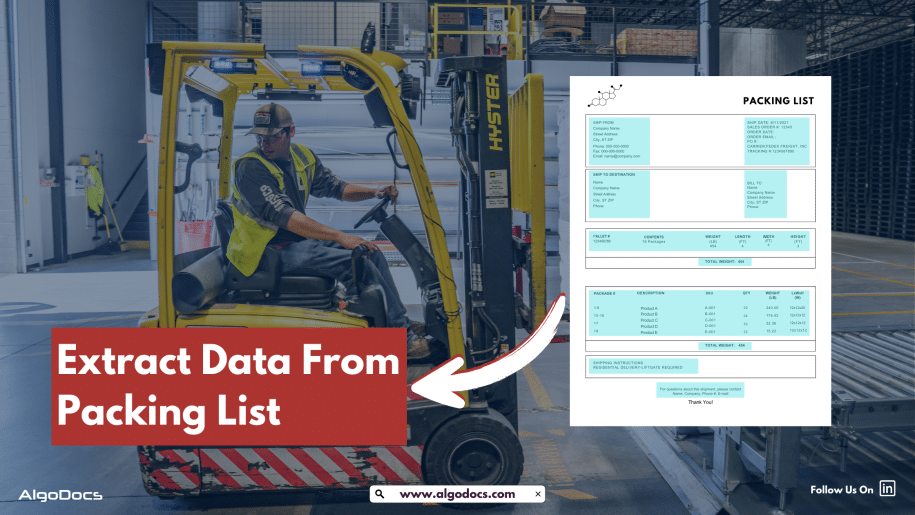
How to Automate Packing List Data Extraction: A Practical Guide

Back to Blog Table of contents On this page How to Automate Packing List Data Extraction: A Practical Guide Home › Blog › Algodocs › How to Automate Packing List Data Extraction: A Practical Guide Categories Algodocs Tags ai platform for data extraction algodocs invoice Logistics machine learning packing list ocr By Shubhankar Biswas Published September 1, 2025, 07:38 Updated July 21, 2026, 05:30 A packing list document is essential in freight, cargo, logistics, warehousing, and other industries worldwide. This document contains information about the items, such as their weight, quantity, seller information, buyer information, and destination. Packing list data extraction might not seem like the most exciting task in the world, but if you’re part of a business dealing with logistics, shipping, or supply chain operations, you already know how important these documents are. As straightforward as it sounds, extracting data from these lists can quickly turn into a time-consuming and error-prone chore, especially when done manually. Manual data extraction is slow and full of human errors, which can lead to many organizational troubles, such as increased costs for data extraction. However, using AI-based tools such as Intelligent Document Processing can improve data extraction accuracy, speed, and elevate work efficiency from packing list documents. In this article, we will discuss what a packing list document is, where it is used, the challenges of extracting data from packing lists, how AI-based tools such as Intelligent Document Processing can solve this issue and automate packing list data extraction, and how Algodocs is a game changer for automating packing list data extraction using AI and ML technology. What is a packing list document? A packing list document is a detailed checklist used in shipping to show what’s inside a package or shipment. It includes the product names, quantities, and descriptions of items, along with packaging details (like boxes or bags). Unlike an invoice, it focuses only on the shipment’s contents without mentioning prices. Packing lists help avoid errors, ease customs checks for international shipments, and allow receivers to verify their goods. For senders, it ensures everything planned is shipped; for transporters, it offers clarity for delivery; for receivers, it provides a quick confirmation of their items. It’s a simple yet vital tool in logistics. Where Packing List Document is Used? Packing list documents are widely used in industries involved in shipping, logistics, and trade. Here are some key industries where they play a vital role: Manufacturing: To ensure the safe and accurate delivery of products to customers or distributors. Retail and E-commerce: For tracking and verifying items during order fulfilment and delivery. Import and Export: To comply with customs regulations and ensure smooth international shipping. Freight and Logistics: For managing cargo and verifying shipment contents. Construction: To track materials and equipment deliveries to project sites. Packing lists are crucial for maintaining transparency and accuracy in these industries. So, What is Packing List Data Extraction? Packing list data extraction refers to the process of extracting key information from packing list documents. This data includes product names, item quantities, weights, buyer and seller information, packing details, etc. Packing list documents are used in logistics, shipping, and supply chain operations. You can manually extract data from a packing list, which involves a human doing this, or you can use automated tools such as a packing list OCR tool or AI-based intelligent document processing to automate data extraction from packing list. The Challenges With Manual Data Extraction from Packing List Manually extracting data from packing lists might work when you’re dealing with just a handful of shipments, but scale that up, and it becomes a nightmare. Here’s why manual methods are often more trouble than they’re worth: It Takes Forever: You have to carefully comb through each document, hunting for the information you need. It’s boring and eats up tons of time. Mistakes Happen: Humans get tired, and it’s easy to misread numbers, miss details, or make typos. It’s Expensive: Paying people to sit and type data all day isn’t exactly cost-effective. It’s Hard to Keep Up: As your business grows and you handle more shipments, the workload becomes unmanageable. Packing Lists Aren’t Standardized: They come in all shapes and sizes, so it’s not always clear where to find the info you need. Clearly, manual data entry isn’t the best way to go. Thankfully, technology offers a better option. Automate Packing List Data Extraction With AI When it comes to automating packing list data extraction, two key technologies do most of the heavy lifting: Optical Character Recognition (OCR) and Artificial Intelligence (AI). Try Algodocs Packing List AI OCR For Free What’s OCR? OCR is a technology that turns text in scanned documents (or even photos) into machine-readable data. So, if you’ve got a packing list in PDF or image format, OCR can “read” it and pull out the info you need. Pretty cool, right? Here’s what makes OCR so useful: Recognizes Text: It doesn’t matter if the text is printed, typed, or handwritten—OCR can handle it. Works with Templates: You can tell it what fields to look for (like product names or quantities), and it’ll find them. Supports Different Formats: Whether it’s a clean digital PDF or a scanned, slightly crooked image, OCR can adapt. How AI Makes It Even Better AI takes OCR to the next level with solution like intelligent document processing, the entire data extraction from packing list document can be automated with one click. Instead of just following templates, AI can actually “understand” the data it’s extracting, adapting to different layouts and contexts. Here’s what AI brings to the table: Smarter Extraction: It can recognize patterns and figure out where specific info is located, even in unstructured documents. Learning Capabilities: The more it’s used, the better it gets. Language Support: Perfect for businesses that deal with global shipments. Together, OCR and AI make automating packing list data extraction not just possible but incredibly efficient. Why Automate Packing List Data Extraction Automation isn’t just a buzzword—it actually solves a lot of the issues we talked about earlier. Here’s what you get by automating your packing list data

extract data from bank cheque
Algodocs

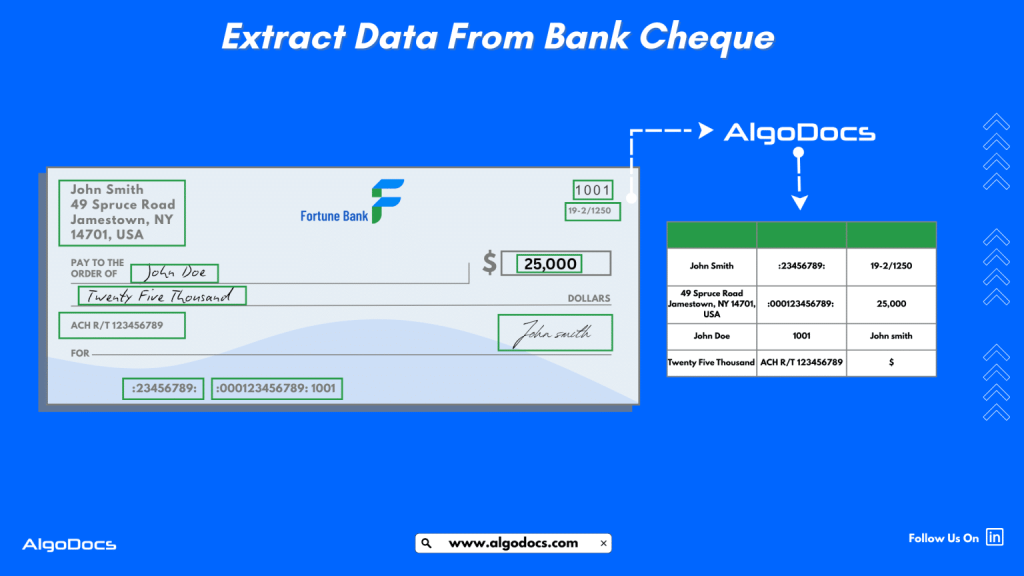
extract data from bank cheque: With AI and ML

Back to Blog Table of contents On this page Making Bank Cheque Data Extraction Easy: With AI and ML Home › Blog › Algodocs › Making Bank Cheque Data Extraction Easy: With AI and ML Categories Algodocs Tags algodocs bank ocr data extraction from images Finance ocr machine learning ocr api By Shubhankar Biswas Published September 1, 2025, 07:35 Updated July 13, 2026, 09:21 Imagine this: you visit your bank to deposit a cheque, only to find out it’ll take days to process because every data validation and processing from the cheque will be done manually. Frustrating, right? Now, picture a world where that same cheque is scanned, analysed, and processed in seconds—all without a single human hand touching it. That’s the magic of AI, which makes bank cheque data extraction smooth and more efficient. This is technology that’s quietly transforming the way banks operate. In today’s fast-paced digital age, where time is money, automating data extraction from bank cheques has become a necessity for financial businesses. Whether you’re a banker, a business owner, or just someone who occasionally uses cheques, understanding this process can save you time, effort, and headaches. In this blog, we’ll dive deep into what bank cheque data extraction is all about, how it works, and why cutting-edge tools like AI and ML are improving bank cheque data extraction. We’ll also explore challenges associated with bank cheque data extraction and how tools like Algodocs are game-changers for these types of operations. So, let’s get started! What is a Bank Cheque? Before we dive into the world of bank cheque data extraction, we need to understand what a bank cheque is. So, let’s cover its basics. Basically, a bank cheque is like a promise on paper. It’s a document you write and sign, telling your bank to take money from your account and give it to someone else—or even yourself if it’s a self-cheque. Think of it as a secure, old-school way to move money around without carrying cash. Cheques have been around for centuries, and even in today’s world of digital payments, they’re still widely used, especially for big transactions like paying rent, settling bills, or business deals, etc. They’re simple, reliable, and trusted. But processing them manually? That’s where things get slow and messy. That’s why we need smarter solutions—like automated bank cheque data extraction solutions—to keep up with modern demands. So What are the Components of a Bank Cheque? So, what makes up a cheque? It’s not just a random piece of paper—it’s packed with important details that tell the bank what to do. Here’s a quick rundown of the key parts: Payee Name: This refers to the individual, business, or entity receiving the payment. On a cheque, it’s typically written following the phrase “Pay to the order of” on a designated line. Accuracy is key here—any misspelling or incorrect naming could lead to processing issues or the cheque being rejected by the payee’s bank. Amount: The exact sum of money being transferred, recorded in two distinct formats for clarity and security. The courtesy amount is written in numerals (e.g., $50.75) in a box or space provided, making it quick to read. The legal amount is spelled out in words (e.g., “Fifty dollars and 75/100”) on a separate line, serving as the official figure in case of disputes or discrepancies. This dual notation helps prevent alterations or misinterpretation. Date: The specific day the cheque is written or issued, usually entered in a format like MM/DD/YYYY (e.g., 04/04/2025). This is critical because banks may not honor cheques deemed “stale-dated”—typically those older than six months—though policies can vary by institution. Some cheques can also be postdated (dated for a future day), but acceptance depends on the payee and bank. Account Number: A unique identifier assigned to your bank account, printed at the bottom of the cheque as part of the MICR line (Magnetic Ink Character Recognition). This string of digits, often following the routing and cheque numbers, tells the bank which account to debit. The MICR line uses special magnetic ink, enabling automated processing by bank machines for efficiency and accuracy. Routing Number: A 9-digit code that identifies your financial institution within the banking system, also located in the MICR line (usually the first set of numbers). This number ensures the cheque is routed to the correct bank or credit union for processing. It’s standardized across the U.S. by the American Bankers Association (ABA) and is essential for domestic transactions. Cheque Number: A unique serial number assigned to each cheque, typically printed at the top-right corner and/or within the MICR line. This identifier helps you, your bank, and the payee track the specific cheque, especially useful for record-keeping, reconciling accounts, or investigating issues like lost or disputed payments. Signature: Your handwritten authorization, usually placed on a line at the bottom-right of the cheque. This acts as your official approval for the bank to release funds, making it a critical security feature. Without a valid signature matching the one on file with your bank, the cheque is considered invalid and will not be processed. Bank Name and Address: The name and often the physical or mailing address of the financial institution issuing the cheque, printed prominently on the document. This information identifies which bank or credit union is responsible for honoring the payment, providing transparency to the payee and facilitating communication if issues arise during processing. What is Bank Cheque Data Extraction? Bank cheque data extraction is the process of pulling out all those key details—such as the payee’s name, amount, account number, cheque number, and other important information—from a cheque with the help of automated tools or manually by humans. Instead of a bank employee squinting at handwriting or typing numbers into a system, machines do the heavy lifting. It’s like giving the cheque a quick scan, and the computer captures and extracts all the information from a bank cheque. A bank cheque can be a physical paper on which all the details are written,

Data Extraction, Optical Character Recognition

What Is Zonal OCR? An Easy Guide to Understanding Zonal OCR and How It Works.

Back to Blog Table of contents On this page What Is Zonal OCR? An Easy Guide to Understanding Zonal OCR and How It Works. Home › Blog › Data Extraction › What Is Zonal OCR? An Easy Guide to Understanding Zonal OCR and How It Works. Categories Data Extraction Optical Character Recognition Tags character recognition ocr api By Shubhankar Biswas Published September 1, 2025, 07:27 Updated July 20, 2026, 11:11   Processing data from bulk documents can be an annoying and time-consuming task if you have to extract this data manually. But with the help of modern technology such as optical character recognition, you can extract data from these documents easily. There is another part of OCR technology known as zonal OCR, which lets you extract specific data from specific sections of a PDF or scanned image. That is known as zonal OCR. So, what is Zonal OCR, and how does it work? We will discuss more in detail below. Understanding the Basics: OCR VS Zonal OCR? Before we explain what zonal OCR is, we first need to understand what OCR technology is and how it works.OCR stands for Optical Character Recognition. It was developed in the late 70s and started to gain traction in the late 80s. One of the main reasons it gained popularity in the 80s was because it started to be used by banks to extract data from various types of documents, which helped them save time and improve data extraction quality. Later, OCR was adopted in business, marketing, and other industries all around the world.The main function of traditional OCR technology is to convert different types of documents such as scanned paper documents, PDFs, or images into editable and searchable data. An OCR tool “reads” text on an image and turns it into digital letters that are editable on a computer. For example, if you scan a printed invoice and use OCR software, the software can pull out the name, address, and price from that scanned image and turn it into usable text. But classic OCR tools extract all the presented data in a document, and you can’t control what to extract and what not to—that’s where zonal OCR comes into play. What Is Zonal OCR? Now that we know what OCR is, let’s answer the main question—what is zonal OCR?Zonal OCR is a more focused and intelligent version of regular OCR. Instead of scanning an entire document and pulling out all the text, zonal OCR extracts data from specific areas or “zones” of a document. That’s why it is called zonal OCR or is known as template OCR as well. These zones are predefined sections where certain types of information always appear.Think of it like this: if every invoice you receive has the “Invoice Number” in the top right corner, Zonal OCR can be trained to look at just that area and pull the number out automatically. It ignores everything else and goes straight to the point. That makes it incredibly efficient and reliable for high-volume document processing. One of the major highlights of zonal OCR is that it is more accurate compared to traditional OCR. So, How Does Zonal OCR Work? Let’s break down how Zonal OCR works in a step-by-step process: Template Definition: First, you define zones on a document template. These zones are rectangular areas where key data lives—like names, dates, invoice numbers, etc. Document Scanning: When a new document comes in, it is scanned or uploaded to the system. Zone Detection: The Zonal OCR engine locates the defined zones on the document. Data Extraction: The engine reads the text from those zones and extracts it into a structured format like CSV, JSON, or directly into a database. Post-Processing: Extracted data can be validated, verified, or even pushed into downstream workflows like CRMs, ERPs, or RPA systems. Features of Zonal OCR What makes zonal OCR so powerful is its accuracy. Traditional OCR might pick up irrelevant text or make errors when faced with complex layouts. But zonal OCR knows exactly where to look because we have already defined the zone from where data needs to be picked and extracted. That means fewer errors, faster processing, and smoother workflows. Real-World Example: Zonal OCR For Medical Billing Imagine a hospital that receives thousands of medical bills every month. These documents have patient names, billing codes, diagnosis details, health insurance info, and payment terms.Using zonal OCR, the hospital can define zones on its standard bill layout:• Top left for patient name• Top right for bill number• Centre zone for treatment codes and costs• Bottom section for insurance informationEach incoming bill gets processed automatically. The software reads just those parts and enters the data into the hospital’s billing system. No manual typing. No human errors. Just fast, accurate data extraction. Where Zonal OCR Is Used Zonal OCR is widely used in different industries that handle large volumes of documents with structured layouts. Here are some common use cases:• Healthcare: Extracting patient data, diagnosis reports, medical codes, and insurance details from forms and bills.• Finance: Pulling out transaction info, invoice numbers, and payment dates from bank statements or receipts.• Logistics: Reading shipping labels, barcodes, and delivery addresses.• Legal: Extracting case numbers, parties involved, or dates from legal filings.• Retail: Processing receipts and purchase orders for inventory management. Why Businesses Need Zonal OCR Now that you understand what zonal OCR is, let’s explore why it’s such a vital tool for modern businesses.Saves TimeManual data entry is slow and expensive. Zonal OCR does in seconds what might take a person several minutes or hours.Reduces ErrorsHumans make mistakes, especially when tired or rushed. Zonal OCR provides consistent and accurate results.Scales EasilyWhether you process 10 or 10,000 documents a day, zonal OCR can handle it. It grows with your needs.Easy IntegrationMost zonal OCR systems can plug right into your existing software—like CRMs, ERP tools, or cloud databases.Improves ComplianceAccurate document processing means better audit trails, stronger recordkeeping, and improved compliance with industry regulations. Zonal OCR vs Full-Page OCR You might be wondering, “Why not just use

Data Extraction

OCR In Healthcare: Revolutionizing Medical Document Processing for Better Patient Care

Back to Blog Table of contents On this page OCR In Healthcare: Revolutionizing Medical Document Processing for Better Patient Care Home › Blog › Data Extraction › OCR In Healthcare: Revolutionizing Medical Document Processing for Better Patient Care Categories Data Extraction Tags algodocs healthcare data extraction healthcare ocr By Shubhankar Biswas Published September 1, 2025, 07:14 Updated July 20, 2026, 05:04 Imagine working at a hospital and having to extract and organize data from various types of hospital and healthcare documents such as patient forms, health insurance documents, lab reports, etc. How will you do it? Not manually, for sure. That’s where OCR for healthcare comes in. These important documents can be in the form of PDFs, scanned images, docs, or handwritten notes. Extracting data from these manually can be challenging for human eyes. Also, extracting data from a document manually is a slow process and full of errors. But with the help of healthcare OCR technologies, we can improve the healthcare document workflow and provide better healthcare service to patients. In this article, we will discuss the benefits of OCR for the healthcare industry, how OCR and AI are improving healthcare document processing and serving the patients in real-time, the challenges with manually extracting data from healthcare documents, and how AI is improving the healthcare document workflow with OCR technologies. So, before we jump into OCR for healthcare, we need to understand what OCR is. So, what is OCR? Optical Character Recognition or OCR is a technology that extracts data and converts it into machine-readable format so that computers can understand it. Simply put, it converts data from PDFs, scanned images, and docs to editable formats. OCR technology is a very old technology that has been used by many different industries for different purposes. One of the main advantages of using OCR technology for data extraction is that it can extract data from PDFs, scanned images, and documents with great speed and higher accuracy compared to the manual data extraction approach. The old manual data extraction approach is slow and full of human errors, which oftentimes leads to data discrepancies and high error rates. But on the other hand, OCR eliminates these challenges by providing data extraction with greater precision and faster speed from documents. What is OCR in Healthcare? We have covered what OCR technology is—now let’s talk about what OCR in healthcare means. OCR in healthcare is a technology that extracts data from healthcare documents such as patient forms, medical prescriptions, insurance documents, lab reports, and other healthcare documents. We can refer to this as a customized OCR tool that is specifically fine-tuned to automate and extract data from healthcare documents.The benefit of healthcare OCR tools is that they automate data extraction from documents with great speed and accuracy, which isn’t possible with manual data extraction approaches. This eventually improves document workflow efficiency, staff productivity, and serves patients in a more efficient and timely manner. Why OCR Technology is Essential for Healthcare We all understand the importance of data accuracy and time when it comes to serving a patient with greater care. Doctors, pathologists, labs, and other hospital departments need to access data in a very timely manner. But if we go with the manual data approach, delays in data extraction and collaboration can be fatal for a patient’s life. One of the main advantages of OCR for the healthcare industry is: Faster data retrieval – For better clinical decisions, doctors and healthcare providers need to access patient data quickly. Healthcare OCR helps by automating data extraction and organizing it for faster retrieval. Enhanced patient experiences – When it comes to treating a disease or a medical emergency, everyone wants access to treatment quickly and accurately. Accessibility of patient data improves the overall treatment experience for a patient. Lower administrative burden – You can achieve more by automating basic tasks and reducing the administrative burden on hospitals and their staff. Higher billing accuracy and faster claim processing – Technologies such as OCR and Healthcare OCR offer great data extraction accuracy and speed, which help improve billing and accelerate the claims process for hospitals and healthcare institutions. Compliance with health data regulations – Healthcare OCR offers greater security for patients’ sensitive data, which is a big factor in offering quality healthcare services. Ultimately, OCR in healthcare empowers organizations to focus more on patient care and less on paperwork. Core Use Cases of OCR for Healthcare Medical Record DigitizationOCR in healthcare can transform handwritten or printed patient records into structured Electronic Health Records (EHRs). This allows hospitals, labs, and healthcare providers quick access to past diagnoses, lab results, prescriptions, and treatment histories. Insurance Claims ProcessingOne crucial process in healthcare institutions and hospitals is the extraction of key information such as policy numbers, diagnosis codes, patient demographics, and billing details from insurance forms, which can be easily done with healthcare OCR tools. This improves and accelerates the claims process and approval. Patient Intake Form AutomationCapturing patient data instantly from intake forms can be a tricky task as many patient intake forms are handwritten. But OCR in healthcare reduces manual entry errors and improves front-desk efficiency by speeding up this process. Medical Bills and Invoice ManagementOCR extracts service codes, billing amounts, and payment details from invoices, making audits and reconciliations faster and more reliable. Diagnosis and Lab Report ExtractionWith the help of OCR, you can turn complex diagnostic documents into searchable, structured digital formats for easy integration with hospital systems. Clinical Trial Data CollectionOCR speeds up clinical research by extracting structured data from consent forms, reports, and survey responses, helping researchers meet tight timelines. Key Benefits of Using OCR in Healthcare Try Algodocs Free Healthcare OCR app to automate data extraction for patient forms, lab report, dignosis report and other healthcare documents for free. Operational EfficiencyHealthcare OCR platforms can automate data extraction for various types of healthcare documents such as patient forms, lab reports, diagnosis reports, etc. This can reduce repetitive tasks and give healthcare professionals more time to focus on patients. Accuracy and ComplianceAccuracy is one

LLM models for document processing and automation
Algodocs

Best LLM Models for Document Processing in 2025

Back to Blog Table of contents On this page Best LLM Models for Document Processing in 2025 Home › Blog › Algodocs › Best LLM Models for Document Processing in 2025 Categories Algodocs By Shubhankar Biswas Published September 1, 2025, 07:11 Updated July 21, 2026, 05:34   Modern businesses run on data. And when it comes to extracting valuable data from PDFs, scanned images, handwritten notes, etc., the task becomes harder. However, with the evolution of technologies like OCR, LLM and intelligent document processing, this task has become faster and more accurate. LLM models for document processing and automation has not only improved the quality of data extracted but also streamlined the entire process with your existing business tools. While enterprise-level data extraction solutions already exist, there’s one new technology that is also emerging and gaining attention in document processing: AI (Artificial Intelligence) and LLMs (Large Language Models). One of the most popular LLMs is ChatGPT, developed by OpenAI, which has inspired several other companies to launch their own LLMs for public use. But when it comes to document processing and extracting data from various formats such as PDFs, scanned images, handwritten notes, invoices, bills, or even personal notes, do these models actually stand up to the hype? In this blog, we’ll talk about the top commercially available LLM models you can use for document processing, the types of documents they support, and what kind of data they can extract. We’ll also go through the pros and cons of using LLMs for document processing and how they compare with OCR and IDP technologies. But before we jump to the best LLMs for document processing, let’s understand what an LLM is. What is an LLM model? An LLM, or Large Language Model, is an artificial intelligence program that is trained on huge datasets to generate text, create images, write code, and automate various tasks. LLMs are built using neural networks that learn patterns in language and data to understand, predict, and perform specific actions. In simple terms, you can think of LLMs as bots that can automate tasks like document processing and data extraction. However, they do have limitations and are not always reliable when it comes to complex or robust data extraction tasks, which we’ll cover in detail in this blog. What is an LLM for Document Processing? LLM for document processing refers to using large language models to extract data from various types of documents such as invoice, bills, insurance documents, purchase orders etc.  There are no LLMs tools built specifically for document processing, but several commercial models such as ChatGPT, Gemini and others have decent capabilities when it comes to extracting data from structured and basic document layouts. Why Use an LLM for Document Processing? LLMs available commercially can be useful when you want to extract data from simple document layouts or if the number of documents is small. For example, if you want to use a tool like ChatGPT, Claude, Gemini, or any other LLM platform available to the public, you can easily use them to perform light document processing tasks. They can help summarize PDF documents or extract specific data from the file. However, the main drawback is that LLMs don’t perform well when it comes to structured, unstructured, or complex documents. Compared to native document processing tools, LLMs offer limited features and flexibility. Top LLM Models for Document Processing in 2025 The answer depends on your specific requirements. Some of the most commonly available commercial LLM models for document processing include ChatGPT, Gemini, Copilot, Claude, Gork, and Llama 3. However, there are several other large language models in the market that can also be used for document processing. Let’s break down the features, pros, and cons of these LLM models for document processing. 1. OpenAI GPT-4 Turbo GPT-4 by OpenAI (ChatGPT) is one of the most widely used commercial LLMs for document processing. Its accuracy, speed, and ease of use make it a strong contender. OpenAI provides both free and paid versions depending on the type of data you want to extract from the document. Features: Supports multi-turn document interaction High accuracy in data extraction and summarization Can extract data from PDFs, scanned images (partially), and document files Pros: Easy to use Can be integrated with third-party platforms High data accuracy Cons: High computational cost Requires fine-tuning for domain-specific documents Limited capabilities with complex layouts and blurry images Pricing: $20/month, Free Plan Available 2. Claude 3 by Anthropic   Claude is another LLM that performs well when it comes to extracting data from documents. However, it is not as powerful as ChatGPT. It supports PDFs, DOCs, and TXT files but does not support data extraction from image-based PDFs. Features: Strong contextual understanding and summarization abilities Pros: Excellent for regulatory and compliance document analysis Cons: Limited file size (30MB) Tends to hallucinate with poor-quality or disorganized documents Pricing: $17/month, Free Trial Available 3. Google Gemini Pro Gemini by Google (formerly Bard) is another promising LLM you can use for document processing. Features: Integrates natively with Google Workspace Pros: Excellent multilingual support Can extract data from PDFs, DOCs, and scanned images Cons: Poor performance with complex PDFs or blurry image files Limited pricing transparency Vendor lock-in with Google Cloud Pricing: Starts at $22/month, Free Plan Available 4. LLaMA 3 by Meta LLaMA is an open-source LLM developed by Meta and released in 2023. It can handle PDFs, DOCs, and scanned files fairly well. However, it still struggles with complex layouts and blurry images. Features: Open-source with no usage restrictions Available in various model sizes Pros: Flexible deployment options Strong community support Cons: Not as robust as ChatGPT or Gemini May produce hallucinations during complex document tasks Pricing: Available for free How to Choose the Right LLM for Document Processing There are several LLMs that you can choose from. Make sure to check the following parameters: 1. Document Type and ComplexityStructured documents are easy for LLMs to extract data from. However, scanned PDFs and complex layouts like medical bills or invoices are still difficult. Most LLMs are

Algodocs

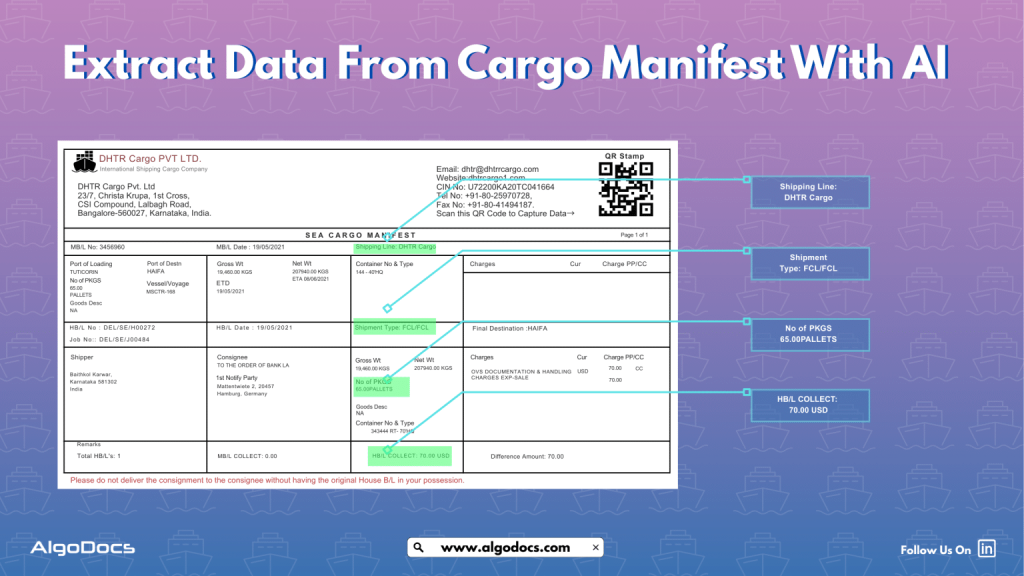
Cargo Manifest Data Extraction Using AI and Intelligent Document Processing: 2025 Guide

Back to Blog Table of contents On this page Cargo Manifest Data Extraction Using AI and Intelligent Document Processing: 2025 Guide Home › Blog › Algodocs › Cargo Manifest Data Extraction Using AI and Intelligent Document Processing: 2025 Guide Categories Algodocs By Shubhankar Biswas Published September 1, 2025, 06:55 Updated July 21, 2026, 03:58 In the fast-paced world of global trade and the logistics industry, efficiency and accuracy are key components for success. A widely used document in the logistics chain is the cargo manifest, which details the goods loaded onto a vessel. Extracting and automating valuable data from this document can help streamline operations, improve compliance, and ensure faster turnaround times for businesses. With advancements in AI, machine learning, and intelligent document processing (IDP) tools, organizations can now automate cargo manifest data extraction, which can greatly reduce manual labour, data errors, and improve document workflows. This article delves into how to efficiently extract data from a cargo manifest using modern technology, with a focus on cargo manifest data extraction and cargo manifest OCR. What is a Cargo Manifest? A cargo manifest is a comprehensive document that lists all the cargo on board a ship, aircraft, or vehicle. It includes detailed information such as the description of goods, quantity, weight, consignee, consignor, port of loading, and destination. This document plays a vital role in customs clearance, tracking shipments, and verifying the accuracy of goods transported. The cargo manifest is typically generated by the carrier or shipping company and is used by customs authorities, freight forwarders, and logistics professionals to ensure the legal and efficient movement of goods across borders. Difference Between Bill of Lading and Cargo Manifest People often mistake the bill of lading for the cargo manifest, but these two documents are different and serve different purposes. Bill of Lading (BOL): It’s a legal document between the shipper and carrier that outlines the terms of transport, serves as a receipt for goods, and can act as a title of ownership as well. It is usually specific to a particular shipment or container. Cargo Manifest: This is a summary document listing all shipments on a vessel. It provides a holistic view of the cargo and is used mainly for administrative, regulatory, and customs purposes. In essence, the bill of lading focuses on individual shipments, while the cargo manifest provides an aggregated view of the cargo. Here is the detailed explanation: Feature Bill of Lading (BoL) Cargo Manifest Primary Role Contract of carriage, receipt of goods, document of title (often negotiable). Consolidated inventory of all cargo on board for a specific voyage/trip. Issued By Carrier or its agent to the shipper. Carrier or its agent. Issued To Shipper (who then forwards it to the consignee). Customs, port authorities, vessel/aircraft operator. Scope Covers a specific consignment from one shipper to one consignee. Lists all consignments from all shippers on a single vessel/vehicle for a specific journey. Content Focus Detailed terms and conditions of carriage for a single shipment, description of goods, shipper/consignee details. Summary details of all shipments: BoL numbers, shipper/consignee (often summarized), marks, quantity, weight, port of loading/discharge. Legal Standing Legally binding contract, evidence of title. Primarily an administrative and customs declaration document. Use in Data Extraction BoL data extraction focuses on individual shipment details for contractual and title purposes. Cargo manifest data extraction focuses on a holistic view of all goods for customs, logistics planning, and reconciliation. Try Algodocs Data Extraction Tool To Automate Data Extraction From Cargo Manifest With 99.99% Accuracy. Sing Up For Free Account Today. Create Free Account What is Cargo Manifest Data Extraction? Cargo manifest data extraction means capturing relevant information such as MB/L number, shipment types, HB/L number, destination, product weights, and size from cargo manifest documents and converting it into structured, machine-readable formats. Traditionally, this extraction was done manually, requiring human operators to read through documents and input data into systems. But today, AI-driven tools, especially those employing cargo manifest OCR (Optical Character Recognition), can automate this process with remarkable accuracy. Challenges with Cargo Manifest Data Extraction Despite its numerous benefits, extracting data from cargo manifests poses several challenges such as: Document Variability: Cargo manifests can come in various formats and layouts, depending on the shipping company or region. This can create challenges for apps in data extraction and accuracy. Handwritten Entries: One common aspect of the shipping and cargo industry is that many documents contain handwritten notes or edits, which are difficult for standard OCR engines to interpret. Poor Document Quality: Scanned copies pose a great challenge because the scanned documents are often blurry, misaligned, or contain background noise. Data extraction tools find it difficult to extract data accurately. Multilingual Content: Global shipping and logistics involve documents in multiple languages, complicating the extraction process for data extraction tools. Regulatory Compliance: Ensuring extracted data meets regulatory standards and accuracy is essential for customs clearance. How to Choose a Reliable Tool for Cargo Manifest Data Extraction While there are many cargo manifest data extraction tools available in the market, selecting a reliable and accurate tool can be a challenging task. It needs to align with your business needs, should be accurate, and must integrate with your existing business apps and third-party platforms as well. Most importantly, consider how much ROI it delivers for every dollar you spend on the tool. Below are a few factors you need to take into consideration before picking a tool: Accuracy and Precision: Accuracy is the paramount factor for any data extraction tool. Be it a bill of lading, cargo manifest, or purchase order, a data extraction tool must offer high accuracy. Also, the tool must be able to extract data from scanned, blurry, and skewed documents. AI Capabilities: Traditional document extraction tools built on OCR technology miss many advanced features such as automation. AI-based document processing tools offer automation, third-party integration, and other benefits due to their vast ecosystem. Look for platforms using advanced AI and machine learning to improve extraction over time. Customization: The cargo manifest data extraction tool should come with customization features to make the process more

Data Extraction, invoice extraction

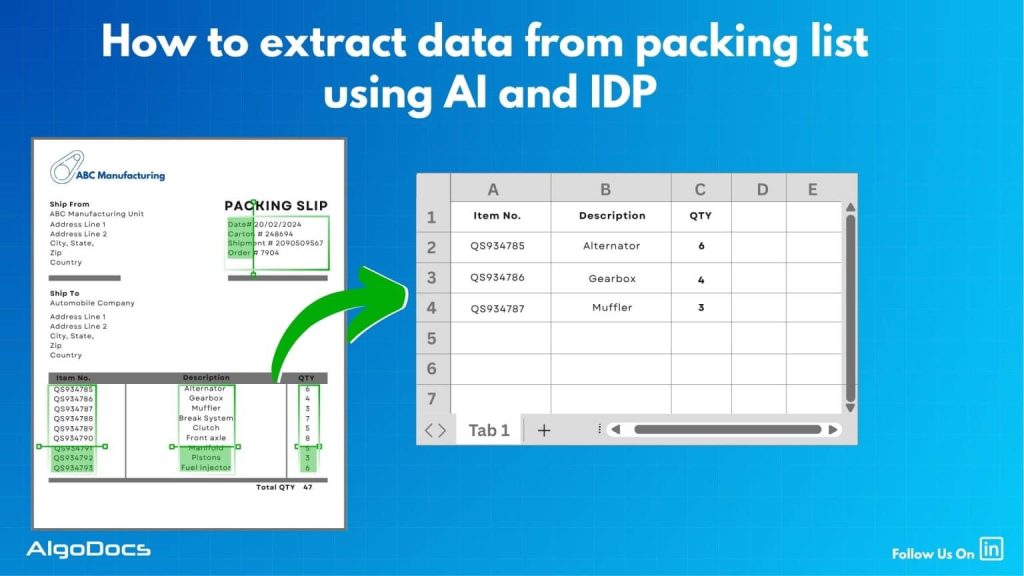
How To Extract Data From Packing List With AI And Intelligent Document Processing (Complete Guide)

Back to Blog Table of contents On this page How To Extract Data From Packing List With AI And Intelligent Document Processing (Complete Guide) Home › Blog › Data Extraction › How To Extract Data From Packing List With AI And Intelligent Document Processing (Complete Guide) Categories Data Extraction invoice extraction Tags ai platform for data extraction invoice extraction packing list data extraction By Shubhankar Biswas Published September 1, 2025, 06:50 Updated July 20, 2026, 10:02 The world of eCommerce revolves around many types of documents. Some of the major documents include packing lists, purchase orders, bills of lading, sea waybills, etc. Now, extracting data from packing lists is another challenge that requires a proper technological approach. But the question still remains: how to extract data from packing lists? Utilizing technology such as OCR, Intelligent Document Processing, and the new tech revolution such as AI has made data extraction from packing lists very easy, accurate, and efficient for businesses. However, handling packing lists manually is a slow and error-prone task, especially when you’re dealing with hundreds or thousands of shipments every month. The risk of human error is high and can lead to serious business setbacks.In this blog, we will explain in detail how to extract data from packing lists using AI and IDP, how packing lists and SKU lists are two different documents, what challenges you may face with packing list data extraction, top tools for packing list data extraction, and how tools like Algodocs offer an effective solution for packing list data extraction. What Is a Packing List? A packing list is a document that provides details of the products lined up for shipment. This includes details such as product names, product descriptions, product quantities, weight, dimensions, number of boxes, and other relevant information.The packing list is usually prepared by the seller or the warehouse and is included with the shipment process. It serves as a reference for everyone involved in the shipping process, including logistics providers, customs officers, and the buyer.Packing lists are typically generated in digital formats such as PDFs, spreadsheets, or Word documents, but they are often printed or scanned, especially in traditional supply chain settings. Because of this, the quality and format of the document can vary significantly. What Is the Purpose of a Packing List in eCommerce? In the eCommerce industry, the packing list is not just a formality—it’s a crucial document that supports the entire order fulfillment process. Here’s why it matters: Order Verification: Helps verify that the correct items and quantities are shipped. Prevents order mismatches and customer complaints. Inventory Management: Supports stock tracking and inventory control. Assists in identifying discrepancies between what was picked and what was shipped. Logistics Coordination: Enables warehouse teams and shipping providers to organize packages efficiently. Streamlines dispatch and delivery operations. Customs and Regulatory Compliance: Helps international shipments clear customs smoothly by providing product details. Ensures compliance with import/export regulations. Returns and Disputes Handling: Used to confirm the contents of returned shipments. Acts as proof in case of disputes regarding missing or damaged items. What is the Difference Between Packing List vs SKU List? SKU list – A SKU list is created and maintained at the individual business level, which shows how many products are available in their inventory to sell in the market. This list contains product details such as product title, product dimensions, weight, SKU ID, product image URL, and other information. Various types of businesses use different types of SKU lists, which can be for their online or offline business inventory. Try Algodocs Free Forever Plan to Automate Data Extraction From Packing List and Other Logistics Documents In Real Time Try Now Packing list – A packing list is generated to list all items that will be shipped by the shipping or logistics company. A packing list includes various information such as the number of items to be shipped, their quantity, number of boxes, tracking number, etc. It basically serves as a receipt that indicates the number of detailed items. What Is Packing List Data Extraction? Packing list data extraction means extracting key-value information from a packing list document with the help of automated tools such as packing list OCR, intelligent document processing tools, or AI and ML-based tools. A typical packing list document contains details such as item descriptions, quantities, product dimensions and weights, sender and receiver address details, shipping dates, and delivery terms. These extracted data from packing lists are later used for record-keeping, tracking, billing, and other business activities by businesses or shipping companies. Previously, packing list data extraction used to be a tedious process as most of the data extraction was done manually by humans. The manual process took more time and the possibility of human error was high. This resulted in many setbacks for businesses due to slower extraction speed, inaccuracy in extracted data, increased extraction costs, and other challenges.But the modern data extraction approach has shifted from manual methods to AI-based methods, which have significantly improved workflow efficiency for businesses. Challenges With Packing List Data Extraction While packing list documents are major documents for shipping and logistics businesses, extracting and organizing data accurately remains a challenge due to: Document Format Variation: A packing list document can come in various formats or layouts. Every logistics provider designs packing list formats in their own way. This could be due to region, language, preference, business type, or other external factors. Unstructured or Poorly Formatted Data: Packing list documents are often generated in unstructured formats, and extracting data from these documents creates many challenges. Scanned or Low-Quality Documents: Document quality is another issue. Poorly scanned documents, documents of very low quality, and skewed fonts create many problems in data extraction. High Volume of Documents: While extracting data from one or two packing list documents seems feasible with manual methods, extracting 100 or sometimes 1000 documents at once isn’t possible manually. It’s slow, full of errors, and inefficient. Language Barriers: Multilingual packing list documents create hurdles in data extraction. Extracting data from regional language documents

invoice extraction, Logistics Data Extraction

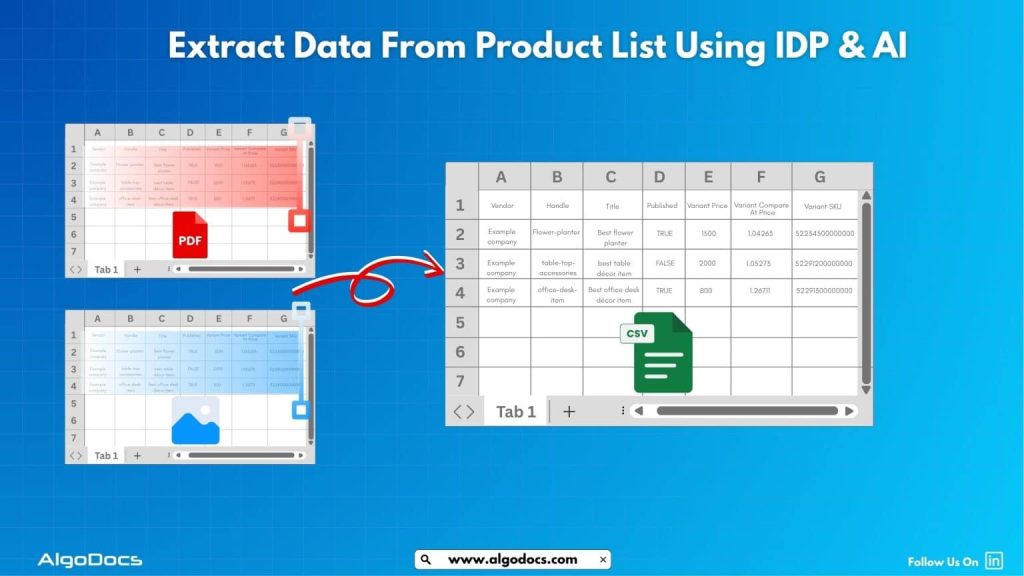
SKU List Data Extraction With Artificial Intelligence and IDP: Benefits, Features, Risks & More

Back to Blog Table of contents On this page SKU List Data Extraction With Artificial Intelligence and IDP: Benefits, Features, Risks & More Home › Blog › invoice extraction › SKU List Data Extraction With Artificial Intelligence and IDP: Benefits, Features, Risks & More Categories invoice extraction Logistics Data Extraction Tags data extraction Invoice Data Extraction Logistics By Shubhankar Biswas Published September 1, 2025, 06:42 Updated July 21, 2026, 08:07 What is An SSKU List Data Extraction With Artificial Intelligence and IDP: Benefits, Features, Risks & MoreKU List? The paradigm shift of global shoppers has changed from offline to online in recent years. The eCommerce industry is currently a $7.5 trillion economy and is growing at a very fast pace according to a report. This rapidly growing eCommerce economy has given birth to many big platforms as well as small eCommerce businesses. Many traditional retail businesses have transitioned their business model from offline channels to online channels in recent years. And this transition has increased their sales and revenue. Now eCommerce businesses thrive on many factors such as their business model, where their customers are, how they want to target their customers, and how the sold product will be delivered to the customer. Unlike a physical store that is only able to display and market a limited number of inventory items, an online store is able to display and share countless numbers of items without requiring much space and manpower. With such a large number of products and items, businesses need to maintain a list of product data which is known as an SKU list. An SKU list is used in both online and offline channels. But data extraction from an SKU list is a challenging task. Due to the number of items, various fields, and tables, data extraction becomes a challenging task. The old manual data extraction method is prone to human errors and data accuracy remains a big challenge. But with tools such as SKU list OCR, intelligent document processing, and Artificial Intelligence, SKU data extraction has become more accurate, speedy, and efficient. In this blog post, we will discuss various aspects of SKU list data extraction, including its challenges, benefits, and other key considerations. What is An SKU List? An SKU list or Stock Keeping Unit is a list of products that shows the available and sold inventory of a store. An SKU list consists of details such as product name, title, variants, color variants, size variants, SKU number, product URL, price variants, availability, etc.This helps businesses to maintain a record of what products have been sold and what is in stock, with all corresponding details of product types, variants, etc. In both online and offline businesses, the SKU list plays a vital role, but specifically in online and eCommerce businesses, it holds major importance. Difference between SKU List vs. Product List: There are many types of documents used on a day-to-day basis in online and offline businesses for various types of business activities. Documents such as bills, invoices, SKU lists, packing lists, and purchase orders are a few essential documents that are frequently used in business. But every document is different; similarly, an SKU list and a packing list are two different documents. But sometimes people get confused and consider the SKU list as a packing list. Here are the differences: Feature Packing List SKU List Purpose Details shipment contents Tracks products in inventory Scope Focuses on shipped items Covers all stock in a system Usage Used in logistics and shipping Used in warehousing and retail Contents Item descriptions, weights, packaging details Product codes, descriptions, stock levels Format Structured for shipping documentation Formatted for inventory databases Tracking Ensures shipment verification Monitors stock movement and availability Customization Focuses on shipment accuracy Includes pricing and supplier details Regulatory Role Required for customs clearance and freight calculations Not required for shipping Verification Helps buyers confirm received goods Helps businesses manage stock levels Integration Linked to shipping and order fulfilment Integrated with inventory management systems What is the Purpose of an SKU List in eCommerce? The real purpose of an SKU list is to keep a record of the items that are available or being sold by a store or business. This helps businesses manage their inventory and keep a record of which products are in stock and which have been sold. Secondly, when an online business or store fulfills an order, they can ensure that the right product has been packed and shipped to the logistics company. The third important role of an SKU list is to help with product listing in both online stores and offline stores. If a business sells its product on multiple online eCommerce platforms, then with a single SKU list, you can manage your product listings across all channels. Analysis and reporting of sold and unsold products can also be done with the SKU list.A well-maintained SKU list is the backbone of smooth eCommerce operations. But extracting and organizing this data can be tricky. What is SKU List Data Extraction? SKU list data extraction means extracting information such as product names, titles, variants, SKU ID, size, color, availability, and other information from an SKU list using automated software. The main purpose of SKU list data extraction is to improve workflow efficiency for logistics, product listing, and other decision-making activities for an online or offline store. A typical SKU list is usually generated in Excel or CSV format, but in some cases, it could be a scanned image PDF, native PDF, handwritten note, or JPG image as well.Extracting data from a long and bulky SKU list manually isn’t efficient, but tools such as SKU list OCR and Intelligent Document Processing have made this task more efficient and smoother. Challenges with SKU List Data Extraction Extracting data from an SKU list manually is not very reliable for a business. Manual SKU list data extraction poses great challenges such as: Multiple Formats:SKU lists generally come in Excel format, but sometimes they can be PDFs, scanned images, or emails as

Scroll to Top